

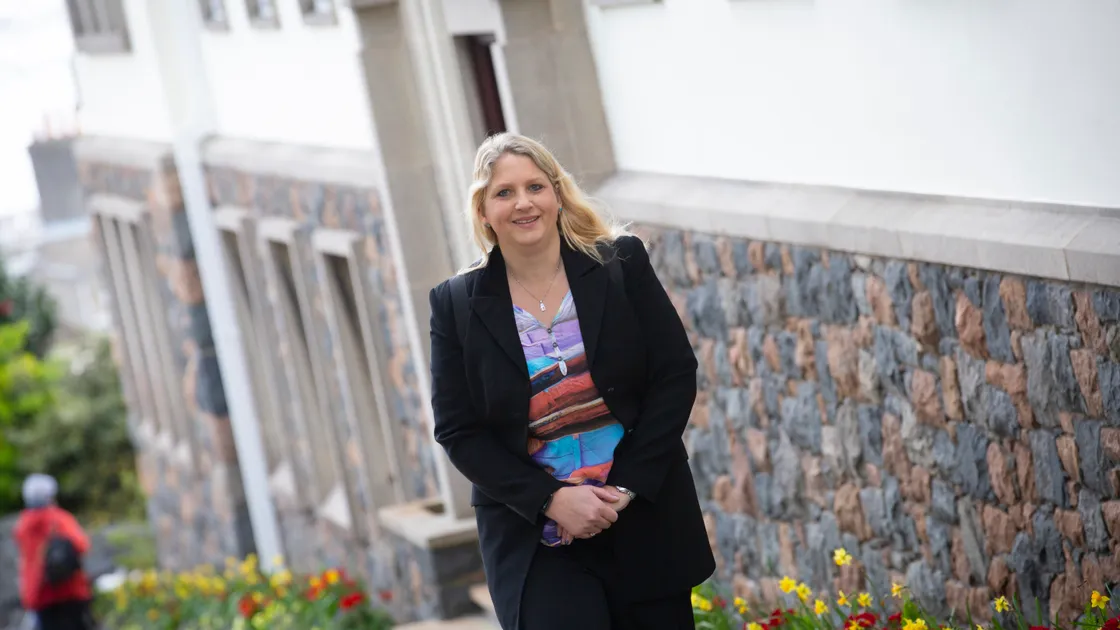
She obtained a building control permit which was approved at staff level despite the authority’s own scheme of delegation stating that any application from its members or senior officials must be dealt with by the committee itself.
Deputy Oliver was granted the permit three years ago, around the same time that the authority published its scheme of delegation after discussion between its members and officials.
The failure of process was uncovered only in recent days when a member of the public lodged a formal complaint, which was upheld by the authority.
It said the error had been made by staff and that Deputy Oliver was not to blame.
‘There was recently an instance identified when this process wasn’t carried out correctly as a building control decision was not referred to the DPA,’ said an official, speaking on behalf of the authority.
‘The correct process has now been followed and internal processes strengthened in response to this oversight. This was a process oversight and does not relate to the conduct of any member of the DPA.’
The building control permit was granted by the head of building control and no open planning meeting was publicly recorded.
‘It’s important to clarify that this matter concerned a building control decision, which is primarily about ensuring that a proposed development is safe and healthy, as opposed to a planning application, where a broader range of considerations apply, including design, effect on character and amenity and effect on the reasonable enjoyment of neighbouring properties,’ said the spokesman.
Deputy Oliver said that the first she knew of the oversight was when it was raised at the DPA a couple of weeks ago.
She said that the scheme of delegation stipulated that planning and building control permissions could be determined by the authority at open planning meetings. But this was usually done only for planning permission and she said as far as she knew there had never been a open building control meeting.
Her planning permission had been properly determined following an open meeting.
‘It’s more for planning that safeguards are important, not building control,’ she said.
‘Building control applications are matters of a technical nature and political members have not been involved in the determination of any building control applications this term or previously.
‘I didn’t know I had done anything wrong.’
Deputy Oliver said that she had retained her written permission from building control and said that officers had carried out site inspections throughout her development.
In papers submitted to support the complaint, the complainant claimed that the failure of process and the development itself raised concerns that required greater transparency, scrutiny and accountability.
In his reply, director of planning Jim Rowles told the complainant that he agreed with the substance of the complaint and it would be upheld.
‘In the light of your complaint and my finding, the building regulations application was referred to the DPA [political members], for which item the president recused herself, on 11 June 2025, and the application was approved by the committee,’ he said.
‘There was no requirement to hold this meeting in public.’
Last week Deputy Oliver, a qualified chartered surveyor, lost her seat in the States.
Her term as a States member, as well as DPA president, will come to an end on 30 June.
She took over at the DPA after the 2020 general election, having been its vice-president in her first term.
She said she ‘inherited a system that was bogged down with red tape’ and she had looked to change things by ‘bringing private sector methods to what was a bureaucracy-heavy committee’.
She was among those deputies prepared to bypass the GP11 planning policy which she said had held back numerous development projects.
At the DPA she had also extended planning exemptions, pushed for action on clearing derelict buildings, and launched a digitisation project.



You need to be logged in to comment.