

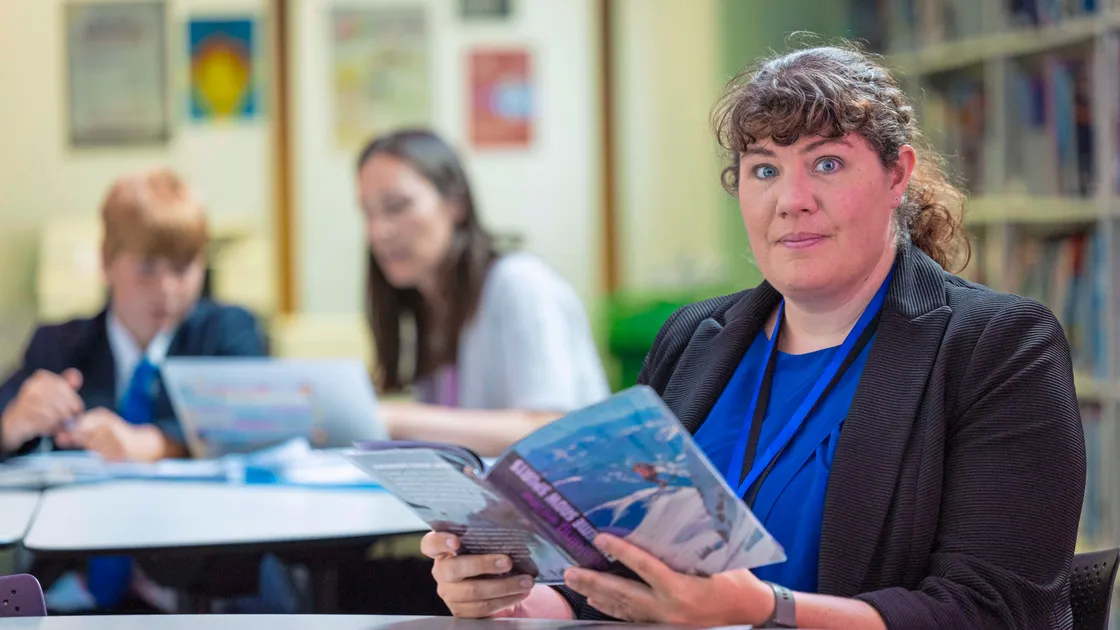
Thirty Year 7 pupils across a range of secondary schools have been enrolled on a literacy programme as part of efforts by Education to address the shortcomings.
Thinking Reading started in September as part of an expanded literacy strategy in States schools, made possible by the re-allocation of funding from projects including the Dyslexia Day Centre, which will close at the end of this term.
The programme has seen five students at a time receive three bespoke one-on-one sessions a week, with areas of focus including de-coding, the ability to read words, fluency, reading speed and accuracy.
So far 19 students have graduated from the programme, with the remaining 11 set to graduate before Christmas.
Les Beaucamps High School secondary literacy intervention lead teacher Josie Marsh said the team behind the programme had managed to ‘pretty much meet’ every student on their case list for each school in terms of giving them the support they required.
‘The idea is if we prioritise Year 7, we prevent that from going further up the school.’
Mrs Marsh said there had been a ‘massive dip’ in reading and academic ability since the Covid lockdowns, with many of the affected children only five or six years old back in 2020.
Covid outbreaks in Guernsey resulted in students having to be taught remotely at times, including between March and June 2020, and then January to March 2021.
Students also needed to self-isolate at times and schools operated with classroom bubbles until January 2022, all of which added to students’ learning being disrupted.
Mrs Marsh said some students struggled with the sounds of words, while others found comprehension difficult.
Some simply did not like reading, or were reluctant to read.
‘When I have spoken to my primary colleagues, they have said the starting point has changed,’ she said.
‘Previously, kids would come to secondary school and they could read, write, do the basics, but they’re finding that when they come into primary that they can’t sit up, they can’t tie their shoes, they can’t feed themselves, the kind of the very basics that you would expect.
‘They’re having to put more in at that end, so less is coming out at the other end.
‘I think it’s a bigger problem than education, if I’m honest.’
Because of the economic pressures arising from Covid, and the fact that both parents were now often required to work to make ends meet, Mrs Marsh said this could have been having an impact on the time they spent reading with their child.
‘They don’t read with their children as much, perhaps, or pupils maybe don’t read as much outside of school because of social media.’
Addressing the role of smartphones among students, she said bans in other schools had helped, with children able to focus and not be as distracted.
‘I don’t know if it’s just that there are so many distractions for young people nowadays that they no longer read for pleasure,’ she said.
‘I do think not having smartphones out during the school day would be better for everybody.’
She added there were older pupils who had the same issues which had not been addressed by the Thinking Reading programme, but said they were able to access their particular school’s own intervention programme.
‘The additional learning needs co-ordinators in the schools will prioritise whatever interventions they have,’ she said.
‘It’s not that they’re not getting anything, they’re just not getting something from us.’




You need to be logged in to comment.