

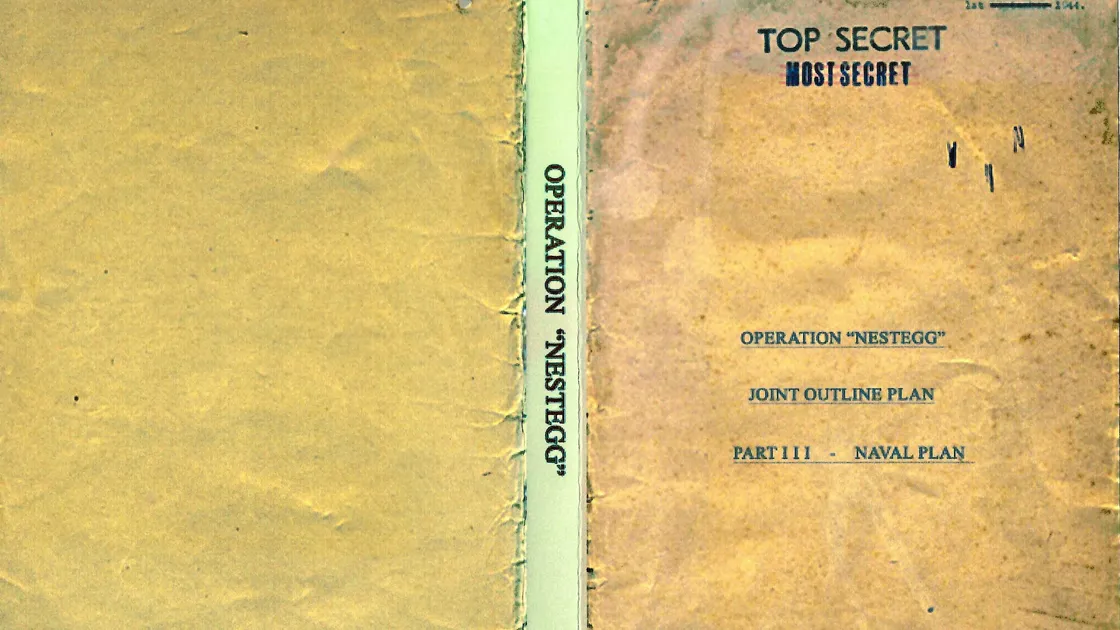
Hansons Auctioneers of Derby announced earlier this week that the naval plans of Operation Nestegg had been discovered in ‘a dusty box of papers in a UK sale room’. The document of ‘approximately 47 pages’ has been given a guide price of £800-£1,200 and has been listed as lot 211 in an auction of medals, militaria and firearms to be held at 9.30am on Wednesday.
When approached by the Guernsey Press, Mark Lamerton – a Jersey-based historian and author of an 1,100-page illustrated history of Operation Nestegg – confirmed that the document constituted the third section of a seven-part joint outline plan, of which 42 top-secret copies were distributed in 1944.
Mr Lamerton said he obtained a digitised copy of this third section – specifically outlining the naval plans – a little over a decade ago.
‘I purchased the CD on eBay for £14.99 in November 2014 from a seller based in Derbyshire called ruperttherooster,’ he said. ‘They were selling other copies.’
Mr Lamerton was surprised to see that the image released by the auctioneers was of the same copy as the one of which he had bought a digital version – copy 34. He knew because it featured distinctive pen marks on the cover.
‘The creases, pen and water marks are identical to the plan up for auction,’ he said.
According to the distribution list, copy 34 would originally have been despatched to the quartermaster of movements, though it could then have been given or sold on to other parties.
The lot description says it was ‘the property of Sub-Lieutenant Walter Page (1916-1996) of the Royal Naval Volunteer Reserve, when part of the crew of LCT-2138’.
D-Day invasion maps of Normandy beaches, which this same sailor also owned, are included as separate lots in the auction.
Although Mr Lamerton was able to confirm that the information within the document was already in the public domain – with copies held by Jersey Archive, the National Archives at Kew and the National Archives and Records Administration in America – he was also keen not to pour scorn on its estimated value.
‘It is a rare item, so if someone wants to pay that, I hope it finds a good home,’ he said.
The document gives details of the need for three battalions of 700 personnel to be involved in the forcible re-invasion of the Channel Islands, but by the time the liberating flotilla was sent to Guernsey waters on 8 May 1945, the surrender of German forces had already been signed at Reims and a ceasefire called across the European theatres of war.
Consequently when Operation Nestegg was finally enacted, the advanced party which set foot on Guernsey – named ‘Omelette’ – consisted of only a couple of dozen men.





You need to be logged in to comment.