

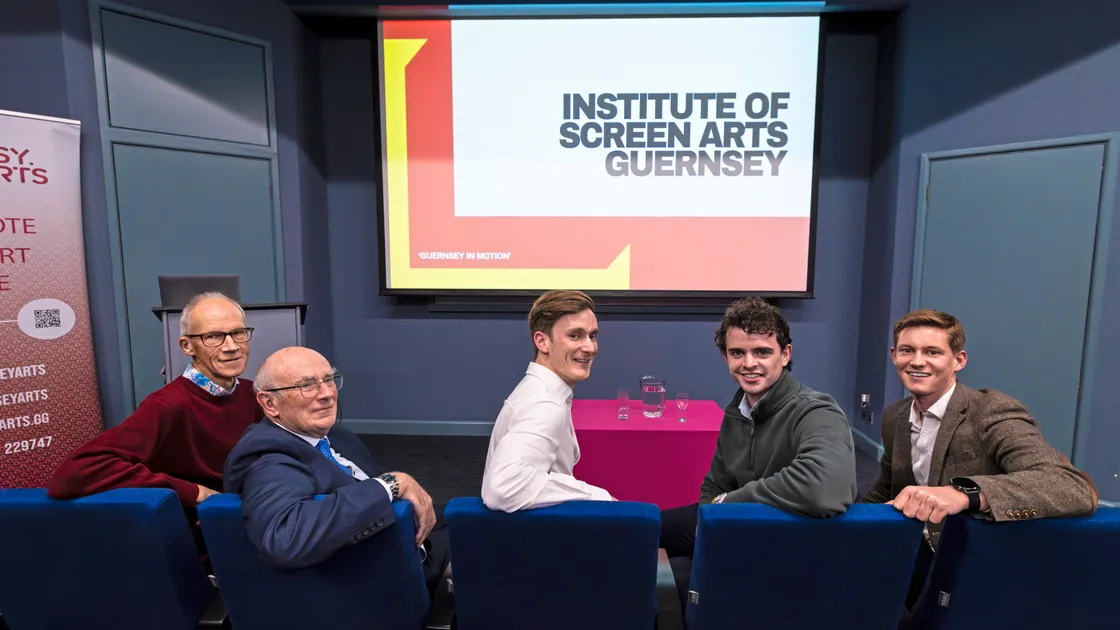
The island, rich with creative talent, has developed a booming screen arts community over the last five years.
It is thought that the pandemic helped bring a lot of that talent home and anchored in place.
Prior to 2020, only two film-making applications were received in Guernsey, both from outside the island.
Since the end of that year, there has been a surge of interest, with 14 applications for grants – 11 of which were supported – all from young, local creatives, who have since developed their skills and produced increasingly ambitious projects.
To continue the momentum, the Institute of Screen Arts Guernsey will launch next year, backed by the Economic Development Committee. It will focus on promoting the island, while offering production support, location coordination, and financial assistance to local creatives – hoping to create a local industry that will grow the economy and provide more job opportunities.
One of its directors is Cameron Ashplant, a local actor and producer, who said a body of this nature was what was missing when scouts and producers came looking to film The Guernsey Literary and Potato Peel Pie.
In the end they turned their backs on filming in the island and shot island scenes in Devon and Cornwall instead.
He said that if there had been a point of direct contact to help secure locations and coordinate plans, the successful 2018 film might well have featured the local scenery its poignant story deserved.
Deputy Haley Camp has been appointed as film lead within the States to help find practical steps and solutions that could help the sector reach its full potential and ensure future opportunities are not missed.
She spoke at the charity’s soft launch, held at Candie Museum, to members of the arts community, business leaders and deputies who were all invited in a bid to raise support.
‘We’re at the beginning of something new, ambitious, and unlike anything else on-island,’ she said.
‘The creative arts spark innovation, build skills, and help tell the stories that connect us – all of which make our island a more dynamic and attractive place to invest, visit and call home.’
ISAG’s chairman will be Stephen Ainsworth, who brings experience in charity governance. As well as Mr Ashplant, its directors will include Jonathan Allaway and Stephen Collas.
‘It’s all very exciting,’ said Mr Ashplant. His brother, Brandon, also a filmmaker, will be the charity’s treasurer.
‘It’s just about getting that message out there.’
With its unique coastline and untouched historical features, he said the independent island presented a desirable backdrop for action – not just for films, but for longer-running TV series too.
He was optimistic that in time, their efforts might find Guernsey’s Bergerac.
‘We’ve got opportunity to diversify the economy here, to engage with the new industry. Marketing will be key. And we need to provide that basic infrastructure and logistical support. If people come to film here and they don’t see those bare essential elements or an organisation that’s going to help them get going – they’ll quit before they start. It really is that important.’
ISAG’s first location and talent catalogue will be published with next year’s launch – designed to aid casting directors and scouts in hiring local talent.
‘I think it’s a really interesting movement,’ said local filmmaker Dan Le Friec, who co-founded the production company Freaky Geese.
‘A more formal way of capitalising the movement that we’ve already created on Guernsey. It’s great to bring in national and international filmmakers as well. We were sitting on a comedy committee in the UK, and every single big player in that room was talking about wanting to leave the UK – they’re wanting an exodus. So if we can provide a place that’s half an hour on the plane – perfect.’
He said the industry needed to strike while the iron is hot.
‘The problem in the film world is blink and you miss it,’ he said.
‘If you’re out of sight, you’re out of mind. So it’s about keeping the interest.’
Freaky Geese co-founder and joint director, Rhys Ashcroft, added that financial backing was paramount.
‘Housing is such a debate at the moment,’ he said.
‘It financially wasn’t viable to bring over and accommodate all of the crew and the actors from the Guernsey Peel Pie film. To do a whole feature here, of that size, at the moment is going to be really tricky – but that’s the whole point of this.
‘The dream is to create deals, to create financial backing so that we can bring people over.’
Former filmmaker and cameraman Kit Gillson said he wanted to see this initiative a decade ago, and now that it has been established, he was going to be a filmmaker again.

You need to be logged in to comment.