

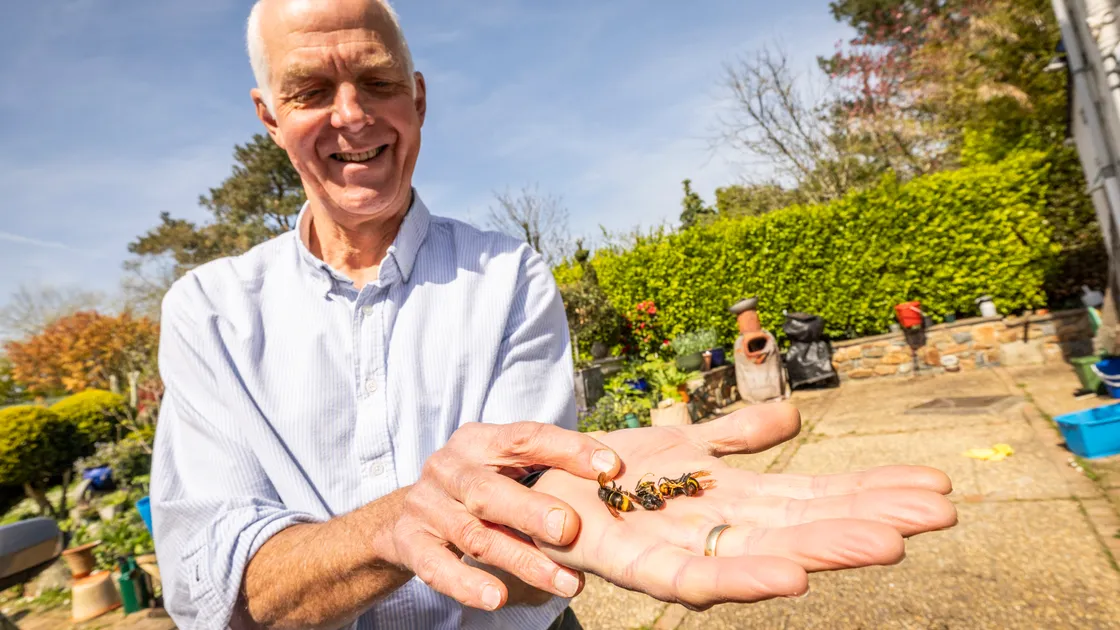
And the team behind the work believe that the issue is still under control in the island.
The invasive insects are now well-established in France, and the UK has seen dozens of nests in Sussex, Dorset, Kent and Surrey destroyed this year.
More than 650 nests were found in Jersey this year, compared to just eight in Guernsey.
Invasive non-native species policy & coordination officer Francis Russell said while it had been a busy year locally, with 79 queen hornets caught in the spring, he felt Guernsey was in a good position, nine years since Asian hornets were first spotted in the island.
‘There have been no confirmed sightings of Asian hornets since that last nest was removed [on 17 October from a pine tree in the Vale] and the Asian hornet team is optimistic that all large secondary nests have been dealt with,’ he said.
‘Reducing the number of large, secondary nests that are built by capturing queens when they arrive is a very cost-effective way of stopping the species being established in Guernsey.
‘Because the strategy has been successful at keeping the number of secondary nests low, the cost of implementing this strategy is significantly less than would be expected should nest numbers rise.’
He said that the cost of the programme varied each year.
This year’s operational budget allocation was £10,000, but the actual costs were less than £2,000, which was spent primarily on PPE and the use of contractors to allow nests to be safely removed from trees. Mr Russell noted that certain staff members contributed to the the team's work in their daily duties too.
‘The evidence shows that so far, we have been able to eradicate hornets every year.
‘This is only possible thanks to the help of our spring queening volunteers and members of the public reporting sightings.
‘They are an absolutely vital resource to this strategy.’
Each year more than 260 traps are placed across the Bailiwick, capturing arriving queens before they have time to establish nests.
‘Because the network of traps spans the whole island, capture rates each year should continue regardless of where the queens have originated from,’ Mr Russell said.
‘If increased pressure from neighbouring jurisdictions results in an increase in queen numbers in the spring, we are well placed to ensure that that does not result in Asian hornets becoming established in the island.’
Mr Russell said hornets arriving in the Bailiwick are most likely coming from France.
‘However, if they become well established in other neighbouring jurisdictions they may migrate from there too,’ he said.
Jersey’s Environment Minister Steve Luce has said that tackling the annual invasion in his island was like fighting a losing battle.




You need to be logged in to comment.