

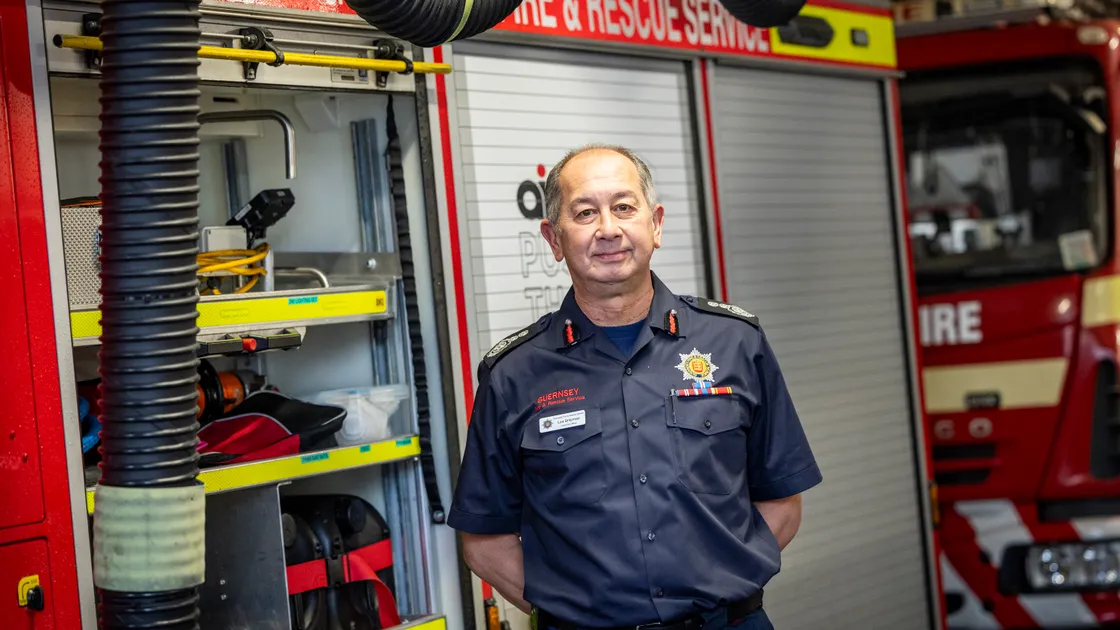
Following Storm Goretti, Les Britzman, who has been in post for just short of a year, said the island’s Fire Service was well-equipped for effective response, but he was worried that it would be unable to sustain days’ worth of damage control.
‘What makes me nervous is if that storm had gone on for two or three days, or we’d had two or three days of fires – that’s where we would struggle,’ he said.
‘We haven’t got that assistance coming from over the border, and then it’s the same group of people being recycled. There’s only a small number of them as well.
‘We need to build a resilience, modernise our procedures and make sure they’re up to date and reflect best practice in the UK.
‘We’re learning from Grenfell, Manchester Arena, and the recent tragedy in Bicester.
‘But unless we address those, look at our procedures and adapt them, then we’re putting our staff at risk.’
Mr Britzman came from Lincolnshire Fire Service to take over the role from Jon Le Page, who retired last March.
He said the new report into the Fire Service that was published this week, has correctly highlighted the areas that need improving – specifically the need for more financial investment from the States.
The report highlights that GFRS’s budget remained largely static, and significantly below inflation, in the period from 2011 to 2020. In recent years, it has reflected RPI more closely, but the findings show it still needs more to sustain excellent standards.
Its annual budget for this year is £5,089,000. In 2019 it was £3.86m.
‘It’s clear that we’ve got a long way to go,’ said Mr Britzman.
‘I don’t think we should be afraid of facing up to that reality.
‘There’s been lots of reasons why there’s been financial austerity, and that’s applied to all services on the island. Unfortunately, that’s hit the Fire Service quite hard. It’s been difficult and we’ve got a lot of catching up to do. That gap has meant there’s lots of things we haven’t done and are behind on.’
The report stated that the legislation was in urgent need of updating.
It also recommends implementing various action plans, including one to better identify and prioritise risk.
‘It’s difficult to say the budget it needs,’ said Mr Britzman.
‘We are developing a community risk development plan, articulating all the island risks. Not just operational risks, but risks to do with the ageing population, too. That will quantify where we need to focus our attention, and what we need in terms of staffing and resources. It won’t be an overnight thing when we can say “we need X amount”.
‘But I can’t keep my staff safe unless they’re trained and have the right equipment. We don’t have gold-plated fire engines – we have the basic, minimum equipment needed to be safe and keep the public safe.
‘It’s enough at the moment, but we need to do more. We need to improve equipment and training in relation to flooding-based risks.
‘We need to do more work out in the community, not necessarily in the fire engines, but out with our partners identifying who the vulnerable people are and doing work to keep them safe in their homes. It’s those areas we’re lacking on.’
The report notes that the service has limited capacity – ‘not enough people with the right skills to effectively manage identified and emerging risks’. There are currently 48 full-time firefighters, 10 on-call firefighters in Herm, and nine operational fire officers – including the chief and two senior officers. There are also three civilian support roles.
Having served in a number of fire services across the UK, including London, Mr Britzman agreed that the local service was small, but said the biggest difference he had felt was its lack of neighbours, that could help in the event of a major fire.
‘The island crew is on its own.
‘We can get support, but you’re probably looking at 12, possibly 24 hours or longer to arrive,’ he said.
‘We have to be self-sufficient. We’re basically a small country – with all the risks that you’d get in a whole country condensed into one small area. Probably a wider diversity of risk than any other single fire service, and we’re busy.’
Last year, the Fire Service received 1,341 call-outs, and Mr Britzman said it was noticing a steady increase. In 2022, there were 989 call-outs.
But he said the increase was partly due to the changing nature of the service. Roughly 10% of call-outs are to special service calls – rescues, road accidents and general assistance to people in danger. It also answers to a large number of assisting ambulance calls, supporting with CPR and getting elderly and vulnerable patients out of buildings.
The review for the Peer Challenge Report was carried out last October by senior fire and rescue professionals and government officials from the UK and other Crown Dependencies. Mr Britzman said it was an organic and comprehensive process, leading to a credible report.
‘It’s very clear where we need to put our efforts,’ he said.
‘It wasn’t a surprise. It’s good to get that emphasis, it drives us to improve.’
It also sheds light on the unique States set-up, and advised that the professional relationship between the chief officer and the Home Affairs Committee needs a more distinct arrangement.
‘I should point out the relationship isn’t bad,’ said Mr Britzman.
‘But the committee is relatively new, I’m relatively new and it’s important we establish the professional boundaries between our roles.’

You need to be logged in to comment.