
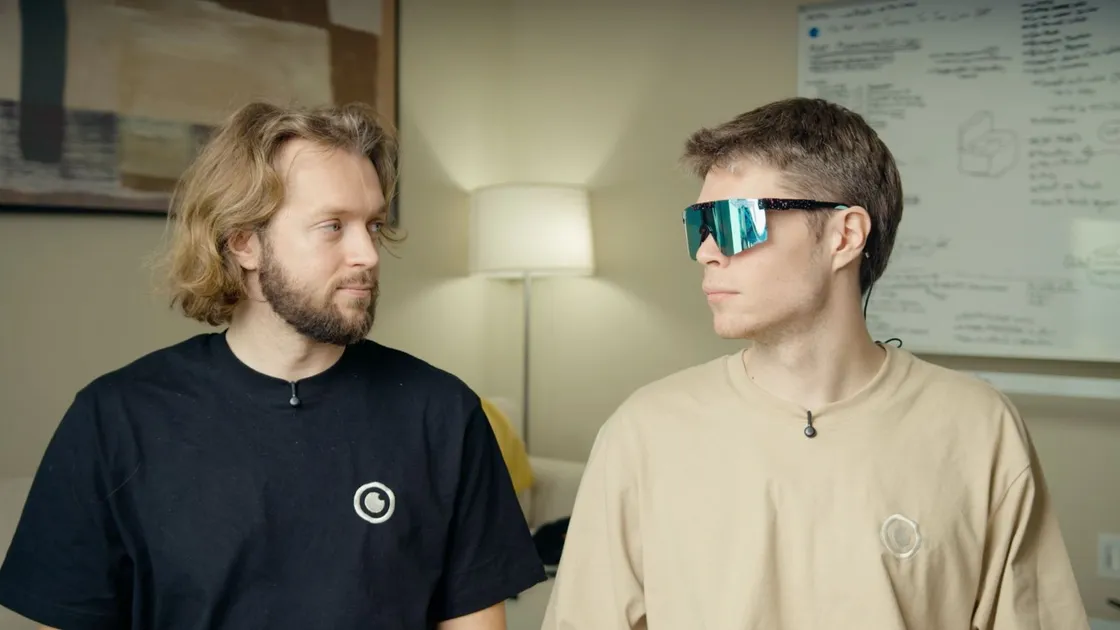
Brothers 28-year-old Matthew Le Maitre and Alex Le Maitre, 25, secured $500,000 in funding for their company Seeing Systems when they were selected for the highly competitive Y Combinator programme.
‘When you get into a start-up accelerator like this, your chance of success is massively increased,’ Matthew said.
‘No one really expects to get in – their acceptance rate is less than 1%. It’s harder than Harvard. I was incredibly excited.’
Despite the high level of competition for the programme, the brothers’ company – a business dedicated to designing and building defensive drone systems – secured the placement, numbering them among companies supported by Y Combinator such as Airbnb, Dropbox, Reddit and Coinbase.
The brothers founded Seeing Systems about a year ago, beginning to actualise their lifelong dream of founding and running their own business. At the time, Matthew had been living and working in Hong Kong as a software engineer with a financial services firm, while Alex had been spending some years working with military personnel and small, UK-based companies involved in defence.
‘A year ago I said “Okay, I’ll pay for this bit. I’ll fund the business from my salary as a software engineer, and then we’ll see if we can get it to go somewhere”,’ said Matthew.
‘We didn’t expect to get into Y Combinator, but it turns out that it did go somewhere, and now we’re here and that was the excuse for me to then quit and go full time. We’ve really been focusing on it for the last 6-9 months I would say, and I’ve only been full time for a few weeks since I quit my other job.’
Previously, the brothers had lived in Guernsey, and had both graduated from Elizabeth College before they left the island.
Matthew had gone on to study physics at Christ’s College, Cambridge, where he achieved a first. He then went on to pursue computer science for his masters degree.
Alex, meanwhile, gained hands-on experience with military drone manufacture both in the UK and across Europe. In addition to their educational and professional backgrounds, both brothers have experimented with drones recreationally over the years.
‘Drones and small embedded systems are a thing that I’ve played around with for a very long time,’ Matthew said.
‘When I was at school, I built my own software to control one of these drones. I coded a thing on my Mac and I found a gaming joystick, and I found a way to control this drone. I was, I don’t know, 13-14 or something, and it was really, really fun. I’ve always enjoyed sort of hacking around with hardware and with drones in particular.’
He was not alone in his household, with Alex similarly taking an interest in using drones for recreation since his adolescence, including racing them and using them for cinematography.
‘He got some work selling his services to films as a drone photographer,’ said Matthew.
‘He got a piece of work where a company would drive a motorbike through a tunnel, and he would fly the drone at high speed next to the motorbike to get some really cool footage for advertising for the company.’
The pair’s long-standing love of drone technology ultimately turned into Seeing Systems when Alex became increasingly conscious of the need for such technology in the military, with the demand directing their general interest in drones in the direction of defence.
In their group of more than 100 companies at Y Combinator, there are few others engaging with drone technology, and none dedicated to defence technology.
‘There are 100-and-something companies in this batch, and only three of them do drone things,’ Matthew said.
‘One of them makes drones that land on power lines to charge, and one of them does drones that ranch cows – so it’s like the drones flying around and chasing cows around.
‘We’re the only company in the batch that does drones for defence. We’re trying to make it easier for people like the Royal Marines to use drones. They’re trying to learn how to use drones at the moment and we’re trying to make it easier for them to fly them, assemble and build them, and use them.’
In addition to receiving funding for Seeing Systems, the brothers are also getting advice and mentoring as they continue to develop the business.
Companies that are selected to receive support from Y Combinator go on to have an unprecedentedly high rate of major market success, with 6-7% of all selected companies going on to become ‘unicorns’ – private start-ups valued at more than $1 billion.
Now, with their early funding secured and access to Y Combinator’s mentoring, the Le Maitre brothers are aiming to secure the next round of funding for Seeing Systems, hopeful that their company will continue to grow and thrive.



You need to be logged in to comment.