

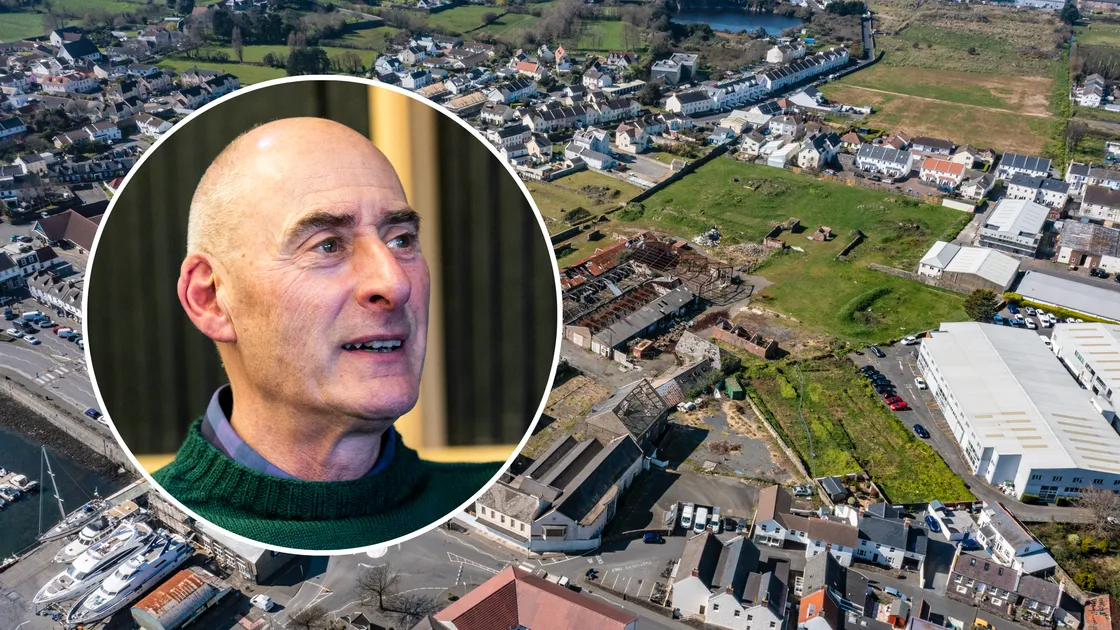
THE States’ new Housing Committee has said that keeping housing issues off the front page of the Guernsey Press will be one way to assess its success over the next couple of years.
At a Scrutiny hearing this week, Housing president Steve Williams, his vice-president Sasha Kazantseva-Miller and senior official Claire Barrett told the Scrutiny Management Committee that it was also looking to reduce social housing waiting lists ‘to a very low level’ and improve affordability for those renting or buying.
But no targets have yet been set.
‘We are working things up, progressing on a number of fronts and pushing as hard as we can,’ said Deputy Williams.
‘We will come back to you with some concrete numbers in the delivery plan later this year.’
The Scrutiny panel was made up of Deputies Andy Sloan, Haley Camp and Liam McKenna.
What do you see as the role of the Housing Committee and what are you seeking to improve?
The principal challenge in the housing market is demand exceeding supply. House prices and rental costs have increased dramatically and there is a log jam in parts of the market. We need to increase the supply of homes faster, which will have an impact on wellbeing and put more money in people’s pockets rather than going into rents or mortgages.
Does your committee have the remit and resources it needs?
Everyone would always want more resources, but we’re mindful of financial constraints. This is a big challenge. It can’t be met overnight. There are no simple, quick fixes to this problem, otherwise they would have happened. We are progressively working away at it.
We have not ripped up the housing plan from last term, but we are trying to refine and prioritise it towards increasing the supply of homes. We must try to make housing more affordable for single people, families and older people as well, and to retain our youngsters. What people want is not theories and strategies and plans, but to see things happening. We don’t want to finish this four-year term saying we’ve got a whole new set of plans. In every item we discuss in committee, we are asking whether it will have a material impact helping people.
Delivery of new homes has fallen well short of the 300 new homes targeted by the previous States. How has forming the Housing Committee helped?
Previously, responsibility for affordable housing and private housing was split between different committees. We have fundamentally changed the approach, for example by going to specific sites and understanding why development has not progressed, and looking at it in a more holistic, joined-up way. This will hopefully allow us to bring forward not just more affordable housing but also more private housing. We are looking at more joint ventures, working with private developers to bring forward private sites, including affordable housing on private sites. A smaller example is St Julian’s House, which was previously hidden away in the mandate of a large committee, whereas we are now able to dedicate the time, oversight and thinking that it requires.
Which specific actions have you taken which would not have been possible under the old structure, without a separate Housing Committee?
We have been going for nine months. It doesn’t happen overnight. We hope it would look different in, say, two years’ time. House construction is currently at a five-year high, but we’re not taking any credit for that. But there has been success talking to landowners and developers of specific sites. We have seen some sites coming forward faster than they would have. We’ve been able to overcome some obstacles and move things faster.
We have been working on a list of all the sites with planning permission that haven’t been developed – there is currently about 439 of them – and that is going out next week. It will have anticipated timeframes for those sites to come forward, if they are going to come forward.
Some sites have barriers which we need to help unlock and that work is really progressing. The list also gives the building trade an idea about which works are coming forward. Homelessness is an issue which has been raised a lot and is a problem, and we are exploring opportunities with third sector organisations to get more accommodation for them to house more people who are at risk of homelessness.
What are you doing with the Castel Hospital, King Edward VII Hospital and Duchess of Kent?
We understand a care home facility of some sort is proposed at the King Edward. There are a lot of staff currently using the Castel, and we have been talking with officials about the need for a phased development, because if there are about 300 staff working from there we can’t wait for the last one to leave before developing it. We’ve got a housing problem, it’s in a good location, and we’re keen to press on as swiftly as we can. We have not been involved at all in the Duchess of Kent.
How much additional supply of housing do you think we need?
Based on the States Strategic Housing Indicator, roughly 300 a year. From a standing start, we’re not going to get near 300 completions, when the average has been something like 120 a year. It’s all well and good to throw numbers around, but we just need to do as much as we possibly can. We’re a long way from oversupply. The objective is to increase the rate of housebuilding. What we can’t give you today is how far we can get towards 300 and over what timeframe. We will come out with more details in our delivery plan later in the year.
You have referred to incentives for developers. Do you have examples of what you are doing in this area?
There is a long list. One is where brownfield sites are more expensive to develop than greenfield sites and we want to incentivise brownfield development, such as a disused vinery. We are working with the Development & Planning Authority and Environmental Health to minimise the costs of dealing with low-level contamination, such as lead or broken glass. Some developers and builders are telling us they have to scrape off a lot of the site and that is costing a huge amount of money, which makes it uneconomic to develop brownfield sites when there are greenfield sites as an alternative.
What contribution to increasing supply of housing do you expect that particular measure to make?
It could be around 10%. It’s not seismic. We’re trying to work on a whole range of fronts to have a bigger impact cumulatively. The one big area where we can really assist the market is developing the Braye projects, such as Leale’s Yard and Kenilworth Vinery. But that’s going to take time and we need to be working on other things while we’re waiting for the Braye sites to come forward.
What is the delivery time for Leale’s Yard specifically, and would it help if it was being led by your committee?
Frankly, it would help because it matters to our mandate significantly in terms of housing supply, but our committee is involved on the political oversight board of that project and that is how we inherited it.
Progress is being made in terms of going out to tender for demolition. We think the demolition contractor will hopefully have been chosen around June or July, but for ecology reasons the target is for the contractor to start demolition in September.
In terms of contamination of the site, I think it’s principally hydrocarbons, from spillages of diesel fuel to oil having been thrown away. I don’t think it’s severe, but there will be areas which will need to be tidied up and potentially scraped away.
You’ve got to get the whole thing finished in order to get somebody to live there – that is just the practicality of health and safety – and that is going to take some time. That’s probably going to be three or maybe four years away before anyone is actually living there.
Are you looking at any developments in the west or south of the island?
Well, the Mallard is 85 properties which has been given planning permission, and there are other sites spread around the island coming forward. We’ve got seven Island Development Plan sites which have been carefully chosen across the whole of the island. The Castel Hospital and King Edward are substantial development sites. Most of that might be five years’ away plus, but some of it could be delivered. Also you’ve got St Martin’s Hotel.
How are you managing the relationship with the Guernsey Housing Association?
We met with the GHA yesterday. They feel they’ve got to a point of agreeing figures with the contractor for the CI Tyres site, which is very positive. There are active conversations with them on a number of sites. It could be that we end up attracting another housing association if we need to, but that’s just potentially another complication. We currently have about 1,650 States housing properties, with a maintenance team and management team, and we could work with developers to create rented accommodation which could then be maintained and managed by our existing staff. The GHA has got its business plan, there is a limit to what they can afford to do in terms of new builds, which are expensive and need more loans and debt, while they have their existing stock to maintain. We have the ability to talk with developers and contractors on sites where we might assist, so that we’re then buying completed units at agreed prices.
What are your plans for the private rental sector?
We would like to set out the roles and responsibilities of tenants and landlords, setting a more professional platform for any institutional investor who wants to get involved. In terms of supply, we obviously want to keep in the market as many of the existing landlords as possible, and we’ve been having regular meetings with the Private Landlords’ Association, some of whom say that because of certain concerns some people are leaving the market. There’s also something else coming through the DPA, which is about dower units, where currently you must have a family member and can’t charge and that could be relaxed. Even if it’s only 30 or 40 units, that’s 30 or 40 households housed.
In the rental market, prices have increased 60% in the past five years, which is serious. What are you doing to address that?
We are very focused on unlocking private sector development, which will translate into some private market ownership but also some of the units will go into the rental sector. We are looking at some rent increase controls, such as saying rent increases are once a year and something close to inflation, but we’ve got some more work to do on that.
Has the committee got any thoughts, views or plans about the open market?
Legislation was passed about inscriptions and there has been some activity following that. One part of the legislation was not commenced, which was allowing for brand new inscriptions. The committee needed more time to look at the appropriate mechanism to award those limited number of inscriptions because obviously there is quite a lot of value associated with the award of an inscription. The committee has been working towards the best way to do that.
How many homes are in the planning process to provide key workers’ housing?
We don’t run key workers’ housing on a day-to-day basis. We’re in discussion with P&R, who oversee it. We know there are plans for some accommodation potentially on the PEH campus and there are 15 under construction at the Oberlands. The key workers’ housing staff are employed under P&R and that responsibility was not transferred to us when the Housing Committee was set up. We’ve had some dialogue in the last few days about getting more actively involved, because it is a concern.