

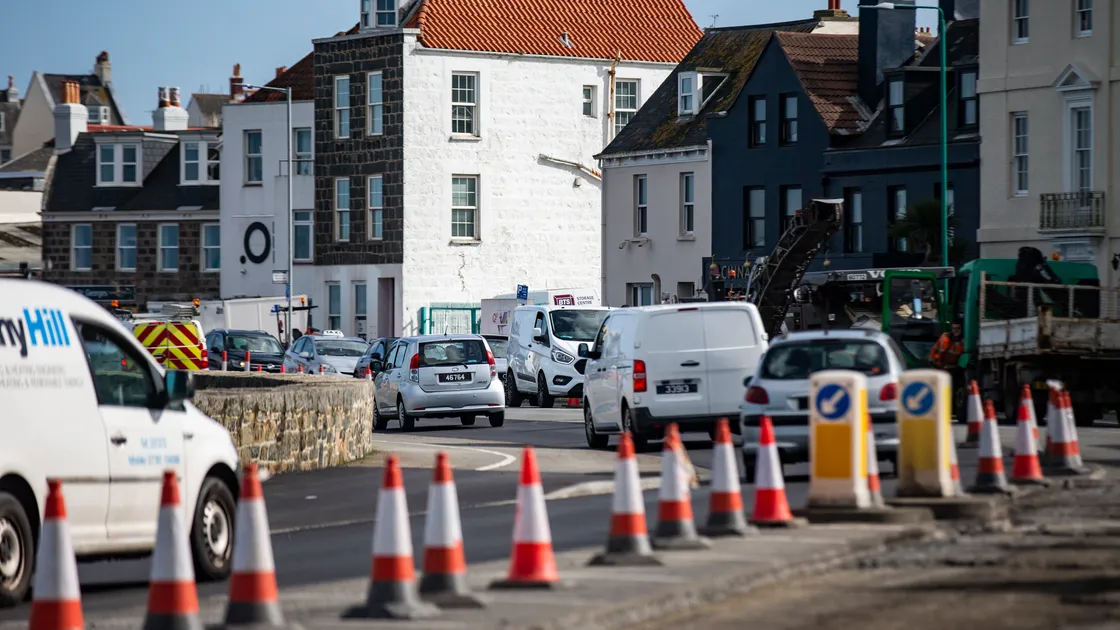
Figures revealed through a Freedom of Information request have shown that some £12.7m. has been allocated to the road resurfacing programme until 2028. Over the same period £2.3m. will be made available for projects including infrastructure for walking and cycling, under the Integrated Transport Strategy.
Road safety campaigner Ross Le Brun, who submitted the request, said he had put the questions to the States as he wanted to know if it was focusing as much on making vulnerable road users safer and encouraging active travel as it was in ensuring that motorists would have a smooth journey.
‘Put simply, we are planning to spend more than five times as much maintaining roads for vehicles as we are investing in infrastructure that helps people outside of vehicles to be safe,’ he said.
‘I want my child to be able to walk or cycle safely around the island as they grow up, and their children after them. We used to be able to do this when there was less traffic and smaller vehicles on the road, but traffic volume just continues to grow, as does the size of vehicles.’
He noted that in the response the States had said that the main objective of resurfacing works was ‘asset preservation and improvement’.
‘That is understandable, but resurfacing also presents a valuable opportunity,’ said Mr Le Brun.
‘When a road is already being rebuilt or resurfaced, it is often the most cost-effective time to introduce real crossings, real pavements, traffic calming or protected space for walking and cycling. Too often those opportunities appear to be missed because the focus is only on vehicles having a smooth surface to maintain the speed limit comfortably.’
The States said that accessibility improvements, including dropped kerbs, tactile paving and traffic islands, were often made during resurfacing jobs.
He said that having looked through the projects listed as ‘active travel’ improvements in the response, many were similar, relatively minor measures.
‘These are useful accessibility improvements, but they do not fundamentally change how safe or comfortable people feel walking or cycling on many of the island’s roads,’ he said.
Mr Le Brun, himself a commercial HGV driver for 24 years, said this resulted in a network that worked well for vehicles but meant people walking or cycling were expected to adapt to conditions designed primarily around traffic flow.
‘Across Guernsey there are still numerous roads without pavements. Cyclists regularly share narrow routes with the conflict caused by two-way motor traffic that already struggles to pass itself. As a professional driver I can say honestly that these situations are uncomfortable for drivers too.
‘The ability of children to walk or cycle to school, visit friends or travel around their community safely should be a central consideration when we design our roads.
‘Deputies have just made sure 16-year-olds can get pierced in a safe space. Let’s make sure they can walk and cycle in a safe space too.’
The States figures revealed that 37 roads had been resurfaced or undergone major patching in 2025 and up to 20 February this year.
Between January 2021 and December 2025 more than 40 travel-related capital projects had gone ahead, and others were funded from general revenue, including the introduction of school streets, the roll-out of travel plans and Bikeability training.
The States said that road safety and encouraging increased active travel were key priorities of Traffic & Highway Services and significant staffing and financial resources were designated to these matters.


You need to be logged in to comment.