
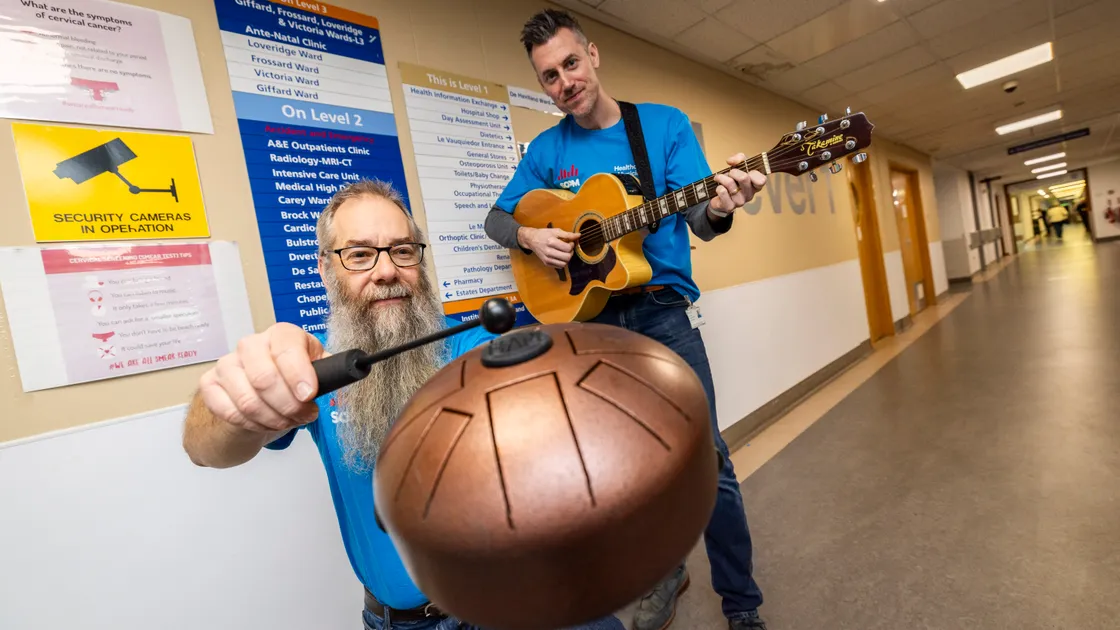
It is the fruit of the School of Popular Music’s latest self-funded initiative, which aims to uplift patients’ health and wellbeing by bringing live music straight to their bedside.
The project works alongside, but is funded independently of Health & Social Care’s creative health section.
‘Most of us musicians are used to learning a set list, going on stage and performing to people, but this is very different. You can’t just go with 10 songs, you have to adapt to every situation. There’s a lot of emotions running high,’ said SOPM director Tyler Edmonds.
UK-based Opus Music came to the island in 2024 to train up the specialist ‘healthcare musicians’, and came over again last year to provide a further course to qualify some local musicians as trainers themselves.
Now, the musicians rotate in pairs throughout as many wards as possible, from Frossard to Bulstrode wards, and most recently the ICU. They have a small trolley of different instruments to play and for people to interact with.
‘When you go into a ward you’ve got to judge the situation. It might not be appropriate for music at that time, and that’s absolutely fine,’ Mr Edmonds said.
They have noticed that due to their ward rotations, there can be a significant gap between their visits to each ward, and hope to raise more funding to expand their capacity and reduce the waiting time.
Healthcare musician Marcel Lenormand said hospitals were often disorienting and scary spaces for people, and that music can be a grounding respite.
‘There’s thousands of studies being done on the impact of music on a person. Engaging in music-making at any level, even if it’s just shaking an egg, does something completely different to the brain, it lights up,’ he said.
Fellow healthcare musician Mark O’Neill says their interactions were not ‘serenades’, but tailored to each patient and ward. A person may wish to just listen to something of their choice, others enjoy participating in the music-making, and other times they are told to go away.
‘A lot of people don’t come here by choice. In a lot of cases, they’re here because of very stressful or traumatic experiences. When we come in, it’s creating that normalcy or curiosity so they can feel present in the moment and have a bit of control,’ he said.
The early feedback has been encouraging.
‘We’ve had people just being tearful, crying with happiness, saying “thank you”. We’ve had feedback from some parents saying that once their child heard the music and was interested in engaging, that was the first time they’d seen them smile in two weeks,’ Mr O’Neill said.
After one session, they said a woman began crying, saying she was missing her friends. Another woman said that she had not sung for four years, but had loved taking part.
One that stood out to Mr Lenormand was an older man who joined in drumming along to Daydream Believer, ending with an enthusiastic “hell yeah!”
‘In what other environment do you get a “hell yeah” out of someone?’ he said.
For Mr O’Neill, the experience has changed the way he looks at music.
‘I’ve been playing music for years, different instruments, guitars and drums, live gigs, festivals – but I’ll never play the same as I do here. I’ll never play music the same again.’