
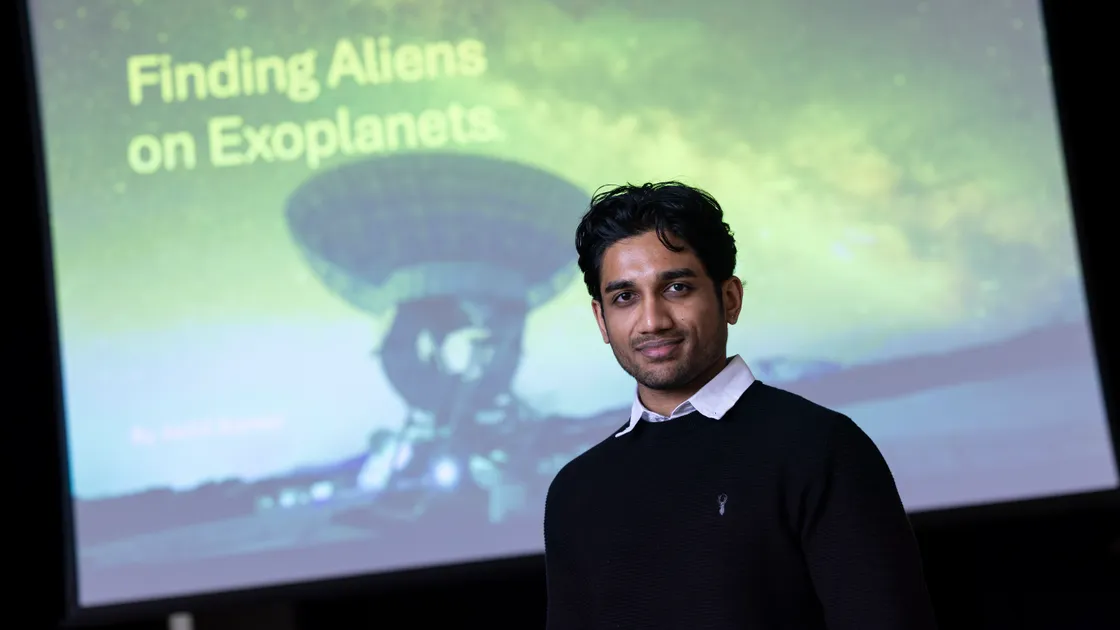
Cambridge PhD student Akhil Kumar visited the college to give a number of talks on his research.
Over the course of the day, Mr Kumar spoke to audiences of sixth formers, Year 7s and the whole school, as well as to an evening audience of interested islanders, discussing some of the research that has been done into potential life on planets outside of our solar system.
‘These type of talks really bring science to life,’ said Ladies’ College head of science Dr Karen Marshall, who invited Mr Kumar to Guernsey after taking some of her students to a student research conference where he had also been speaking.
‘There are very limited practicals that we can do in the classroom in this area of science, so I think it really makes a difference.’
Mr Kumar was inspired to pursue his current area of research and consequent dissertation – focused on linking concrete astrophysical data with theoretical frameworks predicting extraterrestrial life – when observations from Nasa’s James Webb Space Telescope indicated signs of life on exoplanets – planets outside the Milky Way – back in 2023. With interest piqued, he went on to pick up a class entitled ‘Planetary Science and Life in the Universe’, leading him to an in-depth study of astrobiology.
‘It feels exciting – this is the beginning of a new area of research, a new field of its own,’ he said.
‘I’ve always loved space and thought that it would be cool to find life outside of Earth. I think it would be really sad if there wasn’t something else, if we were alone in the universe.’
During the presentation that he delivered to the entirety of the College, Mr Kumar explained the current understanding of how many inhabitable planets actually exist in visible range – approximately 200 light years – and the possibility that they may, in fact, be inhabited.
‘I’m doing chemistry and biology, and it was really interesting to hear about how it relates to life elsewhere in the universe,’ said Year 13 student Eva Redelinghuys.
Her sentiment was shared by Year 7 student Lilyanna O’Dwyer, who said that she was enjoying the current astronomy unit in her science classes, and was interested to learn about the conditions that make planets habitable. Even for those with a less voracious appetite for Stem subjects, the presentation held considerable interest.
‘I thought it was interesting from the research side,’ said GCSE student and ethics enthusiast Alex Fox.
Mr Kumar’s research is not intended to end with the completion of his dissertation. He aims to stay in academia for the foreseeable future, researching, learning and educating about life beyond our solar system.
‘I think it’s really cool that the school hosts this type of thing,’ he said.
‘I love showing people that it’s possible to study and learn about this – when I was at school, I didn’t even know that this was an area of study.’