

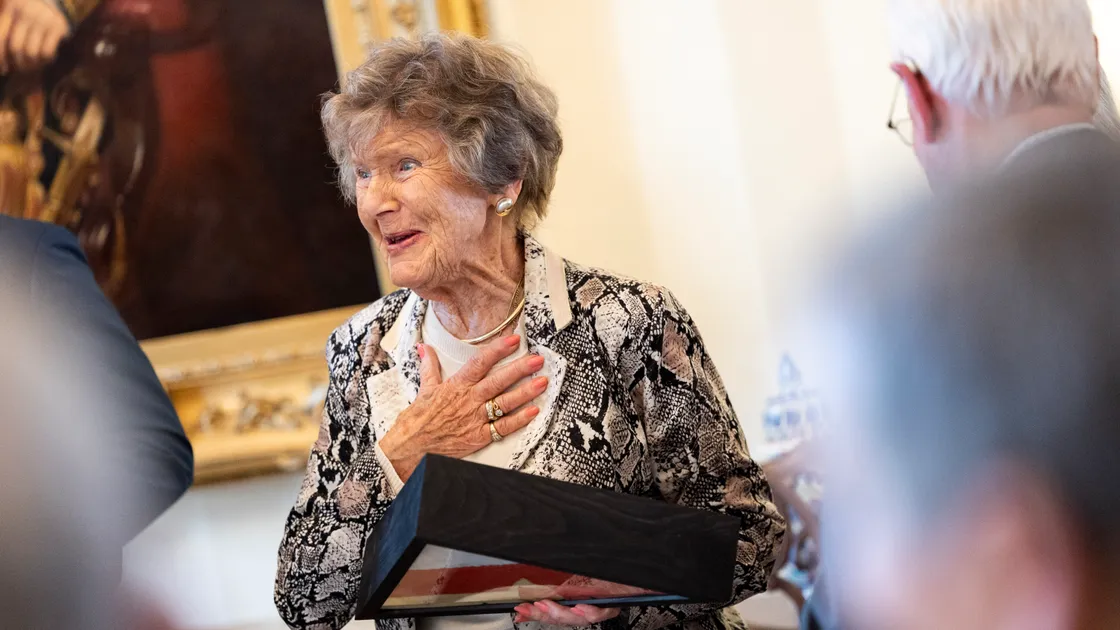
Janet Van Zanten, 90, attended the RGLI reception at Government House, thinking she would never make it to Masnieres to see where her uncle, Charles Henry Machon, had served and was wounded.
She was caught off guard when she was presented with the flag in his memory.
‘I am just so totally surprised,’ she said.
‘To me, he was just my father’s brother. He never really spoke about his experiences, he didn’t push himself to talk about it.’
Mrs Van Zanten was gifted the boxed Masnieres flag from 2024.
The flag hangs in the Town Church below the original flag for one year and then at the beginning of November, it is sent to France, where on 30 November, it is raised for a year. At the end of that period, it is taken down, usually torn and frayed, and returned to Guernsey where it is presented to a local family of a soldier who served.
‘I’m going to enjoy the flag for a while and then I’ll give it to my son,’ said Mrs Van Zanten.
‘My uncle married a Londoner and lived in the city. He would visit Guernsey in the summer, so he always felt like summer to me.
‘He was just the loveliest man.’
The RGLI Trust researched Charles Machon’s story to be able to share with his niece.
Charles Henry Machon was born in 1889 and at the age of 25, on Kitchener’s call for more men to serve, he joined the City of London Regiment. After basic infantry training, was allocated to the Third Battalion and left for the Havre in March 1915, just in time to take part in the Second Battle of Ypres.
In the Battle of Loos in September that year, he was reported as being wounded.
The battalion was moved to Egypt in October 1915.
Meanwhile, the War Department had accepted the Royal Guernsey Light Infantry as a regiment in December 1916 after its creation. They began to scour the British Army for Guernsey men to make a basic cadre of experienced soldiers.
Machon took three months to get back from Egypt and joined the RGLI in 8 May 1917.
For a second time, he was sent to Le Havre, this time with the RGLI, that September, and two months later he fought in the Battle of Cambrai.
He was wounded with shrapnel and was treated and joined the regiment on 12 April 1918 when the RGLI faced the largest German attack, and the very last one of the war, in the Battle of Lys.
Machon was on the line at the Georgette Offensive, one of 1,193 men. Three days later in a fighting retreat, when roll was called by the Lt-Colonel on the Hazebrouck railway line after being relieved by the Australians, he was one of only 57 officers and men to answer. By 30 April 1918 the RGLI had ceased to exist.
The rest of the men returned home in May 1919, but Machon stayed to serve until 1920.