

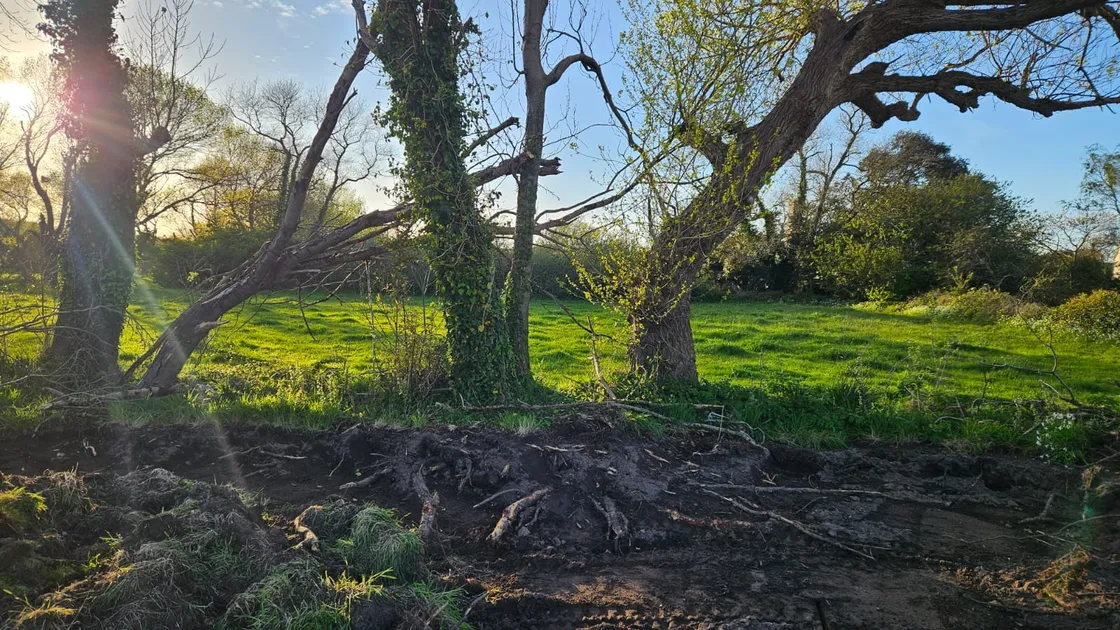
On Tuesday an order was served on Simon Holland, who personally owns the site off Les Tracheries in St Sampson’s that the trees are on.
The neighbouring site is owned by his company Hillstone, which is building 13 one and two-bed entry-level homes.
He said that the issuing of the tree order was a complete shock to him and called it ‘a costly over-reaction’.
‘We had no desire to do anything other than maintain and improve the tree stock,’ he said.
‘On the day in question I was awaiting surgery in hospital and I had an email which came to my phone from the director of Planning, Jim Rowles, in which he sent me pictures of the excavation and asked how the damage had occurred.
‘This was the first I had been notified of the damage. In his email he enquired as to what had happened.
‘I immediately contacted a member of my construction team to enquire as to what had happened and he notified me that a member of staff had disturbed the ground whilst digging a test hole. It was an error of judgment by the staff member.
‘The location he chose was inappropriate, but it was not done with malice or in a direct attempt to cause harm.
‘It was simply a mistake. People make mistakes all the time, and we have since put in place procedures to prevent this.’
Mr Holland said he had made the DPA aware that this had been a mistake. He said that he had already submitted a tree report on the site, commenting on the poor quality of the trees in question, and that they were not subject to any form of protection.
‘So while it was an accident and my staff member was sorry, there were no rules or laws broken. I notified Mr Rowles that the soil would be replaced when we were next working on the neighbouring site, being early next week,’ he said.
‘The next communication I received was the formal tree protection order.’
Mr Holland had also suggested that he would improve the field boundary features to encourage long-term biodiversity.
He has said he will be appealing the decision to serve the order on him.
‘It goes against the DPA’s own legislation on when to use a TPO. It’s become a matter of principle for me, as I am left with no choice but to appeal,’ he said.
‘It’s common practice in other parts of the world to engage with landowners and work to improving features of this nature, through education and good management. The issuing of the order will not preserve decaying trees. Nature will ultimately destroy these ageing trees.
‘If you visit the site, you will see that many of the trees require considerable work as there are many fractured limbs and even fallen trees on the ground.
‘Without investment, these trees will be gone within years, and this TPO won’t encourage the investment required – it’s an overbearing attempt by States of Guernsey to prevent a problem or threat that didn’t exist, and as a result they have come between me and my desire to enhance the field.’
The Development & Planning Authority was approached for comment.
The protection order makes it an offence to cut down, cut, uproot or wilfully destroy the trees without planning permission, and is effective for six months.
DPA president Neil Inder said at the time of the serving of the order that the actions were ‘disappointing, if not cynical’, and warned that he would look to increase tree protection in the future.



You need to be logged in to comment.