

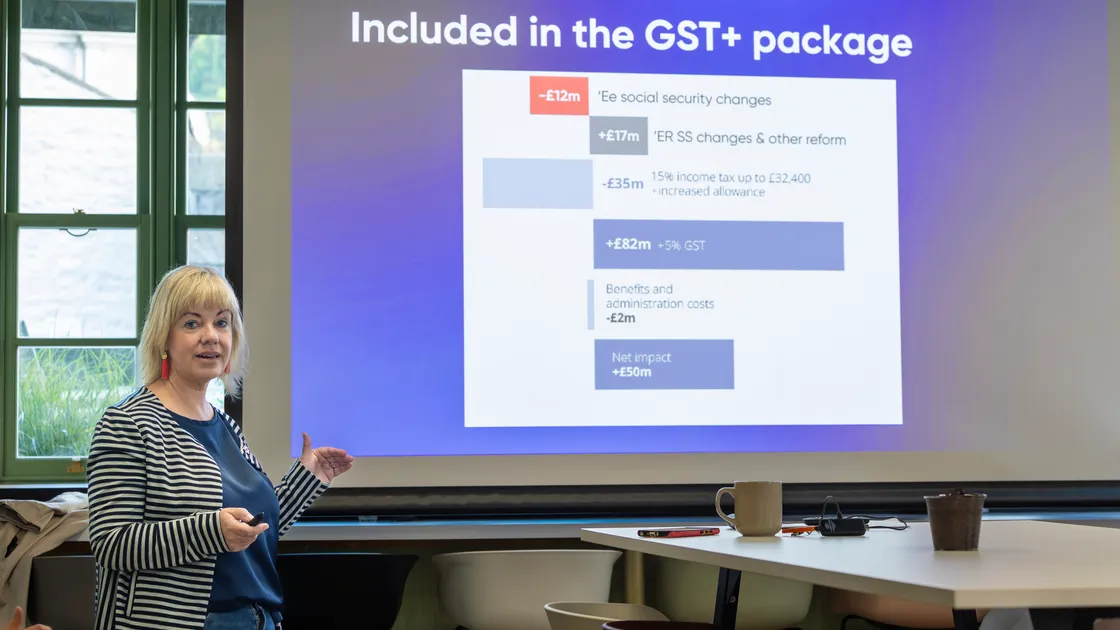
The Chamber had been campaigning against sweeping changes to social security contributions, especially affecting employers, which were a key part of the GST-plus package agreed by the previous States and scheduled for introduction in 2028.
It claimed it had influenced Policy & Resources’ change of direction, after the senior committee announced yesterday that it would ask the States to drop GST-plus in its original form, including scaling back the social security changes.
‘P&R is revising its proposals in ways that directly reflect the concerns you raised,’ said a Chamber spokeswoman, in an email to its members.
‘We had been pressing hard on three key asks – transparency on changes, a more gradual phasing of any increases, and a simplified and fair alignment between the treatment of employed and self-employed individuals.
‘None of this happened by accident. It is the direct result of your feedback and the Chamber’s consistent, evidence-based approach with the States.’
P&R’s revised plan, which will be debated by the States in July, will not include a 5% goods and services tax for introduction during the current political term and will increase taxes less overall, allowing more time to see how much of the projected deficit in public finances could be closed by local and international changes to the company tax regime, spending reductions within the States, and transport taxes.
The senior committee’s announcement disclosed few details of the revisions it is now finalising before it publishes a policy letter on 8 June, but the Chamber told its members of specific differences it expected to see in the proposals relating to social security.
They included smaller and more gradual increases to employer contribution rates, alignment between the treatment of the employed and self-employed, a new income tax deduction for employer contributions, and taking no contributions out of unearned income, such as property rent.
The Chamber said the changes followed ‘sustained engagement’ it had undertaken on each of those issues.
‘This is exactly the kind of outcome that demonstrates why your membership of the Chamber matters, and what effective partnership between business and government looks like,’ it said.
The social security element of the original GST-plus package would allow significant redistribution to less affluent households by increasing revenue raised from the better-off and companies. Any redistribution in the new tax plan being developed by P&R is likely to be more modest.
P&R president Lindsay de Sausmarez had spoken at a Chamber meeting hours before her committee announced its change of direction on tax policy.
She told Chamber members that P&R was keen to ‘soften the impact’ of GST-plus in its original form and hoped business would welcome the more incremental alternative plan it was now working up.
But there will still be reform to contributions, she said.
‘Our current system is unbelievably complicated. There is some scope to simplify our social security system and make it fairer and more effective,’ said Deputy de Sausmarez.
Chamber treasurer and former president Diane de Garis, who led the business organisation’s work on this issue, said it had acted because businesses needed certainty, fairness, simplicity and clarity on how the tax burden would be distributed, and that employers wanted to see a fair and capped employer cost and practical implementation of the new system.
‘The revisions being discussed go a significant way towards delivering exactly that.
‘This is what effective partnership between business and government looks like,’ she said.