

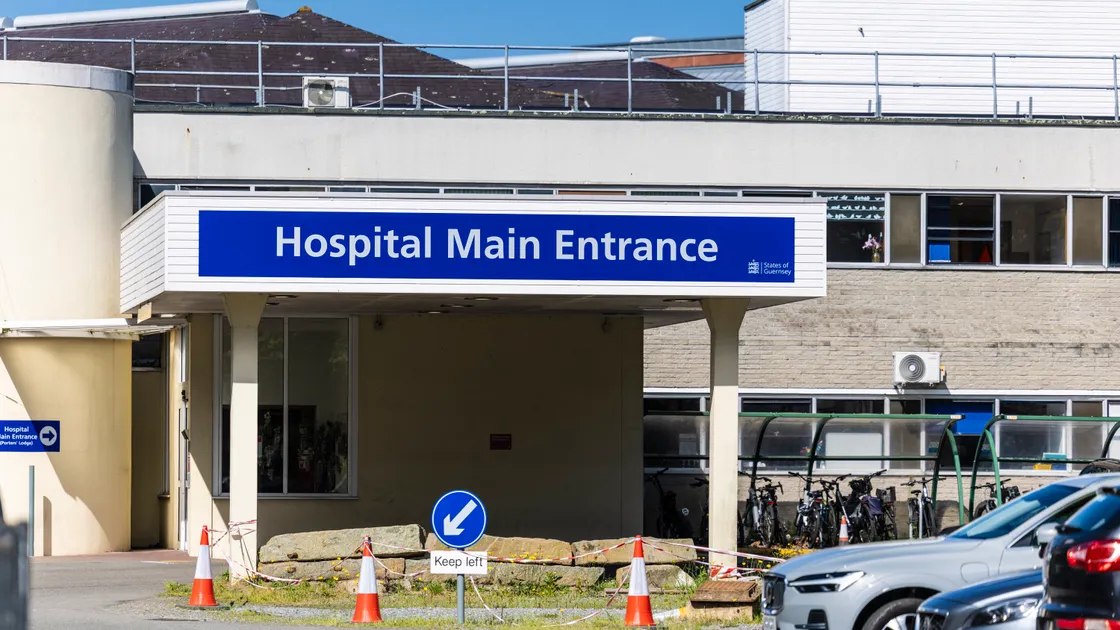
The project was remodelled early in 2025 because of concerns about spiralling costs. Switching phase 2 to 2A was intended to realise about 80% of the benefits within the programme’s original £130m. cost envelope.
But Health & Social Care president George Oswald has admitted that the cost is now out of control and his committee will have to go back to the start on the project.
He said that the exact indicative cost of the project was no longer relevant.
‘The important fact is that the previous plans simply can no longer be afforded,’ he said.
At HSC’s next meeting he will ask his committee to halt the whole programme and decide what can be delivered for £130m.
Deputy Oswald admitted that this was likely to be far less than was contained in the Phase 2A plans, which themselves were a scaled-down version of what had going to be provided in the original Phase 2 proposals.
Phase 2A would have seen predominantly new build construction, including increased surgical capacity which would have offered resilience to meet demand over the next 30 years and beyond.
The Health president admitted that a new plan was set to only include elements of Phase 2A, but might also offer some other clinical features to address pressing current demands.
He said that he particularly wanted to see the labour ward moved next to operating theatres because of the risk if a mother needs to be transferred, and would still need to increase theatre capacity, even in a modular form.
He admitted that the move to scrap the plans and start again was a blow with demands on the hospital set to increase as the population ages. Hospital theatres in particular are already operating at near capacity, which in turn is having an inevitable adverse impact on waiting lists.
Meanwhile Deputy Oswald confirmed that the additional cost of addressing some of the fire safety issues, which have prevented Phase 1 of the modernisation project from opening, was likely to be just more than £1m., and will involve installing a piece of heavy equipment on to the roof, which needs to be strengthened to accommodate it and will need specialised lifting equipment to be brought from the UK to install it.
HSC tried to pursue the firm which carried out the original design work to ask them to meet these additional costs, but it has since ceased trading, and is now looking at whether it can claim on that firm’s insurance. The additional works will further delay the opening of Phase 1 until next year.
In 2025 the Health Committee said that the investment in Phase 2 of the hospital was ‘essential’ and ‘fundamental’ to meet the long-term care needs of the community.
It was hoped that if everything went smoothly, Phase 2A could have been completed during 2029.
The original Phase 2 project was to include four new operating theatres, new maternity, neonatal, paediatric and private wards, a new intensive care unit, an admissions and discharge unit, outpatients area and main entrance.
It also included the refurbishment of four theatres, sterile services, orthopaedics, the breast unit, emergency department, fracture clinic and overnight accommodation.