


Despite the headline GST rate being slashed from 5% to 3%, the accompanying mitigations have also changed.
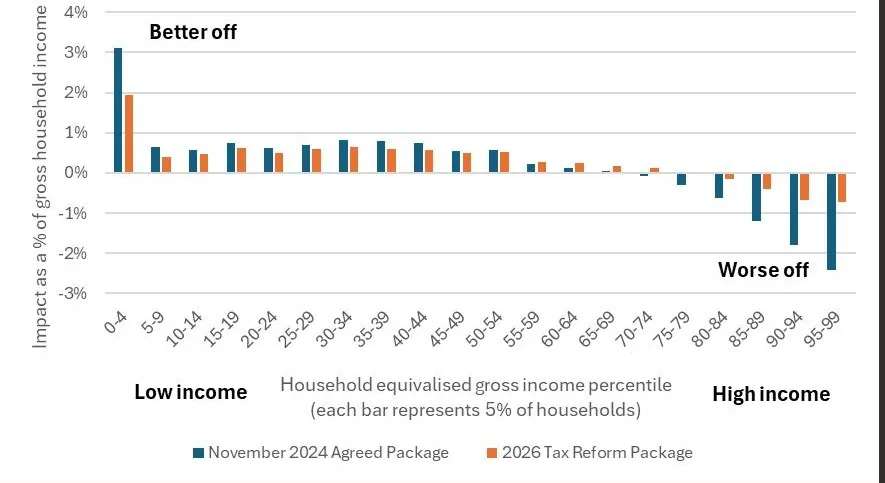
In a comparison of the two packages, Policy & Resources has accepted that the changes will not bring the same benefits to lower income earners, although they will still see some improvement.
‘The combined impact of the changes is that while the basic shape of the household impact remains the same, with lower income and middle-income households being on average better off than they are now, the extent of the redistribution is less, reflecting the lower net revenue gain,’ it said in an appendix to the report.
Households in the higher income bracket will be worse off than they are now, but by less than they would have been with the previous package.
Former P&R member Gavin St Pier, writing in today’s Guernsey Press, calls the current proposals a compromise – better than the status quo, but not as progressive as the previous GST+ proposals.
But he said that, no matter what the proposals, there will always be those who are against them, and with some justification.
‘Opponents can rightly point out that 100% of the cost and pain for government, business and consumers of introducing a GST is going to be incurred, but for only 60% of the revenue previously envisaged when GST was going to be 5% rather than 3%,’ he said.
‘The compromise plays right into one of the principal arguments against introducing it at all: once it’s in, critics say, it’s just too easy to ratchet it.’
Deputy David Dorrity said he was not convinced that a 3% consumption tax rate would be enough to get the island back onto an even keel financially.
‘Some have asserted that a good portion of the reduced monies raised in comparison to the 5% rate will be swallowed by the administration of the new tax for the first year or two, which, if these fears prove true, feels like islanders will still get all the pains of the higher rate with considerably less of the gains,’ he said.
‘I question whether 3% GST will be sufficient to prevent a further downgrading by S&P. If that should occur, we may need GST at an even higher rate to compensate for lost business.
‘The new GST proposals feel to me like needless last-minute tinkering so that the current P&R are able to reinvent as their own a package which the majority of them had previously voted down during the last Assembly.’
He said he was surprised Guernsey never followed Jersey’s lead by introducing a consumption tax in response to zero-10.
‘The lack of political backbone to do something has been a constant source of real worry to me over the past 20 years,’ he said.
‘While we ate into our reserves, Jersey banked a £bn+ of GST income over the same period and their untouched reserves continued to grow.’
He said he will wait to hear the points raised in the July debate, along with any amendments suggested by colleagues, before deciding whether or not to support P&R’s new package.