
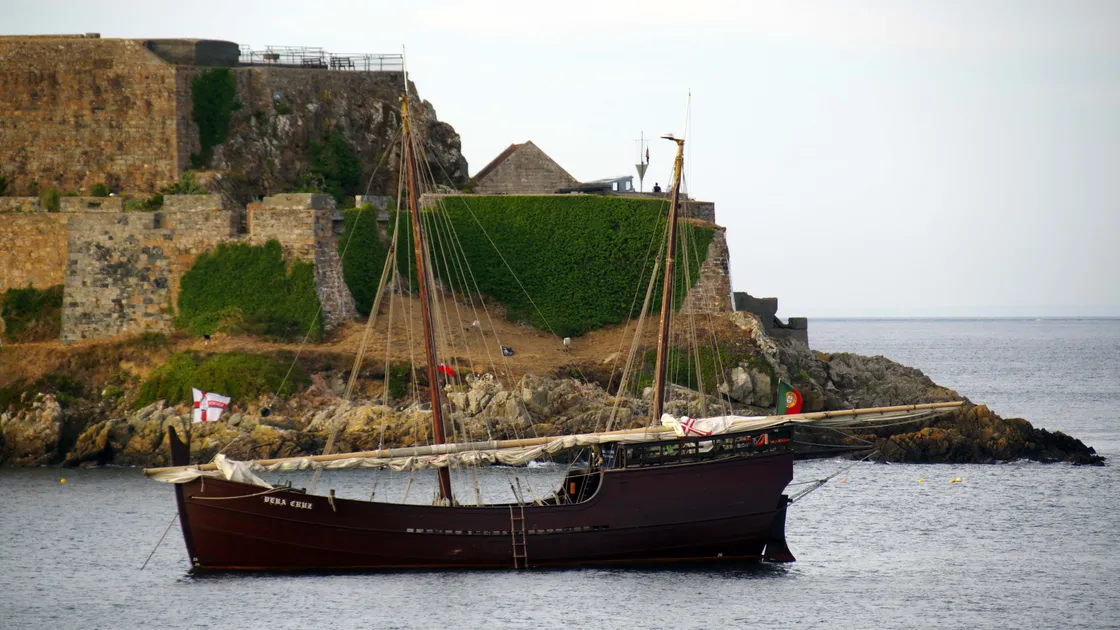
Vera Cruz visited St Peter Port for a refuel while on its way from Norway to Portugal, something it has done several times in the past. But, 2026 marked the first opportunity that its 22-strong crew had to drop anchor overnight and explore St Peter Port on foot.
‘It is a very amazing place, magical,’ said Captain Felipe Costa. ‘We really enjoyed our time and hope to come back for a couple of nights next year, and maybe open the boat to visitors.’
Vera Cruz is a replica caravel, a type of sailing ship used by the Portuguese to explore the Atlantic Ocean and west coast of Africa in search of a path around the Cape of Good Hope to India.
Quick and agile with a shallow draft, it made for the perfect vessel to use when navigating along rivers and coastlines.
Beyond Vera Cruz’s importance as a ‘living museum’, another key purpose is its work in maritime education. The vessel is part of the Sail Training International Group and is regularly used to give young people the opportunity to join its crew for sail training.
‘But it’s not just nautical training that we do with the kids,’ said Captain Costa. ‘We also want to teach them how to be good people and work together in a team. It’s a social project.’
He pointed to the words painted in large letters across the roof beams in the tiller room.
‘It says – “here, at the helm, I am more than myself. I am a people longing for the sea that is yours”. It is two lines from one of our most important poems in Portugal, it is about the human confronting the monster.’
The ‘monster’ in question represents fear and the unknown, and the lines quoted reveal the moment the helmsman puts aside his individuality to embrace the collective courage and will of his entire nation in order to conquer the treacherous seas before him. It is this key message of turning to collectivity and togetherness to overcome challenges and fears that the captain was keen for his young trainees to take home from their time on board. Although a faithful replica of a caravel in terms of its appearance, Captain Costa and his crew are able to sail in a great deal more comfort today than the original crews of caravels would have been able to.
‘Outside is a replica, inside is modern,’ he said.
‘Back in the day, you go out with a full crew and come back with maybe six or seven. Today, I go out with 22, I return with 22.’
In addition to its modern navigational system, Vera Cruz contains separate bunk beds for each crew member, three toilets, one kitchen and one big table for the crew to eat at.
‘We are like a family, gathering here three times a day to eat,’ the captain explained, while two members of his crew tucked into a quick lunch as preparations were being made for the vessel to leave Guernsey.
On the menu was a fresh loaf and dried, salted cod that the crew had picked up during their stay in Norway.