
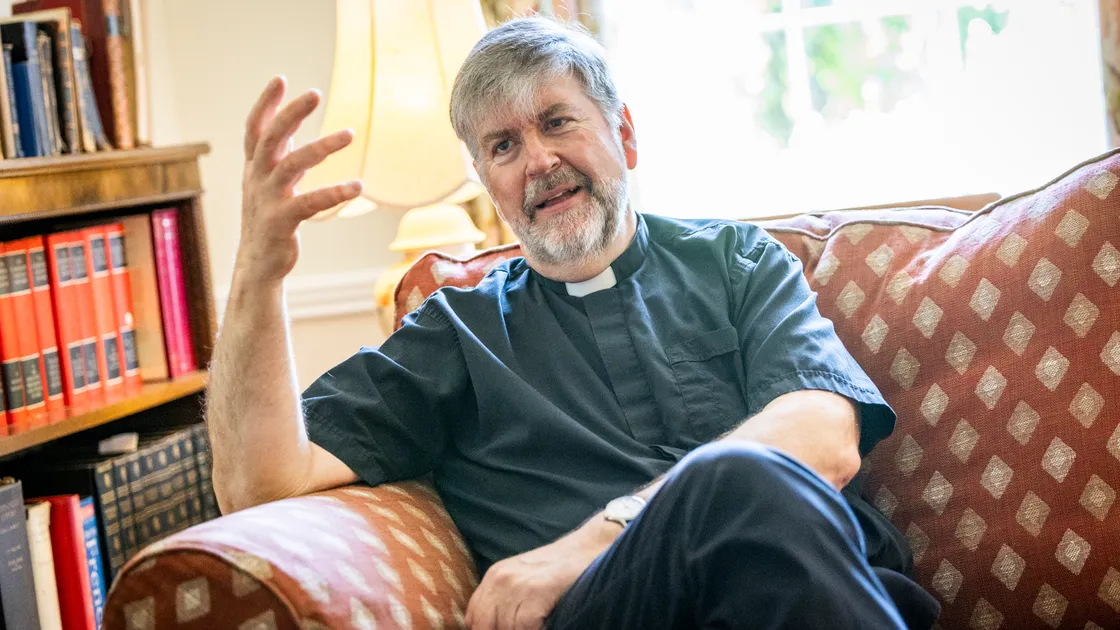
After more than a decade serving the island as Dean of Guernsey, the Very Rev. Tim Barker is retiring from his position.
As well as marking the end of a long and dedicated service to the island, Mr Barker’s retirement concludes his decades-long vocational journey in and through the Church of England, which stretches back as far back as he can remember from when he first felt called to become a priest.
‘For me, it was very sort of gradual, natural journey of growing and deepening and embracing the Christian faith,’ he said.
‘There wasn’t a big flash at the moment of discovery. For as long as I can remember, I have felt that I was being called to be a priest.’
With his heart increasingly set on pursuing the priesthood throughout his teenage years, Mr Barker went off to the Church of England’s selection procedures in his second year of university, whereafter he was recommended for training, and ordained a deacon aged 23.
‘That was the youngest age one could be ordained deacon, and then I was ordained as a priest the year after,’ he said.
He marked the 45th anniversary of his ordination on Sunday 28 June this year.
Post-ordination, he began working in Cheshire, beginning a career that would take him to Runcorn, Chester, into Lincolnshire, and, ultimately, over to Guernsey.
‘I was moved to be archdeacon of Lincoln, which is a senior role in the diocese, supporting the bishop and having responsibility for about 100 parishes in central Lincolnshire. And then, to my surprise, somebody suggested I think about Guernsey,’ he said.
‘They were looking for a new dean, and it was thought that perhaps this might be a me-shaped hole. I looked into the job description and thought it sounded interesting, so I applied and interviewed, and here I am.’
It was only after being offered the post that Mr Barker and his wife Judy made the journey over to the island. They knew little of it prior to their arrival. And their first few months, while not particularly troublesome, over winter did not leave them with the best impression. Mr Barker said it took the couple a while to truly fall in love with it.
‘I think we had very few expectations – I think we thought we were coming to a quite nice but fairly quiet island,’ he said.
‘We came at the end of November 2015. That winter was dark and cold, and we were finding our way around and getting lost. And, gradually, as the spring dawned and Guernsey woke up and we were getting involved with all sorts things, we realised just what an amazing place it was. We felt a real sense of gratitude and privilege for having been asked to come here.’
Since that time Mr Barker has served as a prime figure in the island’s public life, not only leading and supporting Guernsey’s Anglican churches, but also helping to lead many of the island’s political and diplomatic events, and supporting other local religious communities.
‘Being involved in the services for the death of Her Majesty the Queen and the coronation of King Charles and being a part of how Guernsey marked those two events – that’s a powerful memory,’ he said.
‘Other important things are the connections with Masnieres and Biberach. I was here when the Royal Guernsey Light Infantry Trust was getting launched, and I went over for the big event in July 2017 to mark the formation of the RGLI and their being sent off, and just to see the place where so many Guernsey people had fought and died in 1917, because that had an enormous impact on Guernsey.’
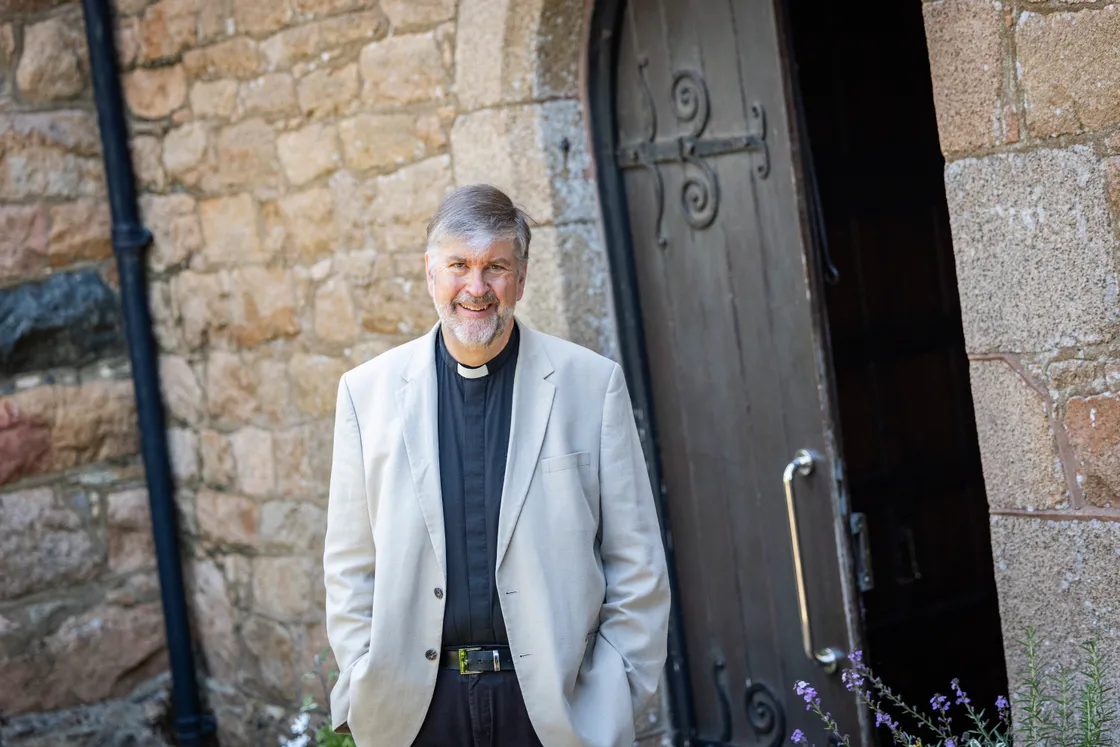
Mr Barker has taken on many further roles in remembrance of wars gone by, being involved in the island’s reconciliation with Biberach – which once held some islanders as prisoners of war – and leading the annual Remembrance Day and Liberation Day services.
‘Unless you’ve been through a Liberation Day, unless you begin to understand what that means, perhaps you’ll never really understand Guernsey,’ he said.
‘So, Liberation Day has been very important. Just talking to people who lived through the Occupation and hearing some very difficult memories – those are such powerful things.’
Mr Barker also looked back on his involvement with a diverse range of religious communities as a highlight of his time on the island, reflecting on the pandemic, which he said brought him to work very closely with the island’s other churches, and cherishing his later involvement with the island’s Jewish community as well.
‘I’ve appreciated getting to know the Jewish community in Guernsey, particularly through Holocaust Memorial Day in January,’ he said.
‘I’ve also been amazingly privileged to be invited to lead the Jewish community’s commemoration of Yom Hashoah, and to be able to work with the island’s other churches.’
While his role saw him be involved in all that is great and grand in island life, Mr Barker said that he would equally treasure the smaller, simpler aspects of his job – his day-to-day interactions with people, and conducting services like weddings and funerals.
‘I’ve just met some lovely, amazing people.
‘One of the memories I take away is those people I’ve met, and particularly those for whom I’ve been able to take funerals and baptisms and marriages,’ he said.
‘Those are important and precious memories.’
While Mr Barker will think fondly on his service to the island, he acknowledged that being dean of a place so small is not without its challenges – although, for him, he thought them few and far between.
‘There are challenges because, I suppose, because it’s a smaller unit, one ends up doing more things,’ he said.
‘There’s also that, while I love meeting people, I love the fact that it’s rare to get on a flight without knowing somebody, and I think that if you didn’t like that, this would be quite a difficult job.’
He added that, for him, the joys far outweighed any difficulties the job posed, but that his successor’s term may not be quite as smooth-sailing.
‘My successor is certainly going to face some fairly significant challenges,’ he said.
‘It just so happens that, as well as my departure, two other colleagues are moving on to new work back in England.
‘It’s not a sign of problems, it’s just how things are – it’s just that people come to the point where they need to move on to a different challenge. So the new dean will actually face the challenge of having to look at how church life is managed and developed here.’
Meanwhile, Mr Barker is and has been saying fond farewells to the island, moving back to England with his wife to be closer to their daughter, son-in-law and grandchildren.
‘It’s hard to move on, leaving such an amazing place with amazing people, but we recognise that it’s the right thing for us to do,’ he said.
‘We’ll be retiring to Canterbury. We don’t know the area at all, but we’ll going with confidence, and with hope for the future.’