

Long after everyone else knew it was impossible, Policy & Resources kept believing. Ok, the States had taken two days to deal with five of the 23 amendments, and there was still general debate to follow, but if the pace quickened perhaps three days would be enough to finish the tax debate. Hope can sustain even the most futile cause.
On the night, three Fridays ago, after a decision on tax had inevitably been deferred until October at the earliest, they put on a brave face, but inside the members of the senior committee were frustrated and uneasy. They had been confident of winning a vote on their controversial tax plan, including a goods and services tax, in time to roll it out in 2028, well ahead of the next general election. But now they faced an uncertain summer as well as an increasingly anxious race against the clock of the electoral cycle.
Politics is always a numbers business. In the States, the key number is 21 – a majority if all members are present. P&R believed they had 22 votes, possibly even 23, but four or five were flaky, and nobody could know how a long delay would affect the numbers. If a week is a long time in politics, 10 weeks is an eternity – certainly long enough for public opinion to sway more deputies against GST and for P&R’s opponents, who had sensed defeat, to sow more seeds of doubt about their tax plan and draft more amendments, aided by absurdly reinterpreted submission rules.
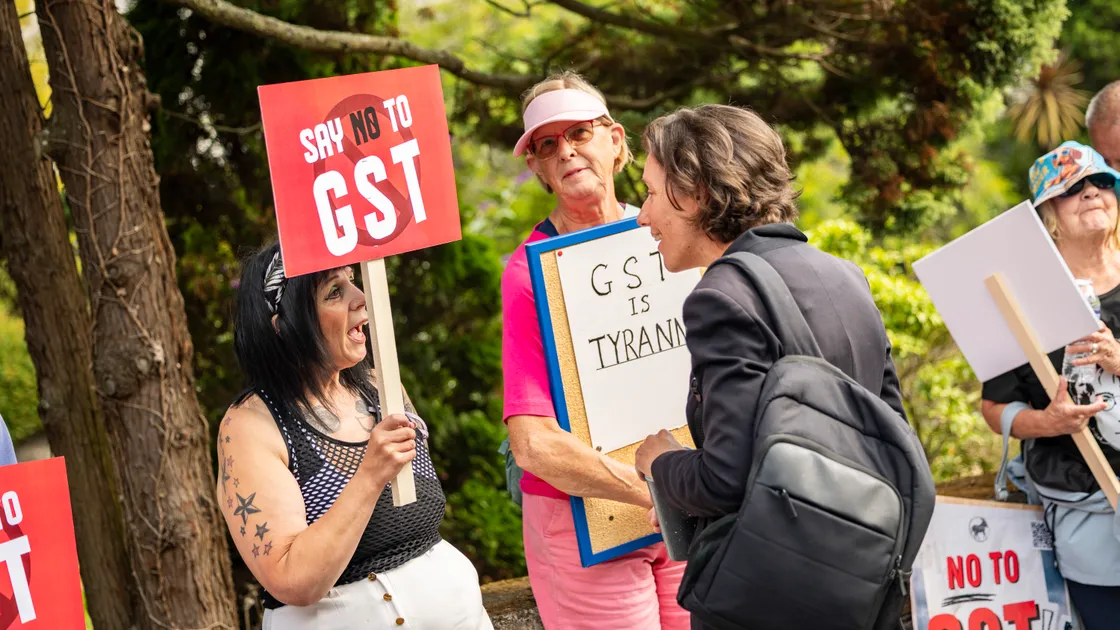
There had been a time, in the spring, when P&R hoped they had a larger majority. By the week of the States debate in mid-July, the momentum was moving against them, as public opposition grew, and in politics ‘the big mo’ matters. It hadn’t yet moved enough to defeat the tax plan, but if it continued to move in the same direction, through August and September, P&R knew that its majority could become a minority.
On the other hand, inside the Assembly, a few deputies who were undecided how to vote when the July States meeting started had become increasingly perturbed by the approach of some of P&R’s critics, which is why momentum slightly shifted back towards the senior committee during the three-day debate – the rehearsal, as it would turn out.

The ‘5%ers’ could be decisive in the autumn
Today, P&R has probably 17 or 18 solid votes for its tax plan, and three routes (or a combination of three routes) to get to 21.
The first route is the two official Alderney Representatives, who if anything seem to be moving in the opposite direction, plus the honorary one, John Gollop.
The second route is committee presidents who are instinctively inclined to support this P&R and know well the growing demands on public services but who in the past have consistently voted against GST, such as Tina Bury, Adrian Gabriel and Marc Leadbeater, the last of whom has now trailed a new amendment which would almost certainly defer a decision on most of the tax plan, including GST, until the next States term.
The third route is critics of P&R who nevertheless believe GST is necessary, and at a higher rate than the 3% now being proposed, such as Mark Helyar, Neil Inder and David Dorrity. At last year’s general election, voters punished most candidates known to be supporters of GST-plus, which had been approved in-principle in 2024 but at a rate of 5%, with several prominent deputies losing their seats over it. It would be ironic if this small group who survived had the decisive say in the tax debate this term.
Lack of confidence in savings target
Deputy Dorrity seems the most open of the third group to backing P&R’s tax plan. ‘At first reading, I did not understand how the reduced GST rate would achieve the level of income required, while incurring the same implementation costs as the 5% rate,’ he said. It is estimated that setting GST at 3% rather than 5% would forego about £35m. a year. ‘That said, I can see that by factoring in the motor tax element that had not been a feature of the previous package, P&R felt they had a little more wiggle room, and are perhaps hoping to limit any inflationary impact by introducing the consumption tax at a lower rate as part of their package.’
The other, non-GST elements of the current tax plan have been too easily overlooked. It includes an annual income of £7m. on vehicles, largely through the reintroduction of motor tax, and £40m. from international company tax changes known as Pillar II. In the original tax plan featuring GST at 5%, put forward in 2022, motoring taxes were absent, and Pillar II was forecast to be worth only £10m. a year. Also added since then is an assumption that annual savings of £20m. will have been found by 2029.
Treasury projections show an annual deficit in the island’s finances of between £80m. and £100m. by 2040. Many alternative projections are available. P&R has estimated that its tax plan would raise £60m. a year net of administration costs and what it calls ‘mitigations’, principally through income tax and social security, aimed at protecting the least affluent half of the island from higher costs caused by GST.
Deputy Dorrity in particular has cautioned against placing too much reliance on Pillar II tax receipts, while Deputies Helyar and Inder are sceptical that even relatively modest savings targets will be met.
‘Cuts are not going to come from navel gazing at service limitations,’ said Deputy Helyar.
‘The prime cost is headcount and that is what would need to be reduced. That doesn’t require consultants or service reviews. The public are demanding that we make cost savings but, unfortunately, I don’t believe the majority of this P&R really support making cuts.’ He believes that may be why an amendment earlier in the year directing real-terms spending reductions, which has yet to be put into effect, was led by a ‘backbench’ member of Forward Guernsey, despite the party’s leader being P&R’s treasury lead at the time.
‘Absolutely no-one believes the size of the state will diminish any time soon,’ said Deputy Inder. ‘For me that is less about whether it’s possible and more that we simply don’t have the type of leadership or system of government which lays down its will to budget holders. The public will demand services and politicians will buckle to those demands. Social Security will keep spending on social policy, Health will fund the demand, and Home Affairs will always have service leaders who want more kit, more training and more resources.’

Is 3% enough?
This scepticism is why they continue to believe that 3% is an inadequate introductory rate for GST, even though the projections behind P&R’s tax plan show it raising or saving more and costing less than the original plan with GST at 5%, thereby filling more of the underlying deficit facing the island’s finances.
‘3% will not get Guernsey to where it needs to be,’ said Deputy Inder. ‘Indeed, Lindsay de Sausmarez [P&R president] has alluded to this being an interim figure which will be reviewed in the next States. My view is that this is a strategic error and smacks of one of those Guernsey fudges, where the government has got to do something but the something isn’t what’s really needed.’
The counterargument goes something like this – get a consumption tax in place now and revisit the correct rate in the future. Several of the ‘5%ers’ are unmoved. Deputy Helyar said ‘3% doesn’t work’. Deputy Inder was even more critical. ‘Why on earth go through all this grief for 3% when 5% is where the island needs to be? One may as well get hung for a sheep as a lamb,’ he said. ‘All this has done is emboldened those who wouldn’t have voted for GST at any rate under any circumstances and irritated those who understand what is required to fund public services. P&R have put themselves in the invidious position of being the first committee to be shot at by both sides.’
P&R thinks that view is cutting off one’s nose to spite one’s face. And they may have persuaded Deputy Dorrity at least. ‘In my opinion, a GST rate hike is not a given for the review in 2030,’ he said. ‘Indications are that Pillar II will raise more than projected in the first year or two, and there will need to be a review of whether implementation of the package [including GST] has had any detrimental effects on islanders’ shopping habits. The performance of these two current unknowns, alongside the outcome of the savings initiative, will make it very clear whether the lower rate of GST has been successful.’
At the other end of this argument about a so-called interim rate of GST, Deputy Leadbeater’s incipient amendment for the autumn resumption would take consumption tax off the table while there is uncertainty about the rate required and revisit it once Pillar II receipts are clearer and savings have been banked rather than merely talked about. One of P&R’s biggest fears is Charles Parkinson, treasury lead only since May, who, like Deputy Leadbeater, fought the general election under the ‘Fair Tax’ banner, publicly indicating more than a little sympathy for that approach, having previously criticised – with much foresight, as it turned out – treasury forecasts for overstating the deficit in public finances and understating Pillar II income and claimed that GST ‘will be a drag on economic growth’.
It’s hard to follow who believes what
Guernsey politics can be an upside-down world, in which many controversial spending reductions have been led by politicians allegedly of the ‘left’, while a recent senior committee supposedly of the ‘right’ sanctioned the largest budget increases in two decades. Currently, members who nearly destroyed their political careers by continually voting for GST in the previous Assembly are being asked by P&R and other recent converts not to throw it out because of a disagreement over the exact rate. It is possible that members who believe GST is unavoidable will cast the decisive votes to reject the one plan which would introduce it. The public could be forgiven for concluding that essentially the same things are being said as were being said last term, in support and in opposition, only with many of the protagonists having changed sides.
‘Those who were poster children for the GST-plus package took a hit at the election and those who did not support it last term did very well. Not one of the current members of P&R voted for any part of the GST-based plans last term,’ said Deputy Inder. ‘The reaction to this feels very different. There was a considerable reaction to the proposals last term, but it feels like there is a different grievance this term. I detect that the public feel betrayed.’
Deputy de Sausmarez is vexed by this accusation. She undoubtedly benefitted electorally from voting against previous plans which included GST, and some voters will naturally have assumed that she would continue to oppose it, although as a matter of fact her consistent position was a preference rather than a promise to avert it. Moreover, she believes she has done what she pledged to do when standing for the presidency of the senior committee.
‘The original proposition agreed in November 2024 directed P&R to finalise proposals for an integrated package of revenue-raising measures, including but not limited to the measures listed in the proposition itself [which featured GST at 5%],’ she said. ‘When I stood for the role of president of P&R, I did so on the explicit promise thoroughly to explore all of the options around tax reform, without delaying potential implementation.’ This was the much publicised ‘no stone left unturned’ approach.
P&R’s growing inflation problem
P&R insists that 3%, rather than 5%, is not only, or even primarily, a convenient political compromise. Deputy Parkinson’s optimism about company tax receipts clearly played a part. They thought there was at least a 50% chance that the lower rate would be enough. They wanted to broaden taxes on motoring as an alternative. They believed they were spreading the burden of additional taxation more reasonably. Louis XIV’s finance minister once famously said that the art of taxation consists of plucking the goose so as to obtain the most feathers with the least hissing, and that was what P&R hoped they could achieve, although it hasn’t worked out like that. Above all, though, they seemed to fear inflation.
‘We extended the consultation period by a further 12 months and one of the key concerns raised through that process by industry, the community, interest groups and political colleagues was the inflationary impact that a 5% GST could potentially have, especially at a time when inflation had run higher than over previous decades,’ said Deputy de Sausmarez.
‘A 5% rate of GST would likely result in inflation of 3.2%, whereas GST at 3% would bring that down to just 1.9%. As a committee, we are very conscious that people are struggling with the high cost of living, so that change was key to our proposals.’
In the past week, two reports have been published which could have damaged P&R’s tax plans. First, it was revealed that the average household spent 6% less and suffered a 12% decline in income, after adjusting for inflation, over a five-year period ending in 2024. Household expenditure was 9% lower in real terms than it had been a decade earlier and income decreased by 13% over the same period. This is Guernsey’s equivalent of figures in the UK which suggest the country is in the longest pay squeeze since Napoleon marched across Europe. Then, 24 hours later, the latest inflation bulletin showed everyday prices in Guernsey accelerating well ahead of Jersey and the UK over the past 12 months, as local RPI hit 4.3% compared to their 2.8%.
Sensing danger, P&R immediately undertook to rerun the numbers behind their tax plan, to take account of the latest cost-of-living data.
But at the time, in a stroke of fortune for the senior committee, some of their staunchest critics were overwhelmed with confected outrage about something irrelevant to do with S&P credit ratings. It was said that Margaret Thatcher was fortunate with her enemies – General Galtieri, Michael Foot and Arthur Scargill. Is Deputy de Sausmarez becoming Guernsey’s Mrs Thatcher?

Using tax to assist the less well-off
Also too easily overlooked in P&R’s tax plans are the reductions in income tax and social security contributions. These they inherited from Peter Ferbrache’s P&R. Indeed, his committee wanted to give even more back to the least affluent half of the island, funded by the higher rate of GST.
The current tax plan includes a basic rate of personal income tax of 15%, down from 20%, on income up to a threshold of £28,000 a year and a £600 increase in the personal allowance. These changes, targeted at benefitting lower- and middle-income households, would cost the States £28m. annually. A new social security allowance would be introduced at £11,122 for the employed and self-employed, offset by higher rates above the allowance, cutting contributions by about £600 a year for an employee earning £40,000 and more for those earning less.
‘This significant tax restructure will reverse the normal impact of a GST,’ said Deputy de Sausmarez. ‘People with average or lower incomes will have more disposable income than they currently have, even after the inflationary impact is taken into account.’
In the opening round of the States debate, last month, an amendment was approved to introduce an additional income tax allowance for people raising children.
Deputy Helyar believes the tax reforms have lost sight of their original purpose of dealing with the deficit in public finances.
‘Changing the previously agreed proposals to turn the whole tax review into a benefits package was a major strategic error by P&R,’ he said.
‘The public knows the rate will have to rise significantly and many now feel the proposals are not open about the inevitability of further, imminent rises on the back of even higher prices. It is also glaringly obvious, particularly now that we have approved another £10m. of child-related benefits, that the current proposals will totally upend our economy for no net revenue benefit once there have been pay rises in the public service.’
Why no amendment for 5%?
The obvious question is whether the ‘5%ers’ will lay an amendment of their own when the tax debate resumes. Their answer is an emphatic ‘no’.
Deputy Dorrity said that ‘any such amendment would need to be laid by P&R’. Deputy Helyar believed it was not for other members ‘to set tax rates from the sidelines’ when it was ‘P&R’s responsibility to lead’. In fairness to him, as treasury lead he led a 5% plan which was rejected twice by the previous States, despite his warning at the time that they had reached ‘two minutes to midnight’ to repair the island’s finances.
This Assembly had been left in a ‘rudderless mess’, he said, with the senior committee having adopted a ‘confused strategy’ of talking up the health of the island’s finances while proposing large tax increases.
Deputy Inder asked P&R to reflect on the state of the debate and consider amending their own policy letter. ‘What’s depressing about this policy letter is that it lacks any economic vision – it sells nothing to anyone and inspires nobody,’ he said. ‘All P&R have done is try to find a compromise which won’t raise the funds needed but will turn the next election into a GST debate.’
The absence of an amendment for a higher rate of GST may be unsurprising. What is bizarre is the absence of a standalone amendment making the introduction of the whole tax plan conditional on the Revenue Service passing a rigorous, independent health check. Even P&R’s biggest cheerleaders must see that it would be ludicrous to require the Revenue Service in its current beleaguered state to manage the most far-reaching changes to personal income tax in decades and a new personal allowance on social security contributions. It would be like hosting the island’s biggest party at a venue engulfed by flames.
The essential ingredient of politics is timing
Faced with demographic pressures and diminishing reserves, like each of the three senior committees before them, P&R has concluded that tax rises, though regrettable, are unavoidable if Guernsey is to maintain a reasonable level of public services and adequate capital investment. Their plan is unloved. Of course it is – almost no politician enjoys raising taxes and voters want to pay less, not more, especially in a cost of living crisis.
P&R may be wrong, but some of the abuse directed at Deputy de Sausmarez in particular has crossed a line and then some, especially I am told in the more anti-social corners of social media.
‘Lindsay isn’t doing this for the bants, you know,’ one of P&R’s advisers aptly put it last week.
She is clear about the advantages of P&R’s plan. She said they include repairing public finances by dealing with at least most of the deficit, diversifying the tax base, easing cost of living pressures for the less affluent, and moving some of the tax burden from middle- and low-income households to the better off, companies and visitors.
However, the outcome of the debate, and what happens after that, may turn less on the strength of the arguments and more on the coincidence of timing. Timing, it has been said, is the essential ingredient of politics.
It is nearly two decades since zero-10, arguably another regrettable necessity, started to plunge the island’s finances into difficulty. Anyone who thinks about the underlying figures for longer than a nanosecond can see the need for more revenue, with or without spending restraint, more of which is also needed.
This is the fourth tax plan in front of the States in as many years.
If this one is finally approved, it will not be because it is better than the others, but because enough of us, inside and outside the States, are exhausted with the merry-go-round of proposals, debates and indecision, and would rather an imperfect plan than no plan at all.