

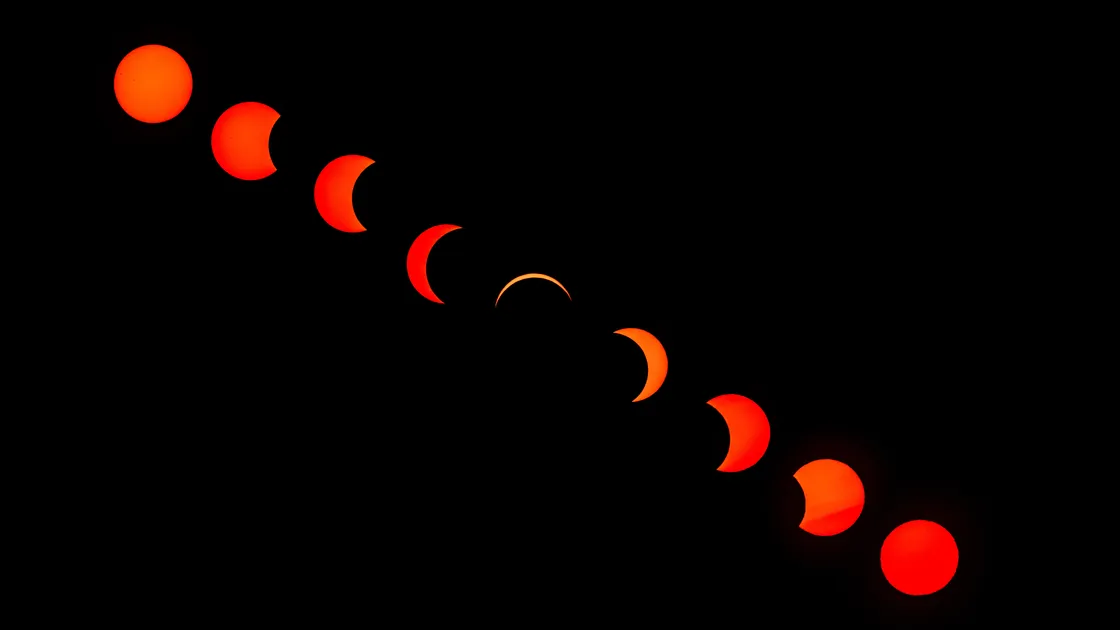
The local photographer said capturing Wednesday’s spectacular solar eclipse was a case of securing a remote spot on the cliff side, quick reactions, and keeping two cameras going at once. And despite the pressure, he was able to savour the unique moment in solitude.
‘I was quite moved when I was photographing,’ he said.
‘Even though I was really busy, leaping from one camera to another every couple of minutes and keeping track of things – it was still a really fulfilling experience. Especially the light change to that eerie quality. It was really special.
‘Sometimes as photographers, we’re too busy to experience the moment for ourselves. But by the time it was happening, I’d settled myself into a reasonable routine. I was completely alone, which was actually quite pleasant. I even took some extra pictures on my phone, just for myself.’
Mr Despres spent several hours preparing for the event before heading to a location virtually below the television mast at Pleinmont, where he scrambled part-way down the cliff with two tripods and two rucksacks of equipment.
‘I actually borrowed my wife’s e-cargo bike so I could load all my stuff and I didn’t have to worry about parking,’ he said.
He arrived at about 4.30pm, well before the eclipse began.
‘I was trying to capture two different views of the eclipse – a wider scenic image featuring people, Hanois Lighthouse and the rocks of Pleinmont, as well as the one that made the front page – a closer, upward telephoto view of the sun.’
The front page image was created by stitching a series of nine images together, which had been photographed on a standard camera with a normal lens, on a fixed tripod.
‘There was no special astrophotography equipment for that,’ he said.
‘I was manually reframing the composition because the sun moves surprisingly quickly through the frame. Every 20 seconds or so I was having to reframe the picture for the next shot, so that the sun was in the same place. I had to work out the timings and make sure the distances were equally spaced. I was taking multiple shots between transitions. But for a composite like that, if you had too much information, I think you’d lose the impact. So I thought nine images worked out about right. I then had to quickly cycle home, and get it all ready. I was done by about 11.30pm, just in time for the paper’s deadline.’
Even with all his preparation, however, there were challenges.
‘One of the cameras started behaving a bit erratically,’ he said.
‘The wind definitely was affected as the sun was obscured. Even things like cable releases blowing around, and the lens vibrating on the tripod. So I had to be really careful and take off the straps so that things didn’t flail around with the wind.
‘The seagulls were quite active at one point, making a fair bit of noise, but then they settled down and thankfully were never in the way.’
Mr Despres said the changing light was what really caught his artistic eye.
‘It was an incredible colour, a very unique quality, and the cliffs behind me looked gorgeous,’ he said.
‘It was a magic experience, and I’m so glad the weather was so perfect for it. That it was so clear and everyone could really enjoy it. Hopefully it’s going to raise interest in everything that’s out there, and the science of it all.’
The photographer, who has been interested in snapping the stars for decades, said his fascination with astrophotography had grown over time, particularly the past 10 years. He has previously photographed lunar eclipses and another solar eclipse last year, which he described as ‘a bit of a practice’ for this year’s event. Seeing his work on the front page was a particularly rewarding moment, he said.
‘That was absolutely marvellous,’ he said.
‘A real surprise.’