
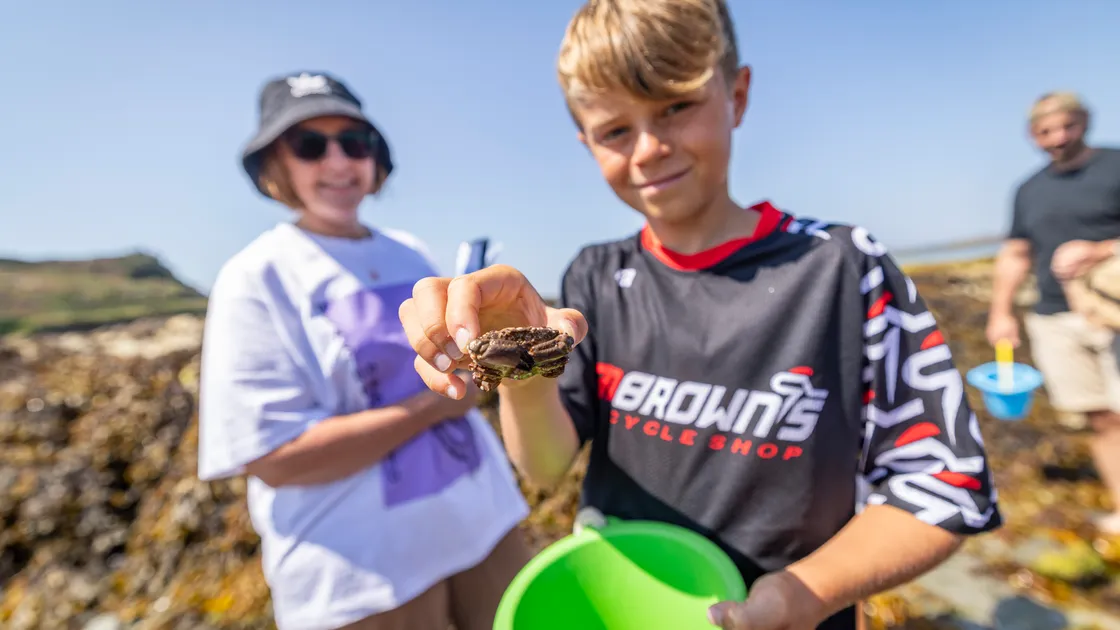
‘We’ve been doing crab surveying around the island for around five or six years,’ said Sarah Allez, La Societe education conservation officer, and co-organiser of the crab surveying event alongside Becky Ogier.
The surveying is a particularly important activity for the organisation to carry out as crabs are easily affected by warmer seas, human activity and the introduction of invasive species.
Therefore, monitoring their population levels can help paint a broader picture of how Guernsey’s waters are being impacted by these threats.
‘We actually refer to them as “indicator species” because they can tell us so much about the state of our coastal environment,’ said Miss Allez.
While not all of La Societe’s crab surveying sessions are designated as child-volunteer events, this summer’s session was integrated into its junior events programme.
‘We run lots of junior events to try and get the kids to connect with local nature and learn a bit about the environment, and crab surveying is just a really inclusive way for them to get some hands-on experience with native species in a way that doesn’t hurt the wildlife.’
That hands-on experience involved rolling over rocks and carefully putting any crab found into a bucket. The crab’s species, size, sex and condition were then recorded before being placed back under the same rock it was retrieved from.
Dallas Priaulx, aged six, secured a good find early on in the day after catching a large, native male shore crab.
‘It feels soft,’ she said while gently touching its back, which had just been shed of its shell in readiness for a growth period.
Also finding a native species was 11-year-old Hugo Johnson, who attended the event along with his younger siblings Henry, 6, and Harper, 4.
He spotted a female Montagu’s Crab down by the shoreline.
‘She looks healthy, but apparently she’s due a shed,’ he said.
The native findings were a particularly welcome sight for La Societe.
‘We’re hoping to spot a lot of native species when we do the surveys, and not so many non-native or invasive,’ said Miss Allez.
‘Finding non-native species is not necessarily a bad thing. They’re crabs that are extending their natural reach to us as our waters get warmer, rather than being introduced into the environment by humans like invasive species are. But we still want to keep an eye on their prominence and make sure they don’t out-compete our native species.’
All data collected by the children’s surveying across the day is due to be handed over to the Guernsey Biological Records Centre and integrated into local records to help with future monitoring and conservation efforts.

You need to be logged in to comment.