

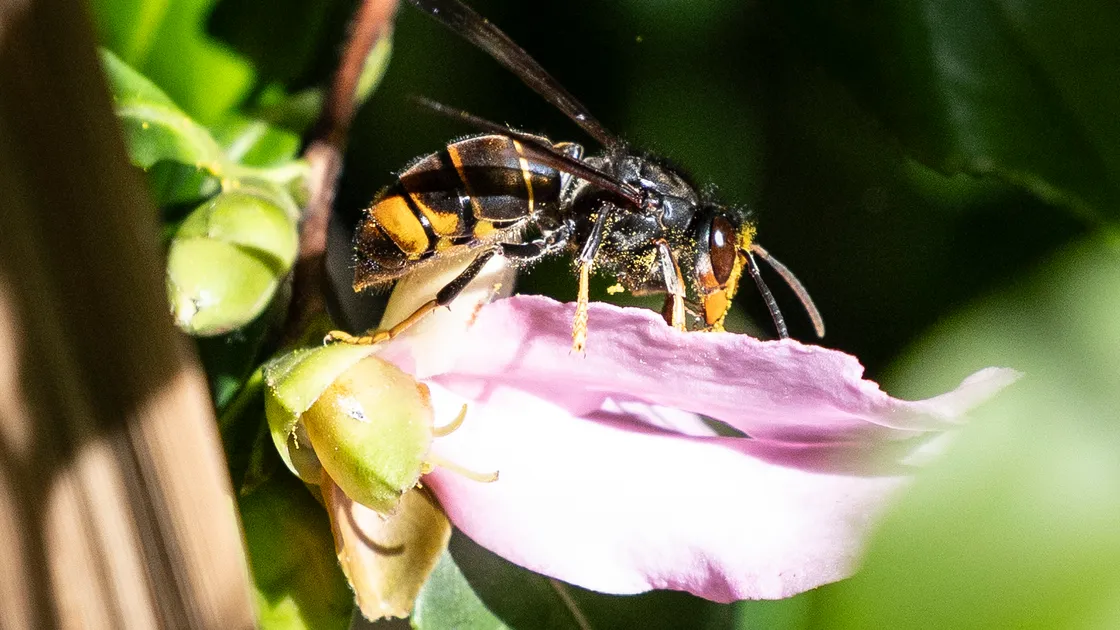
This summer there has been an increase in the number of nests found both in Guernsey and Jersey. Invasive non-native species policy and co-ordination officer Annelotte Baas-Jehan said that complete eradication of Asian hornets was not realistically achievable now they are established in nearby regions.
In Guernsey 204 queens were captured in spring, compared to 80 in 2025.
‘If Asian hornets remain established in nearby regions, as has been the case in France for a number of years, complete eradication is not realistically achievable because new queens can continue to arrive each year,’ she said.
‘However, sustained annual management can keep populations at very low, manageable levels. Guernsey’s strategy to this species is kept under review, which has led to new technologies being applied in the attempt to minimise its potential impacts on pollinators, beekeeping, and public health.’
Jersey’s environment minister Senator Mary Le Hegarat has said the same thing and that resources now must be focused on managing the impact of Asian hornets. She said the invasive species was now a pest problem that Jersey would need to live with and efforts to curb numbers must focus on nests that pose the greatest risk to public safety.
In Guernsey the Asian hornet strategy has two main phases reflecting the species’ biology and how it arrives in the island.
‘In spring, queens emerge from hibernation and begin foraging to rebuild their energy reserves before establishing primary nests. These queens may have overwintered locally or arrived from nearby jurisdictions. By removing queens before they establish colonies, we can significantly reduce the number of nests that develop later in the season,’ said Ms Baas-Jehan.
To support this, Guernsey has an island-wide spring queen trapping network. Approximately 280 modified traps are deployed at 500m intervals across the island and are monitored daily by volunteers. The traps use a liquid attractant to target hornets, and any non-target insects are released.
‘During the summer and autumn, queens remain within their nests while colonies expand and can grow to many hundreds, and sometimes thousands, of workers. At this stage, worker hornets become highly active in searching for food. Asian hornets typically forage within 1-2km of their nest and often travel repeatedly between food sources and the nest along consistent flight paths.
‘This is when public reporting becomes particularly important. Reports of hornet activity, sometimes accompanied by information on flight direction, provide valuable clues that help locate nests. Once found, nests are treated and removed, preventing the production of new queens that would otherwise overwinter and contribute to future populations.’
Press photographer captures Asian hornet
Press photographer Peter Frankland caught an Asian hornet himself recently – while he was waiting for the Royal Court to head through town to the Town Church.
‘I was killing time waiting for Chief Pleas to begin their procession from St James and had positioned myself in a 2m-wide shaft of sunlight illuminating a section of the wall along St James Street. As I sat there, I noticed a large insect in my peripheral vision and turned to have a closer look,’ he said.
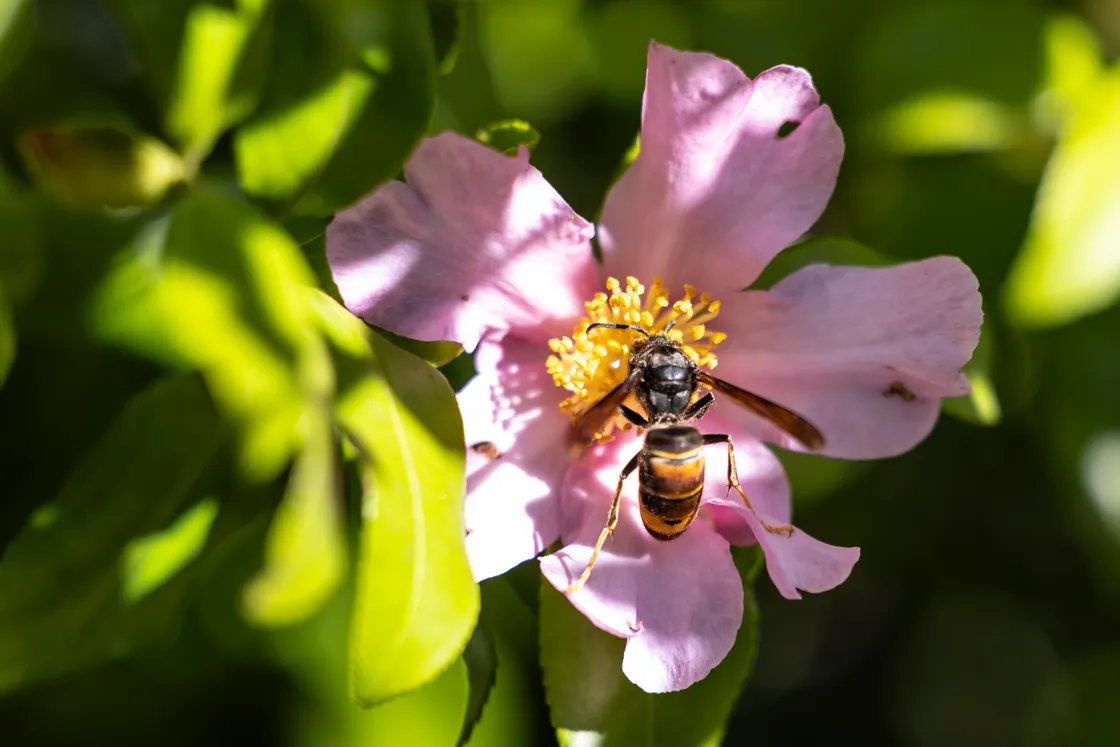
‘I want to say I recognised this beastie straight away as an Asian hornet but the truth is that the only thing I was sure of was that it looked way too big to be a wasp. I took some pictures as it darted from flower to flower and then did a quick Google search to see if I could ID it myself. I couldn’t.
‘When I got back to the office I sent the pics to the States Asian Hornet team who quickly got back to me to confirm this was indeed a Vespa velutina. It turns out that at this time of the year you may see them around camellias, fuchsias, mahonia and bottlebrush bushes where they feed on sugary nectar.
‘Hopefully my sighting will be of use to the States’ team but if nothing else it’s bolstered our archive of images of these invasive creatures for future stories.’