

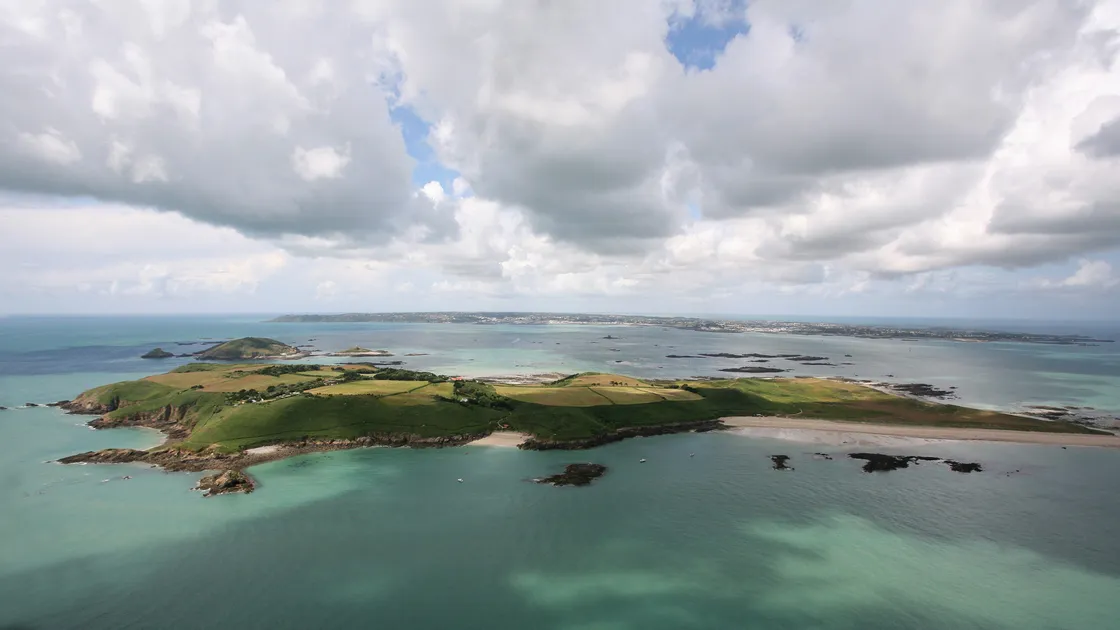
‘It's been an interesting exercise, a real eye-opener, and we think we can help with some practical proposals.’ A few of the comments from members of the Bailiwick Commission when I met them yesterday, just a few weeks before their initial report is due to be unveiled.
I confess that the task facing the commission fascinates me. Perhaps that’s not surprising having, at various times, been politically responsible for nearly all of the ‘transferred services’ under the 1948 Agreement between Guernsey and Alderney. So, when I was offered the chance to sit down with Sir Bob Neill, Dr Lisa Cameron, and Lord Carwyn Jones, I leapt at the opportunity. But I have a confession to make. I certainly envy them their work, I’m impressed with their credentials, but I can’t help feeling a tad cynical whether anyone can produce proposals which all three islands will embrace.
After all, the interests of the parties are pretty divergent. Except, of course, that it’s in everybody’s interest to see strong and resilient communities in each of the three islands. It is very much to be hoped that desire will be enough to overcome any individual insular agenda.
Certainly the commissioners are optimistic on this point.
‘Well, we were set up by all three territories because all three were willing to buy into it,’ said Sir Bob.
‘We will be making recommendations, which we can’t compel them to accept, because of their independence, but they will be evidence-based. We also hope they will be meaningful in terms of the issues people face in the islands, so we hope that the three jurisdictions will take them on.’
So what are the issues people have been sharing with the commission? Connectivity, the cost of living, healthcare, education, and the need to retain young families within our communities, have all loomed large. Another big talking point has been the financial relationship, particularly between Alderney and Guernsey – an issue which the commission believes may generate a great deal of misunderstanding.
‘There is a lot of hearsay and we want to provide some transparency,’ they said.
‘There seem to be different views on what the financial transactions actually are. Certainly in Alderney there is a debate about what the 1948 Agreement costs and how much they get back in transferred services, so we want to provide more clarity on that.’
Perhaps unsurprisingly, there has been stronger interest among the populations of the smaller islands than there has been in Guernsey – not least because the impact of the relationship is proportionally bigger in those communities.
And in some cases, issues like maintaining population levels, and holding on to younger islanders, can seem nothing short of existential matters. These are the sort of things which the commissioners have listened to carefully.
They stress their task hasn’t just been an academic one, considering the technicalities of the islands’ constitutional links.
‘We are also looking at the operational and economic links between the three islands, and therefore job availability. How you can actually develop what economic strength there is between the three islands, rather than just one. This is an important part of our work.’
The commission accepts that to get its initial report out by the end of next month is going to require some intensive work, but its members believe it can be done.
I may be proved wrong but I doubt that first report will contain any detailed proposals. Rather it is likely to highlight the areas the commission believes need addressing in greater depth in its final report a year later. No doubt the reaction – in all three jurisdictions – to the initial publication will guide them over what may or not be achievable at the end of the process.
Personally I hope that all three islands are willing to cede a little of their own interests in order to create the conditions required to advance our collective interest. We may or may not like everything the commission suggests, but they are right to point out that they are entirely independent, with no axe to grind.
‘We came into this with no preconceived ideas. I think it has been an incredibly useful exercise, for the public as well as ourselves, as we tried to identify what the relationships really looked like within the Bailiwick,’ they said yesterday.
‘We started from 1204 and went forward from there. It is important for the population to understand what the relationships really look like, rather than what people think they look like.
‘We know it has been this way for a while but there may be ways that things can be done a bit differently in future to benefit the whole Bailiwick, while of course continuing to respect the autonomy of the three different jurisdictions.’
Call me a political and constitutional anorak, but I am really looking forward to reading this outsiders’ view of the relationships with our Bailiwick family.


You need to be logged in to comment.