

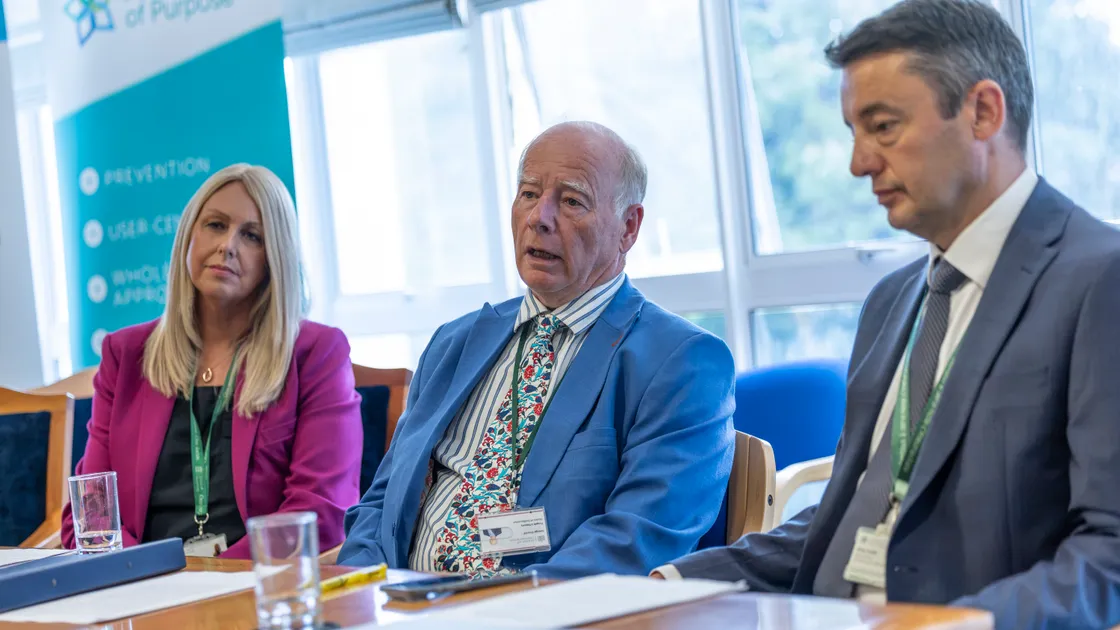
Deputy George Oswald acknowledged that the new Critical Care Unit and Post-Anaesthetic Care Unit at the Princess Elizabeth Hospital were ‘not over the line yet’, having been built but not yet opened after fire-stopping concerns were identified in 2024. Remedial and additional works are still being carried out.
‘The time delays are unfortunate,’ he said. ‘But we saved ourselves. We dodged the bullet there. If we had commissioned the project earlier without remediating the fire safety issues, we would have essentially commissioned a building which would have been unsafe.’
The original phase one construction contract was a fixed price arrangement at £34m., and Deputy Oswald said the work had come in ‘just about within the budget’. However, additional works identified during investigations into the fire safety problems are the States’ responsibility, he said, and are expected to cost about £3m. The official forecast puts the overall cost of phase one at nearly £40m. A further £485,000 of costed risk remains relating to unresolved non-fire defects.
Asked how much more the project could have cost without the protection of the fixed price contract, Deputy Oswald declined to speculate.
But he said that despite the problems and delays, islanders would ultimately get an impressive facility.
‘When the wards eventually open next year, it is a fabulous facility,’ he said.
‘It is really state of the art, and Guernsey will be proud of the work that’s been done.’
Interim HSC chief executive Theresa Cope, who has worked in a number of critical care units over her career, described it as one of the ‘nicest, more well thought-out units’, both aesthetically and in terms of delivering care.
Deputy Oswald also confirmed that not all of the originally scoped work within the Electronic Patient Record programme has been completed.
And rather than continuing, HSC has agreed to transfer the residual projects to the States Digital & Technology team to carry out a rolling programme of improvement.
‘Of course I trust gov.gg to deliver it,’ he said.
‘I can’t pretend it’s going to be an easy programme, and it will need extra resourcing, which we’ve identified. And it will be delivered in bite-sized chunks. So hopefully, we’ll actually get an achievable product on the table much quicker than we would otherwise if we try to save the whole lot at once.’
He explained that its original specification, set 10 to 12 years ago, had been hospital-based only and was never intended to reach the community. Primary care had since set up its own system, he said, and the next phase of work would focus on improving communication between the hospital and primary care systems, rolling out to community pharmacies ‘in due course’ and linking into the NHS spine.
Deputy Oswald confirmed that he now expected to face two Scrutiny hearings before Christmas, one on each project.
‘We have almost bared our souls in public about these areas which are of significant public interest and of generally significant discussion on social media,’ he said.
‘We have laid out the facts that face us. We have laid out the reasons why we come to decisions we’ve made, and we’ve laid out how we’re going to try and tackle these in the future. And hopefully, that will build public confidence in an area where clearly public confidence has been lacking to date.’
Though disappointed at the collapse of Phase 2A at the PEH, he said he continued to look forward.
‘I’ve been in healthcare for over 40 years,’ he said.
‘I’m more used to being faced with issues of we want to deliver, and not being able to because of resourcing. To be fair, this is a different order of magnitude. But it’s a challenge. And this is what we’re here to do, and we will do it.’