

Readers of a certain age will recall the stereotypical trade union leader as a slightly overweight, middle-aged, macho man with tub-thumping rhetoric moulded by decades in the workers’ movement.
It would be difficult to imagine someone further away from the stereotype than Laura Bichard, Unite’s regional officer in Guernsey, who freely admits that she was unaware of trade unionism until well into her 20s and was originally a hairdresser, not typically a heavily unionised trade.
Her unusual story is one of the reasons I had been meaning to set up a longer interview with her since she started in the role last year. Another is that I have a soft spot for the union movement and was once, while working at the dairy, a member of Unite’s predecessor, the Transport & General Workers’ Union. I was also interested to know more about the role today of a very long-established trade union – the T&G was formed in 1922 – in a modern, capitalist economy on an island in which it can often seem that the only acceptable left-wingers are wide players in Tony Vance’s midfield.
Laura is the most senior of two staff employed by Unite in Guernsey. The union also has nearly 50 representatives – shop stewards in old money – in workplaces across the public and private sectors. She says the union has ‘a few thousand members’ in the Bailiwick, which sounds like more per capita than nationally. There is a similar set-up in Jersey, although one difference is that Unite has a formal and well-developed relationship with the political party Reform Jersey, quite unlike the frankly still tenuous links between the union movement and deputies in Guernsey.
‘I enjoy the diversity of the work,’ says Laura. ‘One day I could be representing an individual member who has challenges in their workplace. The next day I could be in wage negotiations with the States. The day after that I could be with workplace representatives building a campaign around an issue that matters to them. I have to be able to adapt at short notice and, in a range of ways, make sure that members’ voices are heard and their concerns are addressed. The most rewarding part is being able to give people a voice who are not comfortable speaking up or who feel they are not being heard.’
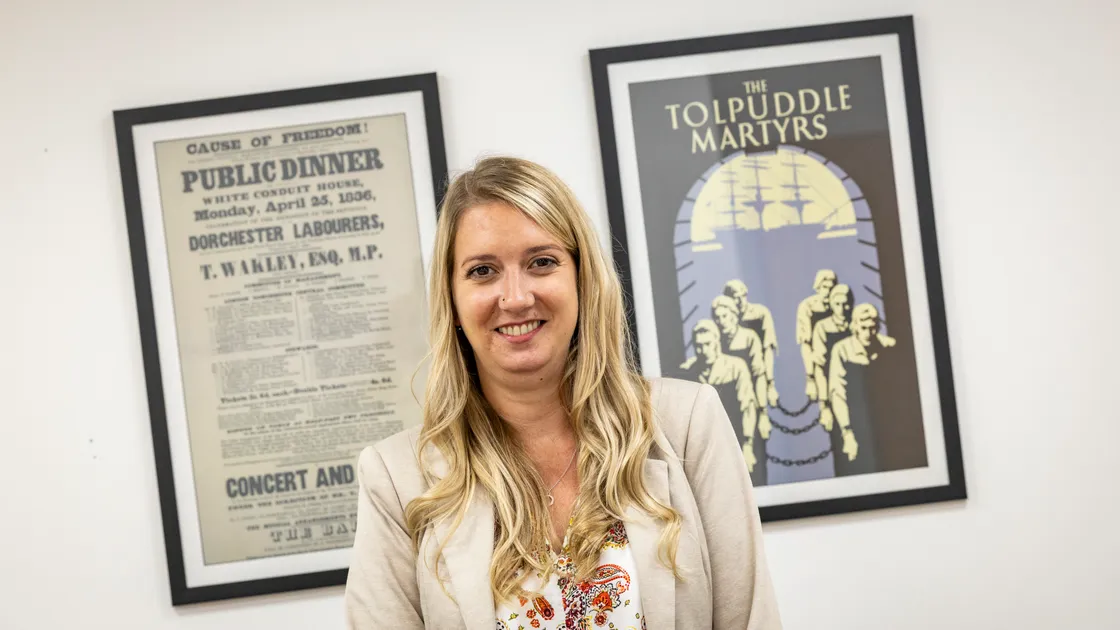
We are speaking in Unite’s small offices at Commercial Road, off the Bridge, which they call Transport House, a name shared with the offices of many other branches and the T&G’s long-time headquarters in London, which also housed the Labour Party for much of the 20th century. Hanging on the wall is a poster commemorating the Tolpuddle Martyrs, six agricultural workers from a village in Dorset who disputed wage cuts which had reduced their income to near-starvation levels in the 1830s and were transported to Australia for breaking an obscure law used to crack down on organised labour.
In the years after that, trade unions played arguably the key role in securing paid holidays, two-day weekends, workplace pensions, the minimum wage and maternity leave. Of course, there are examples of trade unions behaving irresponsibly and self-indulgently, as businesses and governments and other organisations do at times. Winston Churchill, no less, said of them: ‘The trade unions are a long-established and essential part of our national life. We take our stand by these pillars of our British society as it has gradually developed and evolved itself, of the right of individual labouring men to adjust their wages and conditions by collective bargaining, including the right to strike.’
The basis of trade unions is solidarity and collective strength – the belief that as capital organises, so must labour. Members pay a few pounds a month to join together to protect and improve their working conditions and benefits.
Much of Laura’s time is spent on casework, representing individual members, far away from the public spotlight. ‘99% of the time when a member comes to us there is something going on which could potentially damage their livelihood or wellbeing,’ she says. ‘It could be somebody who is being bullied in the workplace or somebody accused of doing something that they haven’t done, or it could be a whistleblower. In my role as a regional officer, I don’t tend to step in unless there is the potential of a significantly detrimental outcome. If, for example, there was a gross misconduct case or an appeal, I would step in at that point. But we have about 48 workplace representatives who are trained to a very high level.’
One part of Laura’s role – wage negotiations – is often more public, not least because of their effect on the public purse and the interest of journalists like me who are often asking union leaders for the latest developments in their talks with the States which, like painting the Forth Bridge, seem to start again as soon as they’ve ended.
‘Initially, I will contact the representatives of the pay group concerned. We will then discuss the best way to approach all members to make sure that we hear as many voices as possible. Occasionally, we’ll do a survey asking members exactly what their aspirations are. We will then build our pay claim, which will be agreed by the relevant representatives’ committee, and submit it to the employer with a request for dates to meet to begin meaningful negotiations. There is always a period of discussion in the majority of workplaces where we have good working relationships and established processes.’
Public sector wage negotiations for 2027 were initially meant to start in the first half of 2026 but have been repeatedly pushed back. Many Unite members have deals due for renewal in January and, when we meet, Laura is increasingly concerned that a new agreement will not be in place by then. This has become a familiar complaint. Since the end of a contentious, three-year deal post-Covid which, perhaps by chance, provided wage rises broadly in line with inflation over that period, annual agreements with the States have often dragged on well into the following year, leaving many lower-paid workers struggling to keep up with accelerating inflation. This year, manual workers, for example, waited until October for a pay rise due from the previous January, and beyond the time when negotiations should have moved on to the deal for 2027.
‘I wish I knew the answer,’ says Laura, when I ask why pay talks seem to be taking longer to start and conclude. ‘It’s really frustrating. I feel the frustration of our members who are often waiting a substantial amount of time, and it shouldn’t be that way. It appears to be taking longer each year. Unfortunately, I think the members are getting used to things taking longer than necessary and perhaps a lack of meaningful updates.’
Campaigns are another important part of Laura’s role. On the day we speak, the Guernsey Press is about to break a story about the fire station at Alderney Airport, which was evacuated after asbestos was found in dust and debris inside the building. Understandably, Laura wants to comment because the firefighters at the centre of the scare are all Unite members, and unions have campaigned hard about the grave risks of asbestos in the workplace.
Other recent campaigns have involved prison officers, for whom Unite has sought public support in their bid for improved conditions after a lengthy period of declining industrial relations, which recently included a withdrawal of goodwill and effectively a work-to-rule policy, and dozens of staff at the ambulance service, for whom Unite has won a recognition deal, which essentially means that it will be the sole representative over pay, terms and conditions, including working hours and annual leave.
Laura says she is planning ‘some other campaigns for the next year or so’ but declines to reveal details until they are more developed.
Hairdressing is, to say the least, an unusual route into leadership in the union movement. ‘From a very young age, I always wanted to be a hairdresser, and I lived out that dream for about 15 years.’ When an injury forced Laura out of her first trade, Unite was looking for a part-time membership services administrator, a job she got despite very honestly admitting at her interview that she didn’t really know what a trade union was. She was soon developing her skills, increasing her hours and taking on more work.
‘I was undertaking individual representations as an accredited support companion and some organising work, going out to workplaces, meeting members, understanding what their issues were. I already had a training qualification and off the back of that there was an opportunity to take over tutoring our representatives across the Channel Islands, which I did for a few years.
‘When the three-year deal was done with the States, it wasn’t straightforward in the way it was presented. One of my predecessors as regional officer gave me the opportunity to understand how to explain it, and I would go around to workplaces explaining it to groups of members who were really quite heightened in their emotions about it, making sure they understood exactly what it was before they made that very important vote on the ballot paper.’
Laura was made regional officer – the most senior job at Unite in Guernsey – nearly two years ago. She was the first female regional officer in the Channel Islands, she says, beaming. ‘It is really important to me. I’m very proud that I’ve been able to achieve what I’ve achieved. Coming in as a young, blonde female with the level of responsibility that I have, I think there is still an element of misogyny. I’ve had some nasty comments, but thankfully my skin is thick.’
Nationally, union membership has been falling for decades, largely as a result of economic changes, not least the decline of heavy industry. From a peak of more than 13m. in the 1970s, unions now have about 6.6m. members, between a fifth and a quarter of the workforce. But that number rose by nearly 200,000 last year. Laura says that Unite membership in Guernsey has also grown in recent years and is still growing.
‘In the past couple of months, two workplaces have joined en masse. Perhaps groups of workers see what we can achieve for other groups and identify where we could help and support them.’ A significant proportion of members are public sector employees but Unite is represented across the labour market – in service industries, the medical profession, law and the finance industry. Unsurprisingly, Laura says there are considerable differences between negotiating with the States and negotiating with private businesses.
‘In the public sector, we have to deal with wider organisational structures, established policies and procedures, and decisions that can be very often influenced by budgets and political priorities. And often the people you’re negotiating with don’t necessarily have the authority to make final decisions for the employer.’ There was a time when deputies were very involved in pay talks, but in more recent years some committees have tried to remain more at arm’s length, much to the frustration of Unite and some other unions. Laura has asked, thus far without success, for pay talks directly with a political member of the Policy & Resources Committee.
‘In the private sector, pressures can be quite different. Employers may need to respond quickly to changes in business circumstances and decision making can sometimes be more direct. If I’m dealing with a smaller business over here, talking to the people with autonomy and authority to make decisions, we can go backwards and forwards and negotiate in a few hours. It is much more straightforward.’
Arguably the toughest part of Laura’s role is keeping employers and union members sweet at the same time. Or, as she more diplomatically puts it, ‘balancing the needs of the membership with the realities of the workplace… balancing expectations while pushing for good, sustainable outcomes for our members’. She says that depends partly on maintaining good relations with employers as well as within the union.
That sounds much like a political role, and I remind Laura that some of her predecessors have indeed gone on to stand in deputies’ elections. ‘No, not for me,’ she says quickly. ‘Well, maybe ask me again in 10 years.’