

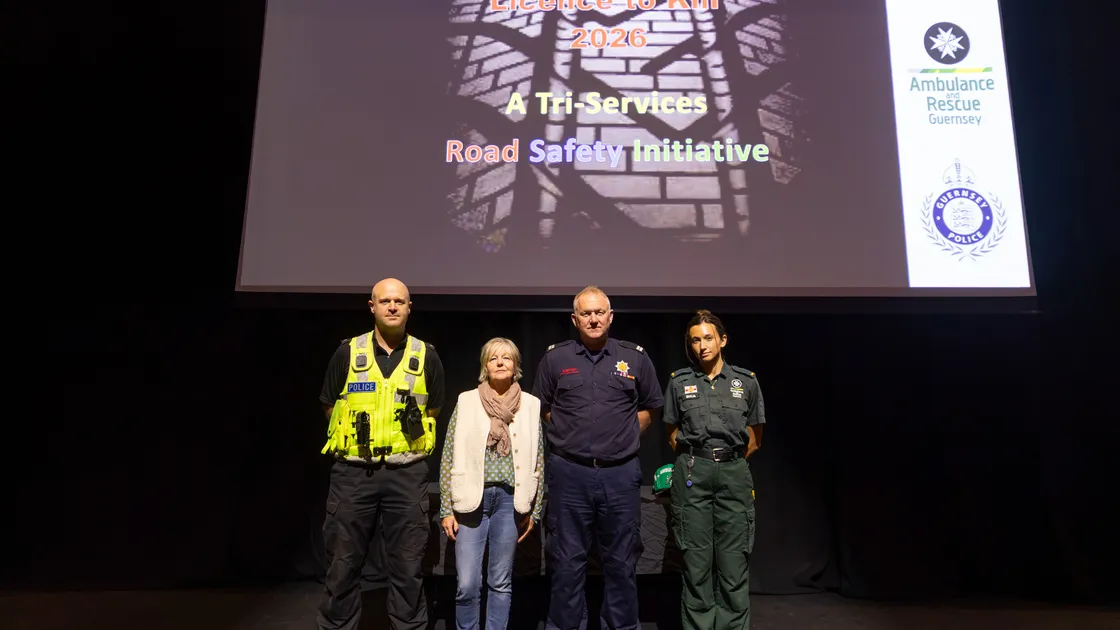
Licence to Kill is a tri-service initiative produced by Guernsey Fire & Rescue Service, Guernsey Police and Guernsey’s Ambulance and Rescue Service.
Miss Klucznyk was a pupil at The Ladies’ College when she first watched the road safety presentation which shows youngsters the potentially fatal consequences of dangerous decisions behind the wheel.
Using footage of local crashes and first-hand accounts from emergency workers and families affected by collisions, it tackles speeding, drink and drug-driving, mobile phone use and failing to wear a seatbelt.
Now a qualified paramedic with more than four years’ experience, Miss Klucznyk said it was that presentation at school that inspired her career.
‘It wasn’t even something I was considering before going to this talk,’ she said.
‘It was – now one of my colleagues and former boss – who came to talk to us. I vividly remember listening to him talk about the cases that he had personally been to, and leaving feeling totally inspired and in awe of what these people do. Having that privilege to be part of somebody’s potential worst day of their lives, and making it even 1% easier for them – how incredible to be able to do that for someone.’
She went home that day and told her mum she had decided what she wanted to do with her life.
‘I pursued my A-levels to be able to do paramedic science at university. I knew that was my goal all the way.’
Licence to Kill is being delivered to Year 11 pupils this week, with Miss Klucznyk now returning to the presentation as one of the emergency service workers delivering the poignant message.
‘One of my old teachers actually approached me after the talk today and I just couldn’t believe it. It was a full-circle moment.’
Her career has since shown her first-hand why the warnings she heard as a teenager matter.
Road traffic collisions could be particularly demanding for ambulance crews, she said, with several emergency services working together in a fast-moving environment.
‘Quite often you’re the only paramedic there and it’s a lot of weight on your shoulders,’ she said.
And the impact does not necessarily end when crews leave the scene.
‘We have to go home with those images in our heads. It’s something inevitably we do have to deal with as ambulance staff, but it’s something that ultimately can be avoided. It’s not just those who directly involved who feel the pain. If we can prevent it from happening, then we help the community, but we also help the staff dealing with it.
‘I think for young people, you’re learning to drive and you’re turning 18 – when you might be excited to start drinking. That age group is at high risk of mixing the two. And they think “oh it’s Guernsey, I won’t get caught”. That’s why Licence to Kill is so good – we have real life cases of Guernsey to bring it home to them.’
Ambulance & Rescue paramedic and communications officer Jim Cathcart said young and newly-qualified drivers feature in many of the local road collisions attended by the emergency services.
‘You pass the test, you get your licence, but then actually you’ve got years of experience to build up,’ he said.
Speed remains a major concern, while emergency services are also hearing reports of motorists scrolling on their phones while driving.
‘Not just using their phones to talk, they’re looking at their phones, scrolling while they’re driving,’ he said.
‘It’s crazy. It’s almost worse than taking a call.’
The Licence to Kill message is purposely hard-hitting and includes a talk from a mum, who travels from the UK to tell pupils about losing her teenage son in a road collision.
Mr Cathcart described the consequences of a serious crash as a ‘ripple effect’, spreading from those immediately involved to families, friends and the wider community.
For Miss Klucznyk, the message she wants pupils to remember when they start driving is simple.
‘Think before you set off – Am I safe in this car? Is the person driving this car safe to be driving? Is this a good decision?’ she said.
‘If you’re questioning even the smallest amount whether it’s the best decision, just don’t do it. There’s no point risking it.
‘We’ve seen, as ambulance staff, the consequences of those bad decisions – and you can’t take those back.’


You need to be logged in to comment.