
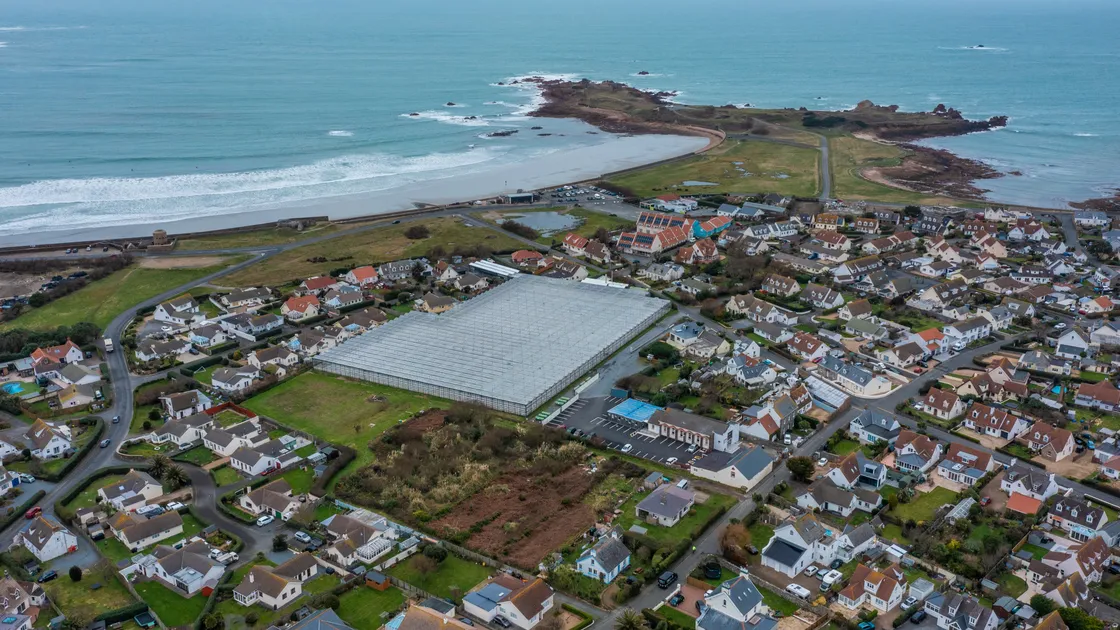
More than 120 people attended at the Douzaine Room and when asked to show their support for the proposals for the zoning of the site, due to be discussed by the States later this month, not a single hand was raised.
The Development & Planning Authority is recommending that the States designate Vazon as a local centre and allocate the redundant vinery for priority, majority-affordable housing, as part of the wider Island Development Plan review. An independent planning inspector disagreed on several points, but the authority said it had reached its own view.
DPA president Neil Inder, who fronted up alongside vice-president Lee Van Katwyk, Housing president and DPA member Steve Williams and two senior officers, told the meeting the inspector’s report was advisory and non-binding, pointing out that 33 amendments went against the same inspector in 2016.
He said the island faced a significant affordable-housing shortfall that needed to be spread beyond the northern parishes, and that the inspector had wrongly treated Vazon as mainly a visitor destination when it functioned as a local centre with a sense of place. Planning officers said the area met 11 of 17 indicators used to identify local centres.
Residents repeatedly challenged that view over the course of 75 minutes. One said the authority was ‘scratching around for facilities’ to justify the designation, comparing Vazon unfavourably with village designations at St Martin’s and Cobo.
Others argued the vinery was still agricultural land and should be kept for food production, citing warnings of food security for the island.
The DPA was pressured more than once over why it would not fight harder to keep what was agreed was still a vinery in good condition for food production, and why more had not been done to attract islanders or businesses to use it.
Deputy Inder said that the site had been offered by its owners, not sought out, and the authority could not dictate how landowners used their land.
It said current policy treated redundant glasshouses as sites for removal, and that it was powerless to designate the site for agriculture without an updated policy from Economic Development.
Deputy Williams said that the land would be sold to restricted buyers – either the States or the Guernsey Housing Association – at well below normal residential value it could attract for private homes, but slightly above the basic land value.
‘There needs to be enough in it to make it worthwhile for people to sell. So a bit more than it’s currently worth, but nothing like normal residential,’ he said.
It is hoped that the Whispers site could realise about 50 homes, mostly one or two-bedroom properties, the area of greatest need.
The housing mix would start at 100% affordable and be fixed in the contract before building, with a minimum of 51% affordable. Deputy Inder said this would be clear before building started.
‘It’s not going to be a fudge and negotiation all the way through.’
On flooding, the authority said drainage issues and the risks of coastal overtopping would be assessed at the planning application stage, with a coastal restricted development area acting as a buffer.
Guernsey Water would be willing to address drainage or infrastructure issues, members said.