

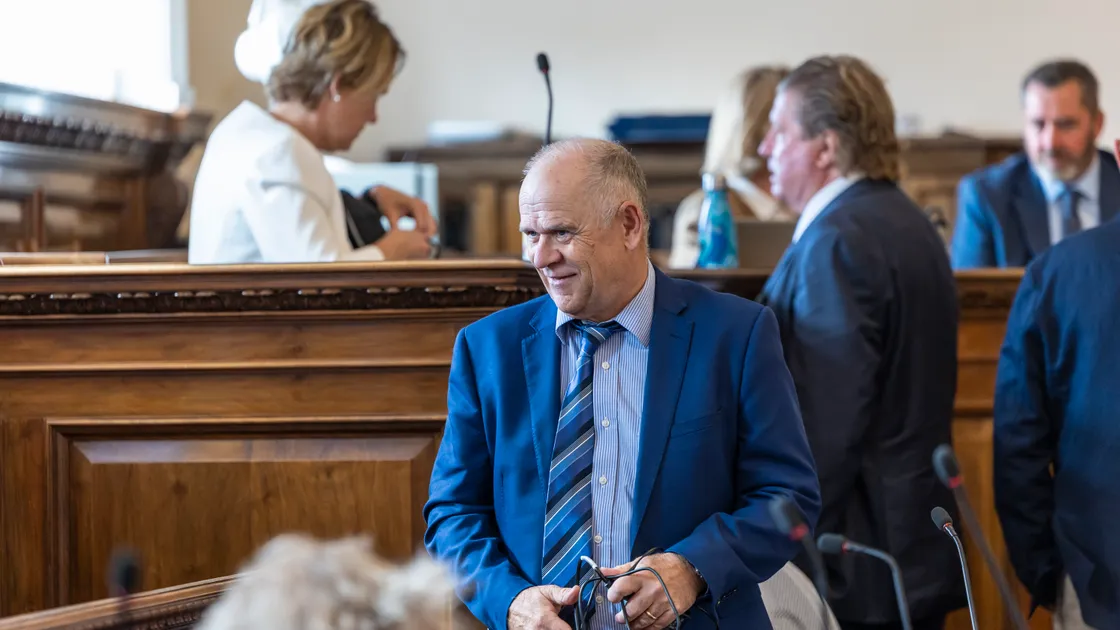
The panel was set up earlier this year, at Deputy Laine’s instigation, and he was immediately appointed to lead it, recruiting several digital and technology specialists from the private sector to work alongside him.
There was initially no member of P&R on the panel, and Deputy Laine said yesterday that he and his colleagues believed that had created an ‘unhelpful air gap’ between them and the senior committee.
‘Subsequently, I contacted the P&R president to state that I was no longer willing to chair the panel, and that a member of P&R should take up the role of chairing. P&R was supportive and a member of P&R has taken up this role.’
The senior committee has appointed its vice-president, Deputy Yvonne Burford, to chair the panel, and Deputy Laine has agreed to stay on the panel as an ordinary member. When the panel was set up, P&R said it would help shape decision-making at the highest level and drive security, resilience and value for money in public sector IT projects.
Deputy Laine said the panel had already carried out important work since members were briefed on the details of the IT risks and challenges facing P&R, which is politically responsible for IT across the States.
‘The first success of the panel was to devise industry-standard reporting designed to be consistent, detailed and strategic on our IT estate,’ said Deputy Laine.
‘The reporting was designed to give the States’ senior leadership team accurate information to form the basis of advice to P&R.’
P&R has started to receive reports from the panel.
Deputy Laine said these reports contained new information backing up advice he had previously given to P&R, which included the need for two senior appointments.
‘My primary, immediate and consistent advice to P&R, even before I was appointed, was to create two technical roles – a chief technology officer and a chief information and security officer,’ he said.
Only the chief technology role has been created and advertised.
‘Both appointments should have a strong engineering background, relevant qualifications and experience. This has taken much longer than I would have liked, but it is progressing,’ said Deputy Laine.
It was revealed late last year that more than £40m. had been wasted by the previous States on two of its flagship IT projects, MyGov and at the Revenue Service.
Chief executive Boley Smillie subsequently published a damning report of the MyGov debacle, which he found had been characterised by weak governance, poor financial control and an over‑reliance on external contractors.
The States revealed last week that it had spent almost £4m. transitioning from the long-running and controversial IT contract with UK supplier Agilisys, which it sacked in the summer of 2025.
The transition project had cost some £3.3m. and more than £600,000 had been paid to lawyers.