

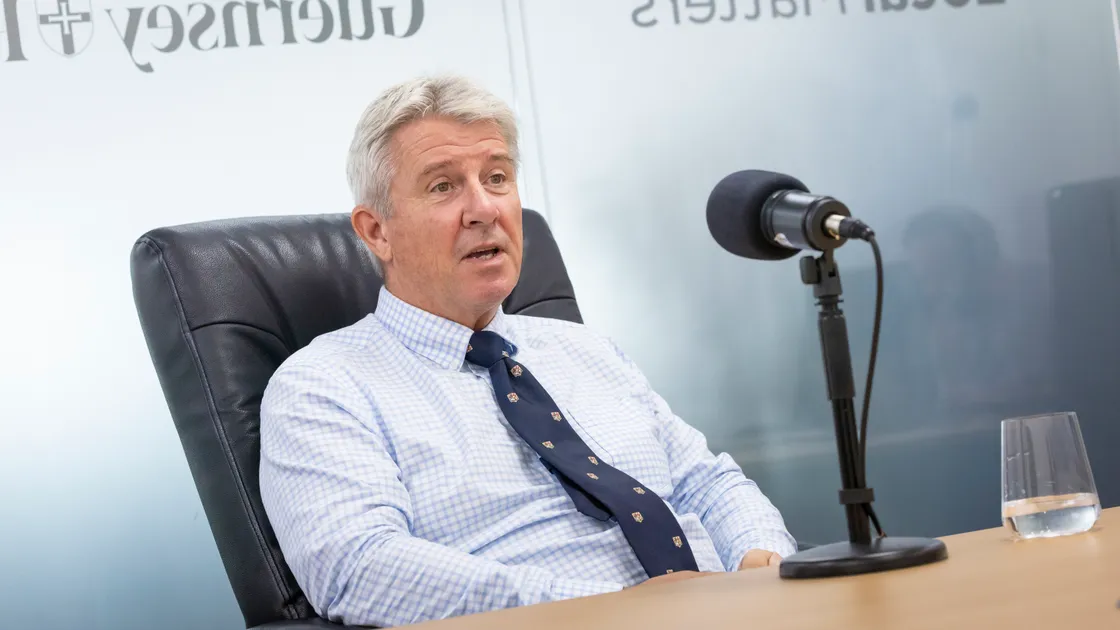
It will be submitted to the States for debate if Policy & Resources shows no interest in clipping the wings of senior officials.
Mark Helyar wants to stop ‘novel, contentious or repercussive’ decisions being made at staff level without the approval or even awareness of committee presidents and members who are later held responsible by the public or media.
He told the latest Guernsey Press Politics Podcast – out today – that he still hoped P&R would lead reform of the relationship between the civil service and politicians, but if not, he would front a requete to force the issue to be confronted.
‘It is drafted, and it will be brought at some point if there isn’t a move by P&R to do some of this. This is P&R’s responsibility to lead,’ he said.
‘The whole of the civil service’s power to administer and run operations devolves from the States and from the people, and therefore we should be in charge of it.
Listen to the full interview with Deputy Helyar on the latest Guernsey Press Politics Podcast
‘Over the course of time, States members will readily see where decisions are being made in which they’ve had no involvement but for which they’re now being pilloried.
‘That’s what happens, and it particularly happens in P&R, because the whole of government is your responsibility effectively. Things are happening all day, every day, and you have no idea what’s going on.’
Earlier this year, Deputy Helyar worked with Deputy Marc Laine on an amendment which directed P&R to publish details of civil service reform being led by chief executive Boley Smillie, and the senior committee has faced criticism for the time it is taking to comply.
Deputy Helyar has told Mr Smillie that he would like that work to include changing the civil service code of conduct to require officials to obtain political approval for decisions and actions which are outside their normal range of activity, are at risk of criticism from the public or have a material effect on the island or residents’ lives.
He expected that such a move would have widespread public support. He also believed it would give deputies more chance of controlling expenditure, which has grown well ahead of inflation in recent years, as part of a new compact with voters, some of whom are now facing the largest increases in personal taxation for decades.
‘I just think we need our chain of command reinforced. The public appoint us to supervise government,’ he said.
‘I don’t want to make a decision about who gets a shed in their back garden or who gets a parking ticket. That’s not where we need to be involved.
‘We do need to be involved when parking spaces are being lost in town. Those kind of things have repercussions for the environment or people’s way of life, and they are things where we should be entitled to have oversight.’
Deputy Helyar revealed that he was kept in the dark for more than a week about the toxic asbestos scare at Alderney Airport which forced the evacuation of firefighters from the fire station, despite being the president of the States Trading Supervisory Board, the committee responsible for the facility.
Numerous samples of dust and debris tested on 24 September returned positive results for asbestos on 5 October, but Deputy Helyar was informed only after the Guernsey Press submitted questions about the incident to the STSB on 14 October.
‘The first knowledge I had of it was being forwarded your email requesting answers,’ he said.
‘That is a really serious one because there is legislation and you can be criminally liable for negligently exposing your staff to a hazard like that. That is a really good example.’
Except for a handful of specialist issues reserved for statutory officials, most decisions are made in the name of a political committee, the members of which are responsible for them.
As the range of government has expanded and become more complex, politicians have delegated more decisions to staff, and some deputies and officials have tried to draw an increasingly firm distinction between policy and operations.
‘Over time a vacuum in governance seems to have developed which has been filled by people making decisions outside of the political sphere, possibly because they couldn’t get decisions made. I think perhaps officials wanted more scope to be able to make operational decisions and so the scope of what is operational has grown,’ said Deputy Helyar.
‘I don’t think it helps our politics either. Certainly in the last States it was very much political personalities fighting each other rather than fighting the system which isn’t producing the results we need. That’s where we need to be focused – on the system, not on each other.’