

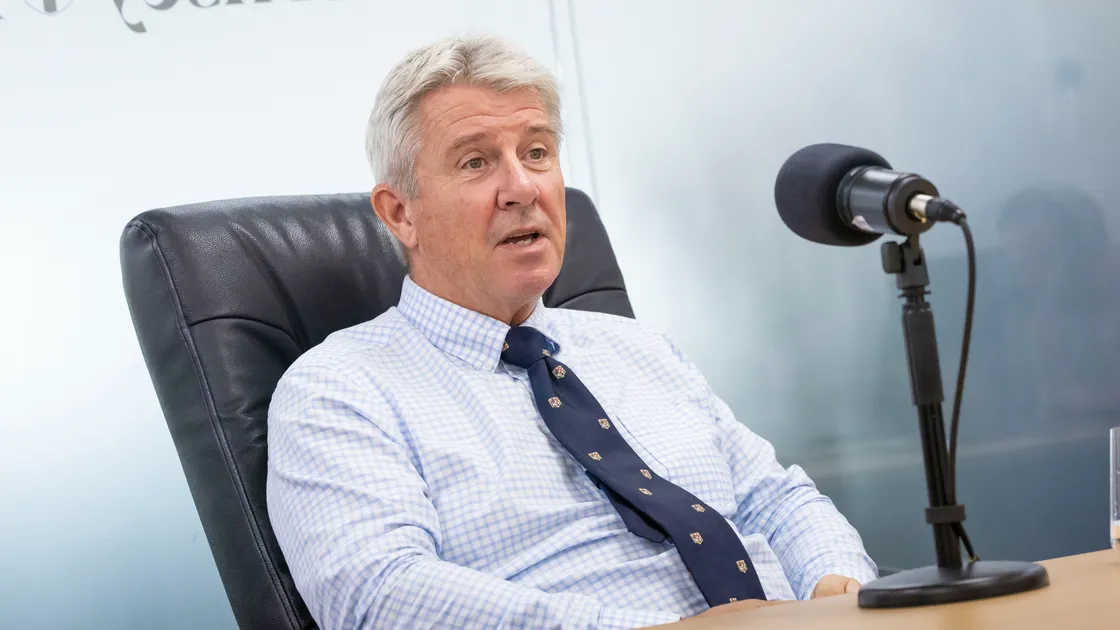
I get the impression that you are enjoying your second term in the States more than your first term?
That’s a fair comment. I’m not really part of a tribe, and although there are some very contentious issues in the States Trading Supervisory Board’s portfolio, it’s not such a political hot potato as leading the tax review at Policy & Resources. The STSB also suits my skill set and we’ve got a really good team of people with lots of experience.
Would you be tempted to go for the presidency of P&R again if there was a vacancy later in the term?
No, I wouldn’t go anywhere near it. I think there’s a lot of misunderstanding about the power of P&R.
There’s no executive power whatsoever, and you’re the scapegoats for everything that goes wrong. Every week there is another disaster to sort out which you hadn’t foreseen coming over the horizon.
You’re reacting all the time. It’s not a very pleasant place to be. I can achieve a lot more where I am.
There are relatively few policy letters going to the States. Does it feel on the inside that this States is taking quite a long time to get going?
I think that’s true and some of it is quite frustrating. At the STSB, we’re cracking on with the stuff we’ve got to do, and as I said I’m not part of a tribe any more so to some extent I’m out of a lot of the political conversations going on.
Does this States feel different to the previous Assembly?
I think it was absolutely right to identify tribalism in the previous States, but it wasn’t necessarily properly identified. I was identified as being one of the tribal people, but I think the people who are now running the government were the tribal people.
They objected then to what must have been sensible policy because they’re now supporting it. Some of the voting in the last term was driven by personalities.
How much progress has the STSB made on rethinking the States Dairy?
It’s a problem that we are asked questions and want to have a discussion before the cake is properly cooked, and this cake is definitely not yet properly cooked.
But there has been progress and it would be fair to say that the STSB and its members completely support the farmers in having an independent solution – an entity not owned or run by government which is able to develop their product and sell it more widely and successfully at a better return for them.
It involves a lot of moving parts, though, including agricultural policy generally.
I would like to see us come back to the States before the end of this term with a definite plan for who is building the dairy, where it is being built and how it is going to be funded.
There are a lot of young people in the industry here who are finding it difficult because of the capital cost of land and we need to be able to support them by smoothing out that financial obligation. There are positive signs that they are joining together to produce something which we can present to the States in due course.
With the Black Rock reclamation scheme seemingly some way off, will you soon have to go to the States with contingency plans for the disposal of inert waste?
I don’t hold out any hope for the Black Rock scheme. Contingency plans are being worked up.
There is stuff in the cupboard which was worked on previously, like the site at Longue Hougue South, and as you know I strongly objected to the policy of using Les Vardes Quarry for water storage and felt we should have used it for inert waste. I’m not actively looking at that again and nor is the board, but clearly nothing is off the table.
The officials say there is a lot more room in Longue Hougue [the temporary stockpiling site] because the rate of inert waste disposal is slowing.
Losses at Aurigny, in which the STSB acts as shareholder, are expected to reach about £15m. across this year and next year. What are you going to do in response to the airline’s escalating losses?
We took a neutral position on the policy around the new Heathrow link. I think the policy has worked – the number of people travelling has gone up, it’s been successful for tourism and it’s strongly supported by the finance sector. What we have said all along is that the Heathrow link is fine, but it will cost money, and the prediction about the effect on Aurigny’s finances was quite accurate.
However, not all of Aurigny’s losses are due to the Heathrow link: there is a big issue in the industry because of a massive rise in fuel prices.
There are other more complex financial issues, like whether you capitalise the repair of engines and things like that, which we’re also looking at. I think there is a benefit to having a strategic asset as an airline but we haven’t calculated what that is.
The airline has been cutting back on its costs and we’ve also looked at how we can help, such as by keeping the airport open later on certain nights next year, which will enable Aurigny to restructure how it uses its aircraft and the number of rotations.
We are thinking very much about what the airline is for, why is it good for Guernsey, and how do we quantify that so that people can transparently see what they are paying for.
The Economic Development Committee is developing a new air policy framework, which we would like to be endorsed by the States, and part of that will be Aurigny’s role and how it is funded. One of the ideas that we’ve thrown on the table is running the airport at a loss instead of the airline and then everybody would get cheaper landing fees and there would be more competition.
The problem at the moment is there is no visibility on where the losses come from or the forces which are causing them.
You led GST-plus in the States but your support at the polls remained much higher than most other deputies who supported that policy. Why do you think that was?
I said firmly in tax debates that we needed to show we could save money and that we needed fundamental reform of government, and I think they were things which people really supported.
Notwithstanding that there is a lot of opposition to GST, there are a lot of people who don’t spend their time on Facebook complaining about things, and they have a view as well as it’s important for there to be people like me to represent those people who understand that we have a problem with public finances.
I still think it was the right thing to do and hopefully people trust me being honest about what I see as the problem.
At last year’s general election you said you would call for the new Housing Committee to organise a public conference to bring together the third sector, builders, developers and the public. What kind of response have you had to that?
I like Steve Williams [the Housing president] and think he’s doing a great job, but he’s battling the same issues we are all battling – the ‘Yes Minister’ approach of a process for this and a process for that and opening another drawer to get out another report.
We really need to batter down some of these obstructions. We have got ourselves into a position where government has become used not to executing anything but just making policy and not putting it into effect. I think that Housing is doing a great job but they’ve got an uphill battle. I just think there are more simple ways of dealing with this, such as providing cheaper finance to developers as a way of getting more things built.
You also said you would propose reviving the idea of building staff accommodation for nurses on the site of the Princess Elizabeth Hospital. Is that being taken forward or have you dropped that idea?
I still think it’s a fantastic idea to build accommodation which the staff actually want on an appropriate parcel of land which would generate rent to pay for itself. It would be totally transformational in a very short space of time.
But I don’t think it would be supported by P&R and it would need their support to get through Planning. It makes perfect sense to me, but it doesn’t make perfect sense to other people, and that’s politics.
You have said you want to see spending growth checked, but when you were P&R’s treasury lead it grew faster than it had for many years. Why did that happen?
One word – Covid. That was the cause of most of the increase. We had a vast re-capitalisation of Aurigny and enormous increases in health spending.
Some of it was meant to be a one-off but has now disappeared in the cracks in the pavement and become operational spending when it was supposed to be extraordinary.
I haven’t had an explanation for why that is. Another thing I’ve been trying to unpack is the increase in the elderly population which is trotted out, and I also trotted out, as an excuse for what is happening with expenditure.
It’s undeniable that when you’ve got more retired people you need to pay out more in pensions. But if you look at increases in spending against increases in our aged population over, say, 70, there is no correlation.
Our spending is going up irrespective of that. The excuse that the elderly are the reason for our rising costs is simply not true. Our costs are rising due to headcount and providing more services. If you want to cut costs in government, you put to one side all the operational people who are doing real work, and you focus on the headcount of those not producing anything operational, and that is where you need to make cuts.
The Treasury lead has no power or authority over anything and is just the person who presents the speech that sits on top of the budget. Until there is power to say ‘stop doing this, those people no longer work for us, we’re not doing this anymore’ then spending is going to continue going up.
Every year the number of people we employ will go up because we’ve got no control over that either and the amount they get paid will go up as well. It’s just an opinion, but the feedback
I get from people is that this is what make them angry. They see a disconnect in the way government money is spent in comparison to the way you would budget at home or the way employees get paid in a real business.
Do you expect the outcome of the budget debate in a few weeks’ time to be an endorsement of whichever option is on the table to allow committees the greatest increase in spending?
If you could sign yourself up to a predictive market and bet on it, you should put money on that.
You only need to add up the committees with higher spending and you’ve probably got 15 to 20 votes automatically from them, so it’s almost inevitable. I will keep trying to argue for spending to be held in real terms because I believe in fiscal discipline and we have to demonstrate fiscal discipline.
I am saying identify all the operational staff, and then take everybody else and just have a 10% cut in headcount. That’s what happens in the real world. You give people early retirement, you don’t replace staff who are going, you move people into new positions, and if that doesn’t work you cut staff numbers. If you want to cut costs you’ve got to cut the payroll because the more people you employ the more stuff they find to do.
We’re never going to get control of spending unless we change the culture.