

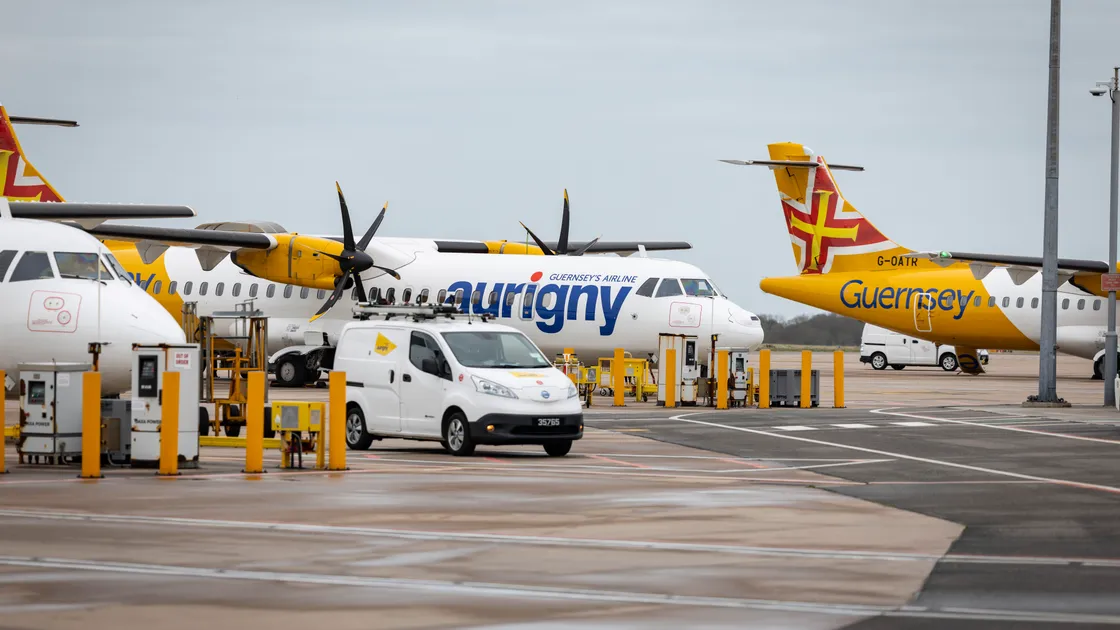
The airline owned by the people of Guernsey is asking the States questions which philosophers have posed since the dawn of time. What are we here for? What is our purpose? What are we meant to be?
Aurigny has been updating deputies on its current position, its challenges, and its opportunities. States members were presented with a mixed picture. On one hand there are the much publicised losses, being driven by a mixture of sky-high fuel prices, and having to respond to a subsidised competitor on its prime London market.
On the other hand, it is being quite upbeat about the opportunities ahead. Helped by more flexible airport operating hours, it assured deputies that it can do more with less, and become more productive.
The message was that, if the States wants it to, it can continue to deliver what Guernsey bought it for. What is that?
Aurigny describes it as guaranteed air connectivity, provided by a carrier whose sole purpose is to serve the islands, rather than to maximise shareholder profits. One which will be there on a wet February morning when the finance sector worker needs a full day in the city. One which will pull out all of the stops to get locals home when travel is disrupted by our unpredictable weather. One which will never even consider quitting local routes because their aircraft or airport slots could make more money by serving another destination.
When I received the briefing which Aurigny had given to States members it was clear that the airline’s leadership team still believed all of these things were important to Guernsey. But at the same time its CEO, Nico Bezuidenhout, stressed that wasn’t really its decision to take.
‘It would be useful in the coming months to clearly define exactly how the island sees the role that Aurigny fulfils, so we can reshape and readjust to the policy framework around us.
‘When we know exactly what the States wants from us we can take stock of what steps we have to take, and also quantify what the cost and benefit of those decisions will be. Then we can all agree how that can be funded,’ he said.
On the question of funding the Aurigny leadership team insists the business could still wash its own face in normal circumstances. It points to the modest profits made in 2022 and 2023 as proof that that isn’t impossible. But they describe the business model, effectively acting as Guernsey’s air connectivity ‘insurance policy’, as very fragile.
As a result the financial performance will always be at risk in a market place distorted by spikes in fuel costs, or having to respond to competitors receiving subsidies from the States.
One of the ways it intends to contain costs is by going back down to five ATR aircraft next year. It took on a sixth when it started to operate some of the routes previously serviced by Blue Islands.
Aurigny says the reason it is able to release it again next spring is entirely down to an agreement with Guernsey Ports to keep Guernsey Airport open later. This allows each aircraft and each crew to be used far more effectively.
On Alderney, Mr Bezuidenhout says they had no choice but to change the operating model in the face of the States of Guernsey reducing the size of the PSO. He insists the switch from Dorniers to Twin Otters, and Aurigny’s partnership with Skybus, were the right strategic decisions, but admits they have yet to deliver an acceptable performance.
‘I fully accept, and sincerely apologise to Alderney residents for the impact on the service’s reliability. We have now taken a more active stance in getting directly involved in Skybus’ recruitment and crew training, because that really is the delay, training newly-joined captains to operate the Twin Otters.
‘But I am happy to say that we now have visibility of both of the dedicated, rebuilt aircraft to be deployed on the route,’ he said.
On European flights Aurigny was clear that there was unlikely to be a return to the wide range of occasional direct flights we saw a few years ago.
It accepts these were popular with many islanders, but says after the launch of regular flights to Paris it took the decision to focus on that destination as its main service into continental Europe.
Aurigny left States members with the central message that 2026 would be a really good year for passenger numbers, but a really bad one for their accounts.
By the end of September it had already carried well over half a million passengers and was heading for record numbers by the end of the year.
But it was still estimating losses just shy of £10m.
In defending its business model in the face of those large losses, it insisted that if there had been no Heathrow subsidy, fuel prices had been normal, and without a couple of one-off costs, it would have returned a modest profit this year.
Pretty big ‘ifs’.
Where will Aurigny go next? Will it continue to need States support? That is really what the airline is asking its owners, because the answers depend entirely on what they want it to do.
The presentation quoted from an STSB statement in the States which simply said: ‘Aurigny cannot be expected to be both a fully commercial carrier and a social utility, and judged as both at once, without that conscious choice being made.’
So it is now over to the States to decide on its air connectivity strategy going forward.




You need to be logged in to comment.