

You’ve yet to decide on a preferred route, direct or via Jersey, but we’re told that the Jersey option [GJ2] could be delivered four years earlier, at a much lower price. So is it really such a difficult decision?
Alan Bates: We’ve kept both in the business case to make sure we understand the value and benefits of both. We’re looking at interconnection, not just as a single investment, but as a strategy for the future. So, while GJ2, the Jersey route, looks optimal at this point, there’s still an opportunity for direct connection to France in the future. Both have their different benefits and disbenefits. GJ2 is quicker, and cheaper, but probably has some nearer-term capacity constraints. When we present the outline business case to the STSB in January it will cover all those factors, but I accept, the preferred route is starting to look like GJ2.
Consumers will say [and they’ll blame the current and previous presidents of STSB] that we’ve gone through quite a few years of real terms increases in tariffs to overcome regulatory issues and historic underinvestment. It hasn’t been popular. Now you’re talking about another maybe 10 years at RPI plus 2% compounded. That’s going to be difficult to sell, isn’t it?’
Mark Helyar: That’s an envelope, based on the modelling. We haven’t agreed that any tariffs will rise at all. Every year the STSB will review the situation. There’s all sorts of moving pieces like global conflict and oil prices and other things that might have an influence. I know it’s not popular, but it’s not a nil-sum game, unfortunately. Doing nothing according to the modelling is actually more expensive, because we’re going to have to replace our plant much sooner, and that’s more expensive.
The policy letter talks about possibly softening the impact of the front-loaded capital costs through an injection of equity into Guernsey Electricity from the States. What sort of sums are we talking about?
MH: We need a bit more time to look at that. It would make the 30-year modelling more favourable. If you really wanted to dream, you could have a sort of Channel Islands grid because that’s what we’re building here. You know, maybe some shared interest, so we can all bear the cost across the whole network.
But Jersey Electricity’s got a slightly different model – they’re 50% privately owned, and I noticed, tucked away in the policy letter, there was a little reference to the possibility of partial privatisation and attracting private cash into the project. How realistic is that?
MH: I’m not advocating privatisation. I think we just have to look at the numbers when we get there, and obviously it depends on what the market thinks about it as well. At the moment, the States is standing behind this organisation because hopefully the financing costs will be lower that way. If we can get private capital to bear some of that risk, while maintaining control in the public interest, then that’s a great outcome. But I don’t know if that’s possible at the moment.
Is the pace of this project being partly being driven by the possible synergies of carrying it out at the same time as the replacement of one of the cables between Jersey and France?
AB: You raise a really interesting point. One of the opportunities we have identified is working in collaboration and partnership with the number two project. Even if the cables don’t go in at the same time, there may be some procurement opportunities with suppliers. But to get to that point we need to start making commitments, probably in the middle of next year. Which is why the opportunity to go to the States this year and get delegated authority is really important.
Isn’t moving to a policy of less generating capacity on-island, from the point you sign a contract, slightly risky? After all, until the new cable is up and running, importing power will still be exposed to a single point of failure.
AB: In reality, we won’t be getting rid of any engines when we sign the contract and move to ‘N minus 1’. But from an investment planning perspective, it says actually you can now start to plan taking one of the existing engines out to put some new kit in, so it’s more of a planning opportunity. We could then take that generator out, probably at a similar time to the cable going in.
The on-island generating plant will be used very differently in a world with dual interconnectors. Does that change the sort of new generators you will be buying?
AB: One of the advantages of increased interconnection is that it really clarifies the role of the power station. At the moment it does base load topping-up over the winter, almost every day of the winter. So it’s kept warm all year. We’ve done a lot of power station tours this summer, and while people see it running in the winter and can understand that bit, they struggle with the fact we have to keep it warm all summer. If you walk into the power station in the middle of summer, it’s ready to go, and that costs a lot of money. When we’ve got further interconnection that role will stop. Instead, it will be about balancing. Balancing the EDF contract by making sure the hedging works really favourably for the island, but also dealing with the intermittent nature of renewable generation. We can manage that through the interconnector, but if the pricing is wrong, we can also use the power station for balancing, using some biofuel hydrocarbon generation, or, more likely, batteries.
The policy letter mentions batteries. How close are we to large, commercial scale electricity storage being a viable option?
AB: It’s getting closer, and the problem is, it’s not a quick thing to install a battery system at the power station. Obviously behind the meter battery storage is increasing quite rapidly on the island, and we’re currently looking at two options. One is the grid scale storage, which is basically putting batteries out into the grid to offset some of the capital replacement for the grid. But we’re now, as part of the generation strategy, considering where batteries fit in terms of power station replacement. So, C station, for example, may be full of batteries in future rather than engines. A decision on the interconnector would give us the time to make the right decision in terms of asset replacement.
It sounds like the mix of plant at the Vale Power Station might be changing radically. Not only the possibility of large-scale battery storage, but also maybe a change from heavy oil for your remaining generators?
AB: Yes. At the moment we’re covering off against the possibility that the cable fails at the start of winter, and you can’t get a repair ship for six months, so you’ve got to run the power station for six months. Therefore you need to use the cheapest product, which is heavy fuel. But if you’re only covering off a French grid network issue, which might be a day, you can use a completely different fuel. That’s where I think there’s opportunity to go to gasoil, which is a lighter fuel, which is brought in regularly by the other suppliers, and also maybe some biofuels. Siting alongside the electricity strategy is a fuel transition strategy as well for the power station.
Might that help with the Guernsey Development Agency’s vision for the whole harbour area?
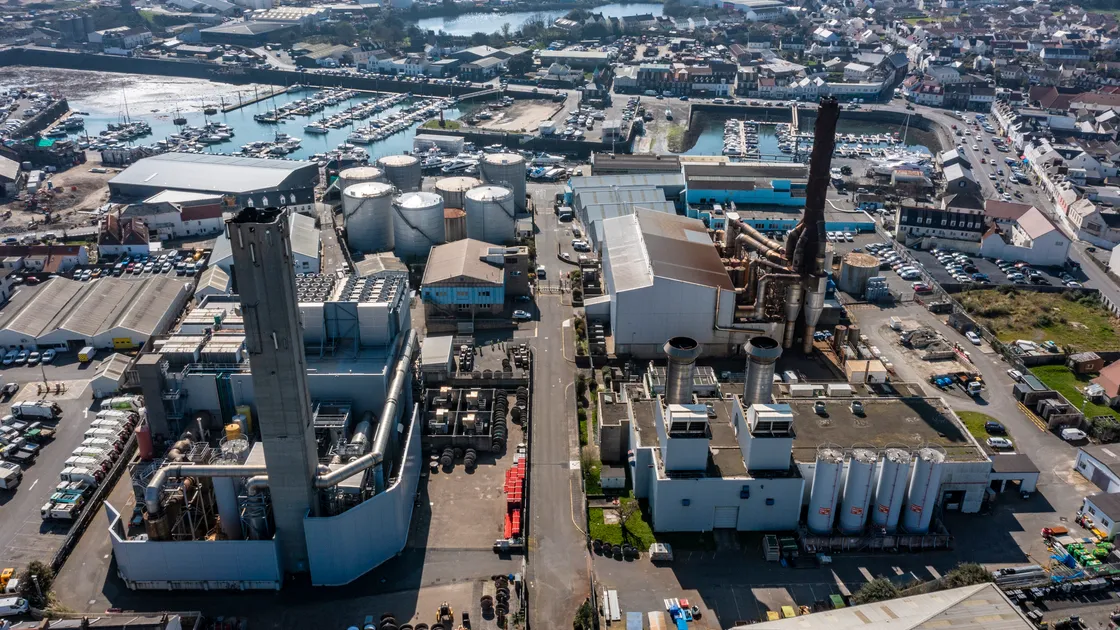
AB: The interesting thing is that the GDA believes the Vale Power Station isn’t in the ideal location. But I don’t think we’ll ever leave the site. There’ll always probably be D station, the control centre, and a lot of the electrical distribution. But, when we come to rebuild a C station, it’d be nice to have an opportunity to build it somewhere else, because if you need some balancing and back up generation, it might be better not to do it in the middle of a small town. Longue Hougue would be ideal.