
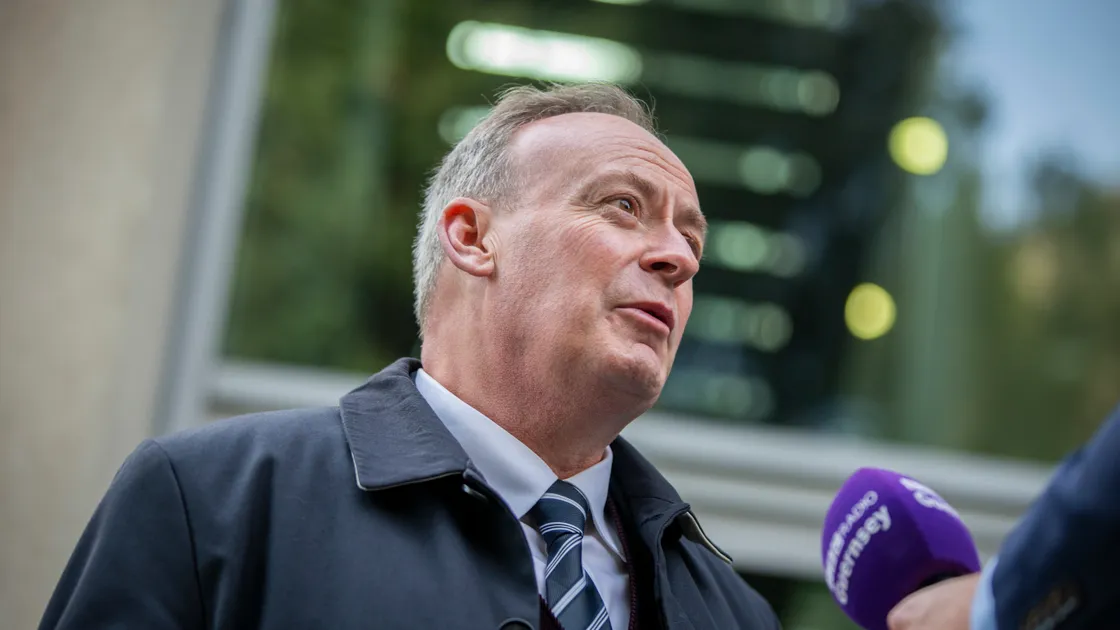
How do you see the Moneyval result being a springboard for supporting the future growth of finance and to the economy generally?
To the international community, who are our clients, the message is a strong one, and it’s that this is a great place to do business, and don’t take our word for it. Take that of international evaluators. This a peer evaluation, this is people who do this all the time who have come to these conclusions. I think Guernsey Finance in particular will do its job in making sure that that is understood by all who are willing to listen.
How do you see the finance sector being able to source the workers and attract the talent necessary to support future growth, to benefit the island as a whole?
Since I became Policy & Resources president in December 2023, I think the States has done everything it can to stimulate housebuilding. We were told by the industry that GP11, was seen, understandably, as being a big headwind. We removed it, but none of the sites that were previously impacted by GP11 have progressed.
There are factors outside of Guernsey that are a genuine challenge, and that has been the case since Covid, then the Ukraine war and its impact on the supply of materials, and that had consequences for global inflation, and house prices and housebuilding costs have risen.
We want our affordability to come down, because it is absurd to see the cost of an average house at 14 times average earnings. The OECD believes that it should be closer to five times, six times than a push, which is how it was when I was a much younger person.
So we’re doing our best, but government is a facilitator. Government shouldn’t be expected to be a provider. It should make the environment within its powers as easy for business as possible. I believe we’ve tried our hardest in 2024.
Do you think net migration of 300 a year is sufficient to meet the demands of finance, public sector, hospitality and society at large, in terms of providing the workers that are needed to grow the economy?
The answer to that question is probably, but not definitely. I mean, I haven’t got a crystal ball, and what has surprised me is just how rapidly we’ve seen the growth in health and social care workers. That is the real problem, and we need a certain number just to secure the looking after of our ageing community.
The numbers employed in financial services have contracted a little bit because it has been very hard in particular for them. Finance employs fewer people than it used to, and people have been employed elsewhere to provide administrative services to the businesses that we do here. I don’t want that. I want these people to live here. But I think to answer your question like, 300 is possibly enough, probably enough, but not definitely.
In terms of infrastructure investment, we’ve been talking about spades in the ground for probably 15 years or so. Do you feel the time is now?
Government has made a few mistakes. We’re not investing anywhere near enough in our infrastructure. That’s obvious. We’ve got about a £1bn-worth of demands, and we’ve got about £150m. to spend.
It’s one of the differentiators between us and Jersey. They have invested far more aggressively in their infrastructure with more to come, where we haven’t done anywhere near enough. Infrastructure is a very important component part of growth, but so is confidence.
Are you confident about the future?
Yes, generally I am, but we do have a particular headwind and that is our fiscal imbalance.
We’re simply not taking enough. We take less tax from our economy than any other comparable jurisdiction. Fact.
We spend less on public services than any other comparable jurisdiction. Fact.
And yet, people understandably want us to stay at the vanguard of the delivery of public services.
If you focus on your resident population, you either tax people through income or you tax them through consumption, or you stop the universality of offerings above a certain income.
I’m convinced as a policymaker that the majority of people would rather pay once within their pay packet than other forms of tax and then and then enjoy the benefits of that process, but that’s not the view of the States.
The States would prefer to tax consumption, and now I’ve thrown my weight behind this. That clearly is the will of this States. If it’s the will of the next States, it will happen. But something material and significant must happen, because we are not bringing in anywhere near enough revenues to sustain our capital investment programme alone, let alone the rising cost of public services.
How big a role do you think the private sector could have to play in filling that fiscal gap?
If I had my way, it would play the dominant role as I genuinely believe in small government. I think that government should only do what it’s good at and leave the rest to the experts.
But let’s be frank, that hasn’t happened. There’s been all sorts of headwinds for local businesses.
Many colleagues would very much like us to extend the runway, but the only people who will make that investment will, regrettably, be the public sector, because as a business proposition, the extension of the runway isn’t particularly attractive, to say the least, because the airport is loss-making. So there are some aspects of public sector procurement where the public sector has to do it because nobody else will. But my preference is that I would much prefer the private sector.
Do you feel that the failure to deliver on infrastructure has been down to fiscal challenges, or because there are so many sacred cows?
I just don’t think we’ve been aggressive enough. We’ve not been willing to take enough risks. I think we’ve just been too slow and too laborious in our in our processes, but though government has really, genuinely, done its best to get out of the way, we haven’t seen the genesis of private sector investment that I would have preferred to have seen.
Should some form of paid parking be introduced?
There’s different types of public land. There’s the public land that we all know down North Beach and Salerie, and there’s a public land that surrounds hospitals and States offices and so on. Are you saying that you expect all States land to have paid parking on it, like up at the airport, or are you suggesting that only some States land has paid parking on it? That’s a more important question to answer. In politics, it’s a little bit more complex than it looks.
Does the island need to declare a housing emergency and suspend the IDP?
You don’t need to declare a housing crisis. We all know we’ve got one, and the cost of housing is certainly too high.
I’m not justifying government’s behaviour, but what I’m saying this government has done its best. It can’t wave a magic wand. It’s there to facilitate. It’s there to provision an environment for which business can flourish. I believe that it’s a lot more fertile environment now than it was, but we’re still not seeing the rewards of that.
We’re very aware of our economically inactive part of the population. Should government encourage businesses to adapt to flexible ways of working to encourage the workforce back in and increase economic activity?
Our economic activity rate is of absolute paramount importance, which is why the so much emphasis placed on the re-skilling and the upskilling of people who are conventionally leaving, getting to the end of their working life.
We need a process in place where they’re retrained, or opportunities are presented to them so they can extend their working life, and with it the economic activity that’s so important to drive us trying forward.
So it’s a question of paramount importance, but it is so multifaceted that it makes giving a concise answer challenging.
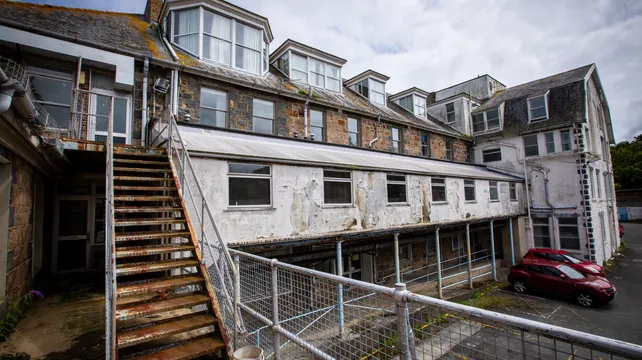
How can you as government ensure that the owners of these derelict hotel sites can be encouraged to develop them for the benefit of this community if you’re not going to use compulsory purchase?
I believe in laissez faire. I believe in free enterprise. It’s certainly served me well.
But I also believe in the deployment of the carrot and the stick, and I think that we concentrate on trying to provide carrots, when occasionally government needs to wield the stick.
I would be, and I remain, very supportive of significant penal rates on derelict property, where the intention is clearly, rather than it being redeveloped as a hotel or redeveloped into multi-occupancy, the desire is often to redevelop it into a single dwelling of some significance, there are a number of sites that fall into that category.
Do you think it’s realistic to hope that we could get a very clear, potentially very brave vision for where Guernsey is going to be in 10 years’ time?
The problem with a 10-year vision is that we have four-year electoral cycles, so it’s all well and good for the next States to set a policy on day one, rather than run the gauntlet of the election in four years’ time.
Would I favour 10-year election cycles? No. I think the electorate should have an opportunity to refresh and replenish its membership every three or four years.
That’s the challenge. So one has to try and imagine what the world will look like in 10 years.
So 10-year visions are difficult. Four-year visions are deliverable.
What can you do to entice young people to Guernsey or back to Guernsey?
One of the challenges we have is young people want to go and experience the bright lights, the big cities.
It’s getting them back after and drawing on those life experiences is the issue.
The newest blocker to having people come back here to start their family isn’t the education system, it’s the absence of affordable housing. Almost everything comes back to this thorny issue of the absence of affordable housing.
That’s why it was the number one priority four years ago. It’s the number one priority of this assembly four years on, and it will be the number one priority of the next.
We’re going to do our very best to make it as welcoming as possible for you to come back here and enjoy island life.
And isn’t it a great place to live? This is a great place to live, trust me, there’s nowhere better in the world.

You need to be logged in to comment.