Abortion law reform. Reorganising secondary and further education. Digital infrastructure. Harbour developments. Anti-discrimination legislation. Reforming the freedom of information code. Quarrying and the supply of aggregate. Planning reform for visitor accommodation. Aurigny’s future finances. A new approach to managing investment funds. A detailed four-year policy plan.
On the face of it, a random selection of political issues. But they have one thing in common – they were all policy letters debated in the first 15 months of the previous States Assembly.
One or two of them – most notably on the harbours – led to nothing much. But all the rest ended in clear decisions which have since endured.
A policy letter? Sorry, I should explain. A policy letter is a document containing proposals, and all the arguments for them, which a committee presents to the Assembly for debate and decisions on major issues. It can be easy to forget, so rare have they become.
Listing the major policy letters presented to the current Assembly provides a striking contrast. Alderney runway certainly, school governance possibly, but that merely set up another committee which is months away from recommending anything. At a push, removing contaminated land stored at the airport. Then we’re scraping the barrel – body piercings, a pair of marina gates, something about dower units.
In the previous States, Peter Ferbrache’s notorious ‘action this day’ pledge became a hostage to fortune, eventually drowning in tribalism and indecision, but the first third of that term now looks almost hyperactive.
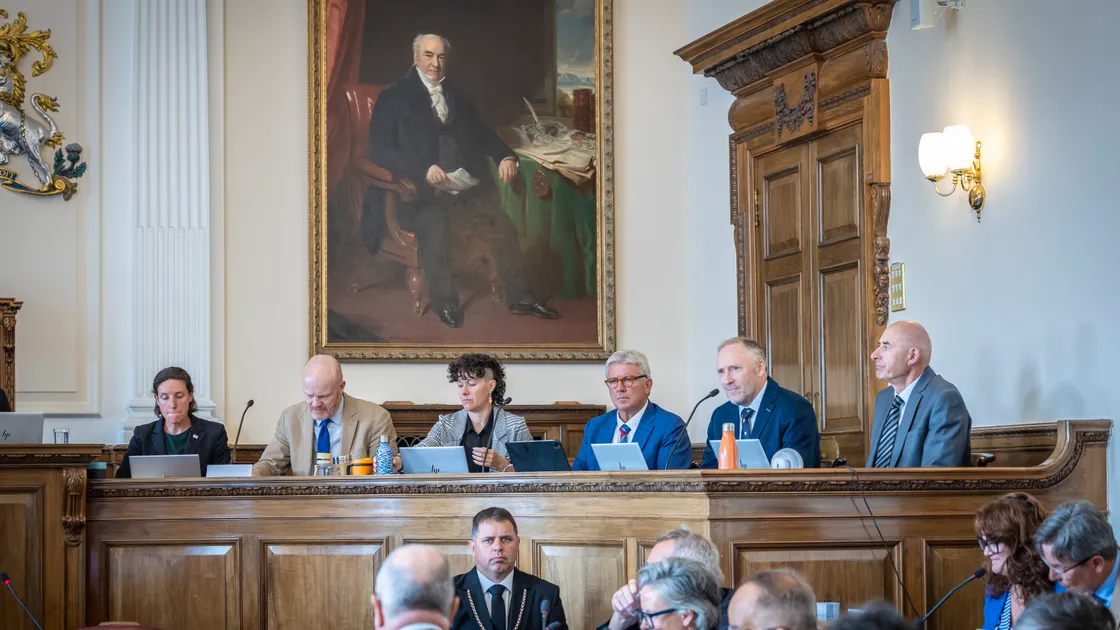
It is too early to label this the ‘States of Inaction’, and of course a lot of work happens away from the public eye, but so far this has been a remarkably inactive, even passive Assembly. We know its agenda until the end of September and there is nothing notable on it. Yes, the tax debate excepted – of which more in a moment – but the previous Assembly also debated tax, including GST, in its first year. Unless several committees have a feverish few weeks after their summer holidays, the Assembly will soon have had a flyweight agenda for 18 months.
Today we are reporting that not one of the seven principal committees – the policy-making layer of government – has so far published its work plan for the term. A couple are imminent, albeit delayed, but several are weeks away from being finalised. Committees have already excused themselves from the previous rigour of having to take their work plans to the Assembly, an unfortunate omission of scrutiny and accountability, but even the pared-back requirement of publishing their policy agenda on the States’ website within a year of being elected has proved too onerous.
Talking of scrutiny, the parliamentary body charged with leading it, the Scrutiny Management Committee, has so far held only one public hearing with a principal committee. Not one with each principal committee – one in total, with Housing. As well as escaping the need to put their policy agendas in front of the Assembly, four committees responsible for half a billion pounds of general revenue spending each year – Health & Social Care, Education, Sport & Culture, Home Affairs, and Employment & Social Security, which also oversees more than £250m. of social insurance expenditure annually – have seemingly not yet warranted a scrutiny public hearing.
‘What are they doing which needs scrutiny?’ the SMC might justifiably ask, but it can have an equally important role prompting action as it can holding to account error.
P&R president Lindsay de Sausmarez knows this Assembly has made a slow start. Doing her best to defend committees, she put the pedestrian progress of their work plans down to members’ inexperience. But that argument holds no water – 17 first-time deputies were elected in 2025, down from 19 five years earlier, and there were 14 in 2016 and 20 in 2012. She insisted that ‘operational service delivery’ was unaffected, which I’m sure is true, but that means only that public sector employees are continuing to work hard, keeping the island running daily. Committees, too, are doubtless working hard overseeing services, which is a necessary but small part of their role.
There are sometimes good arguments for doing less and doing it better. It is a relief that this P&R wisely eschewed the grand promises of some of its predecessors. But the lengthy list of big policy challenges the island faces can be tackled only by politicians, through their committees and the Assembly, which is why its sparse workload, and occasionally an atmosphere of drift, are a cause for concern now that it is out of infancy, if perhaps not yet of adolescence.
There is one possible explanation I don’t discount. Perhaps the committees started life last July with precious little work in an advanced state handed over by their predecessors. Several of the major policy letters I listed at the outset, dealt with in the first third of the previous Assembly, picked up work which had at least been started in the term before that. More transparency and prominence about their work plans might allow us to know if the new presidents and members, much to their surprise, found after the election that things were as bad as they had been saying they were, as an American president once said.
P&R itself is the one committee which has been active sending business to this Assembly. It quickly turned around a revamped Government Work Plan and a new approach to managing capital projects and is now trying to get the most far-reaching personal tax reforms in decades through the Assembly.
Where the senior committee may be less immune to criticism is in its co-ordination role. Bringing the principal committees together is as much about helping them drive their agendas as it is about smoothing over disagreements. This was the one area which seemed to me under-developed when Deputy de Sausmarez explained at the start of the term how she envisaged P&R working. The slightly quieter weeks now ahead are an ideal opportunity for a necessary rethink.
This Assembly had, and still has, many of the ingredients necessary to succeed, or at least to outperform its two immediate predecessors. It is less tribal. It is far less toxic. It has a more experienced and astute senior committee. Dealing with most of the committee presidents is a breath of fresh air – as a rule, but not without exception, they are more open, less suspicious. Several of their committees have a membership better placed to drive a reasonably coherent policy agenda.
But they need more energy and focus, a greater sense of purpose and direction, and a willingness to confront imperfect choices and difficult decisions in place of nascent signs of avoidance.
One of the most difficult issues of all, of course, is tax reform, in which the Assembly, at P&R’s behest, is currently deeply embroiled. A three-day debate last week proved merely a warm-up. Deputies will return to the same arguments at the end of September – and possibly eternally, if a frankly ludicrous initial ruling is maintained which would allow a fresh round of amendments to the same policy letter every time opponents can get it adjourned.
The same arguments on tax – essentially – have been occupying the States for the past five or six years. There is clearly a not insignificant structural deficit in public finances. It would plainly be unwise and imprudent to run down reserves still further in the vain hope of a painless solution emerging later. That doesn’t necessarily require GST, but it requires a coherent tax and spending plan which is presently absent. The States needs to get this done for the good of the island – in a small community with no control of monetary policy, balancing the books is a foundation stone of strong public services and a prosperous economy.
The States also needs to get this done for its own sake. Deputies, last term and this term, have spent enough energy and political capital on endless tax debates. There is other important work to be done, and the Assembly and its committees need to get on with it.