
There was a time when I thought I knew my way around Guernsey reasonably well. After more than 40 years in the island, I can usually get from one place to another without giving the route too much thought. Like most of us, I have my preferred roads, my short cuts and those little alternatives we keep in reserve for particularly busy times.
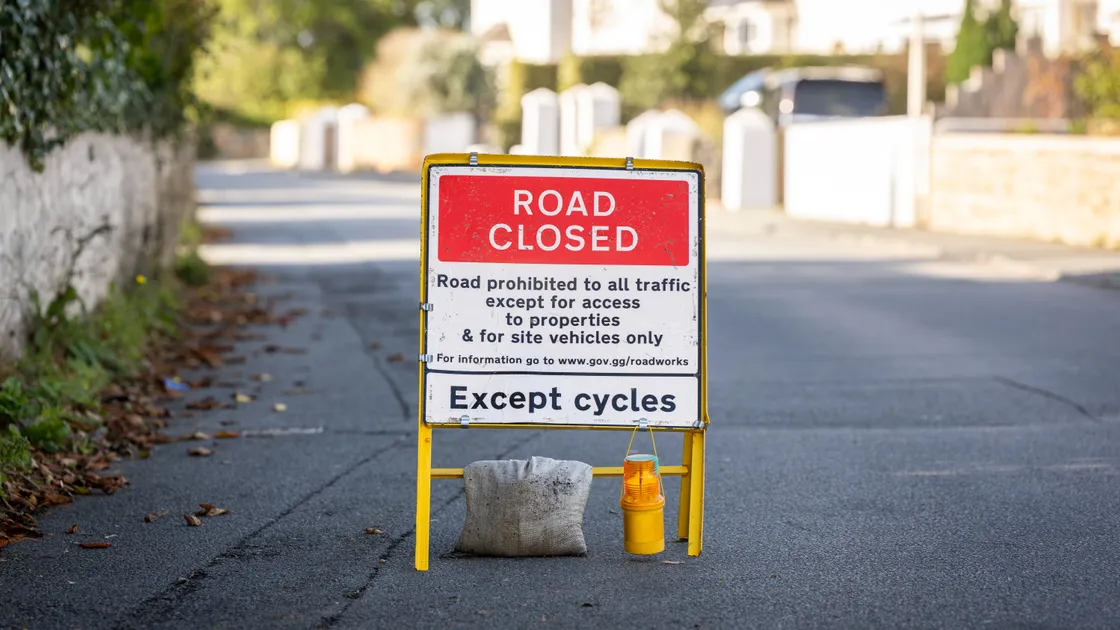
Recently, however, driving around Guernsey has become rather more adventurous. You set off confidently for somewhere you have travelled to hundreds of times, turn a corner and there it is: ROAD CLOSED. Usually, the sign is accompanied by an arrow pointing in a direction you had absolutely no intention of going.
Road closures are nothing new in Guernsey. They are part of island life, and most of us understand why they are necessary. Roads need repairing, water and drainage systems need maintaining, cables and other services often run beneath our feet, and an island with a growing number of vehicles needs its infrastructure looked after. The work has to be done.
However, there appears to be an extraordinary number of closures and diversions at the moment, and getting from A to B can occasionally involve a surprising amount of the rest of the alphabet.
A journey begins normally enough. You reach the first closure and follow the diversion sign. No problem. Then you encounter another sign, followed by another, and before long you’re driving down a lane you have never seen before, despite having lived here for decades. This is where Guernsey driving becomes interesting. Some diversions take you along perfectly familiar roads. Others appear to have been devised by someone with a detailed knowledge of every lane on the island and a determination to introduce the rest of us to them.
You find yourself in a narrow lane, surrounded by high hedges, wondering where on earth you are. Your satnav isn’t entirely sure either. It confidently tells you to turn left, only for you to discover another ROAD CLOSED sign. It recalculates, pauses briefly as though slightly offended that you ignored its first suggestion, and sends you somewhere else. Five minutes later, you have the distinct feeling that you’ve passed the same granite wall twice. Of course, those of us who have lived in Guernsey for a long time have an advantage. We know that most roads eventually lead somewhere useful. Probably.
The difficulty comes when several of our usual alternatives are closed at the same time. That’s when we start becoming strategic. You hear yourself saying things like, ‘If I go through the lanes, come out near the filter, cut across towards the coast and then double back...’ At which point anyone in the passenger seat begins to look concerned.
There is also the fascinating phenomenon of the diversion sign that disappears halfway through the diversion. You follow the first arrow faithfully. Then the second. Perhaps even a third. Then nothing.
You arrive at a junction where three roads are available and apparently you are now expected to make your own decision. Is it left? Right? Straight on? You slow down hopefully, looking for a sign that isn’t there, while the driver behind clearly knows exactly where they are going and would appreciate you making your mind up sometime before Christmas.
Eventually you choose. Whether it was the correct choice may not become apparent for several minutes. Perhaps this is why road closures have become such a popular topic of conversation. ‘Have you seen they’ve closed the road by...?’ ‘Yes, but you can get through if you go round by...’ ‘No, you can’t. That’s closed as well.’
These exchanges can become surprisingly detailed. Within minutes, a group of otherwise perfectly normal adults can be standing around discussing alternative routes with the seriousness of military planners preparing a major operation. Everybody has inside information.
‘I wouldn’t go that way.’ ‘Why?’ ‘Temporary lights.’ That is usually enough. Yet, beneath the inconvenience, there is another side to all of this. The roads are being closed because work needs to be done. Much of the infrastructure that allows modern Guernsey to function is largely invisible to us. We turn on a tap and expect water to appear. We switch on a light and expect electricity. We use our phones and computers without giving much thought to the cables, pipes, drains and other services beneath our roads. We tend to notice infrastructure most when somebody digs it up.
There are also people working in those holes while the rest of us drive past wondering why our journey has taken seven minutes longer than usual. Engineers, utility workers, road crews and others are maintaining systems most of us barely think about until something goes wrong. Perhaps a little patience isn’t unreasonable.
Although I reserve the right to test that patience when the diversion from one road leads directly to another diversion. There is, however, an unexpected benefit to all these alternative routes.
I’m discovering Guernsey again. A few weeks ago, I wrote about taking a walk in the north of the island and finding lanes that Jayne and I had never explored before. I found it remarkable that after living here for so long there were still corners of such a small island that were unfamiliar to me. Road diversions are now continuing my education. Admittedly, the circumstances are slightly less relaxing.
There is quite a difference between strolling down an unfamiliar lane on a bank holiday and meeting a delivery van coming towards you in one when there is approximately six inches of spare road.
Nothing tests your knowledge of the width of your car quite like a Guernsey lane. There is that wonderful moment when both drivers stop. You look at each other. One of you has to reverse. Each quietly assesses which of you passed the most recent driveway. Occasionally there is a brief stand-off, followed by the gracious wave from the person who has accepted that today is their turn.
Then comes the careful passing manoeuvre, wing mirrors tucked in, hedges brushing the side of the car and both drivers behaving as though this is completely normal. Which, in Guernsey, it probably is. Perhaps that’s another reason our current road situation feels particularly noticeable. On a larger landmass, a closed road might simply mean using another main road. On an island of narrow lanes, filters and limited routes, one closure can send traffic into places never designed to receive quite so much of it.
The familiar patterns of island life suddenly change. The school run takes a different route. The journey to work needs another 10 minutes. A quiet lane becomes unexpectedly busy. Then, somewhere, somebody who has lived in the same house for 30 years is looking through the window wondering why half of Guernsey has suddenly decided to drive past their front door.
Eventually, of course, the work will be completed. The barriers will disappear. The signs will be collected and we’ll return to our familiar routes, probably forgetting within a few days that the road was ever closed. Until the next one.
In the meantime, perhaps we can accept that maintaining an island occasionally requires us to travel around it in ways we hadn’t planned. We may even discover a lane, a house or a view we had never noticed before. So, these days, when I set off across Guernsey, I allow a little extra time, keep an eye out for the yellow signs and remind myself that wherever the diversion takes me, I am unlikely to end up more than a few miles from home.
Although if you see me driving slowly down your lane looking slightly confused, please don’t worry. I’m not lost. I’m following the diversion.
Nigel Pascoe has lived and worked in Guernsey for over 40 years. A writer and speaker, he enjoys exploring the people, places and everyday moments that make island life unique. Through Island Reflections, he shares thoughtful observations on community, modern life and the stories that connect us all. nigel@nigelpascoe.com


You need to be logged in to comment.