Excuse my slang, but what a bloney fine bunch of young men.
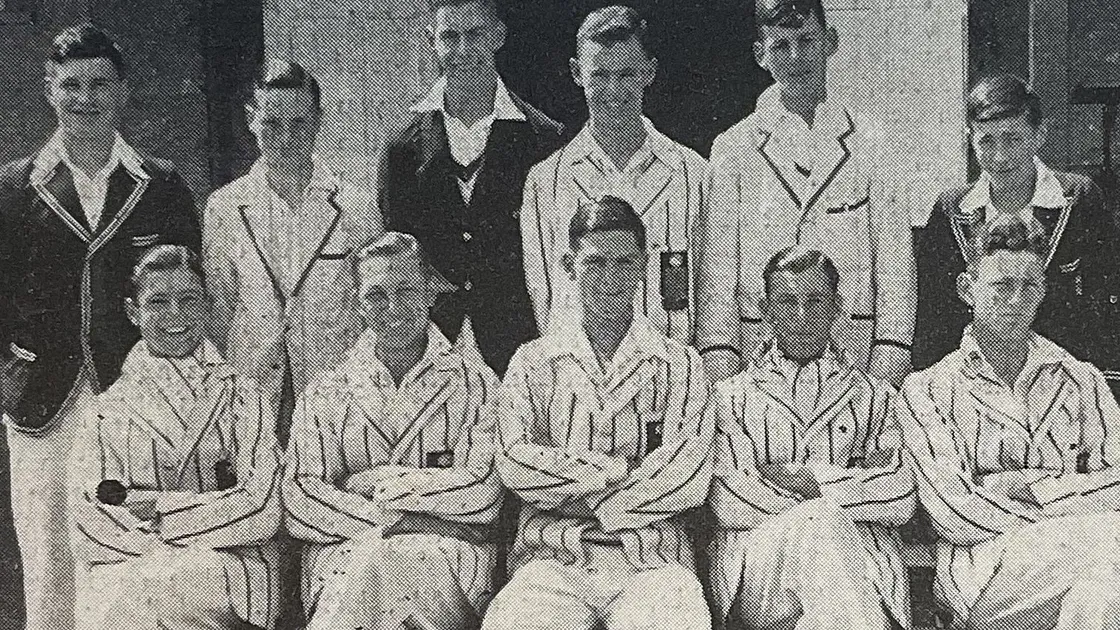
Smartly dressed in a fashion very unlikely to be seen again in the era of coloured cricket clothing and men of great courage, pictured left, right and centre.
You are looking at the Elizabeth College first XI of 1937.
All but one would sign up to fight in the Second World War in the imminent years ahead and in a variety of ways, those that survived many would have a significant impact on island life beyond the Occupation.
The occasion is the return match of the annual inter-collegiate cricket clash against Victoria and to highlight its merit on the social calendar 250 guests would watch and enjoy tea in the enclosure, including the Lt-Governor Sir Edward Broadbent, Bailiff Victor Carey and the celebrated international author and Guernsey resident, E Phillips Oppenheim.
In fact, looking down the guest list everyone that was anyone was present to see the Elizabethans exact revenge, led from the front by their captain and long-recognised Occupation hero, James Symes.
This is what E B Waite, the long-time College cricket master and enthusiast, would say about the young man who just three years later was scrambling up the cliffs above Petit Port as part of a reconnaissance operation to assess the extent of the Germans forces: ‘Good left-handed bat with many strokes, inclined however to throw his wicket away before is set through wild hitting. Excellent field.’
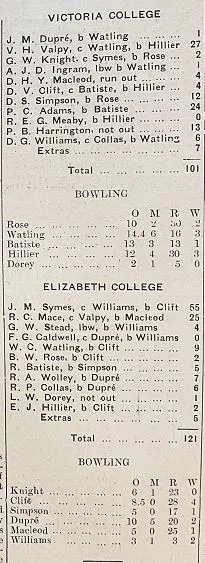
Well, this was one game in which the skipper did get his head down and with a patient 55 ensured his team reached the target of 102.
Come October 1940, Symes would be captured by the Germans alongside his fellow local soldier Hubert Nicolle, and spent the rest of the war years in prisoner of war camps.
He would earn a Military Cross, survive and enjoy a long Army career, reaching the level of major.
Opening the batting with Symes and playing a secondary role in what was a match-winning partnership, was Rex Mace, ‘must I proved as a bat,’ wrote Waite in The Elizabethan season review, ‘makes beautiful shots on the off; excellent cover point and fair change medium pace bowler.’
Mace, an outstanding athlete too, would join Symes at Sandhurst and also attain the rank of major, serving in India and Burma.
Batting three and contributing just four in what was a worrying collapse by the Elizabethans, was George Stead, Leeds born and another who would spend much of the war years in India and Burma.
He, also, would wear major stripes while the next man in, Frank ‘Griff’ Caldwell, would survive the war, be awarded a Military Cross having seen service in the SAS in North Africa and ultimately become a major-general, an MBE, then an OBE.
In latter life (he died in 2014 aged 93) ‘Griff’ was a darn more successful than his ‘duck’ in this game.
At five, came the side’s future captain and man who would leave Elizabeth 24 months later with a reputation as perhaps the school’s finest ever all-round student.
Much has been written about W C ‘Bill’ Watling and not a word of it has been undeserving.
Dead by the age of 21, killed in his Spitfire swamped by fog, in ‘37 Watling had not reached his peak, but yet drew these words of praise from Waite: ‘can go on (bowling) indefinitely at times is unplayable’.
On this day he would send down two deliveries short of 15 overs and take a miserly 3 for 16, relatively nothing compared to what he would achieve in the following two summers before joining the RAF.
In bowling terms the same could be said about the next man in, all-rounder Brian Rose.
‘Quite a fast bowler,’ penned Waite, adding: ‘sometimes short and dangerous; he should learn to pitch them up’.
He took that advice and in the next two years at times terrorised the Victoria batsmen. On this day, his contribution was 2 for 30 with the new ball and a two-run failure.
Like Watling, his figure lay with the RAF and, equally fatefully, he would not survive the war. Killed at just 23.
Next in was Roy Batiste – no relation to this writer I might add.
An all-rounder he bowled 13 overs for just 13 runs and Waite clearly liked him: ‘A promising bat with good shots on the off and very steady medium-pace bowler’.
Come the war years he would win a war-time ‘blue’ at Oxford before becoming a captain in the 2nd Battalion of the Northamptonshire Regiment.
Every good cricket team needs a talented wicket-keeper and this team certainly had that at its disposal in the form of Roy Collas, who post-Elizabeth joined the navy and became a sub-lieutenant.
‘Excellent wicket-keeper to all kinds of bowling,’ was Waite’s assessment.
Like others in the tail Collas would lose his wicket with victory assured.
With distinguished guests to entertain and the game yet to reach its cut-off point, Collas would go for six and Roland Wolley for seven and last man Edward Hillier for one.
Like many of his team-mates Wolley would attain the rank of major and Waite described him as a ‘very fair bat with good strokes on the off; inclined to play forward to everything’.
Hillier hailed from Monmouthshire and in his family life, would suffer the shock of freakishly losing a younger sister who took a drink from the wishing well at Petit Port and 12 days later die from cardiac failure and acute gastroenteritis.
That was 1938 and Edward, who had arrived at the school in 1935, would feature in all the mainstream sport first teams, earning this praise from Waite: ‘Good slow left-armer who has bowled very well on occasions.’
The Victoria return was one of those occasions and Hillier, the only player in the XI not to sign up for war service, took 3 for 30 from 12 overs.
One spot ahead of Hillier in the order was Laurence Dorey, leg-break bowler and future Navy man who at the end of the war would act as an interpreter to German U-boat prisoners of war in Northern Ireland.