

On holiday in the island last year, locally-born artist and former College of FE head of art Eric Snell began working on a project called Tide Line at Pembroke.
‘I was playing around on the beach and by chance Kieran Wyatt-Nicolle, a former student of mine, came by and we got talking. He told me about Art for Guernsey and invited me to the gallery. I came in and had a look and found it to be a great space. I also found out that AFG had education initiatives and the seed of an exhibition was sown.’
AFG founder David Ummels was away at the time but he and Eric met later at the Royal Society of Arts in London.
‘One of the things we talked about was an idea I had about connecting the different parts of the gallery,’ explained Eric.
‘I’d heard so many positive comments from friends about Eric and his work,’ said David.
‘Abstraction is not my forte but I have a background in maths. I went to his studio and understood the substance of his ideas. I was so impressed. I have never seen an artist so prepared, with such clear ideas on a concept.’
Squaring the circle was first proposed in Greek mathematics. It is the challenge of constructing a square with the same area as a given circle using a compass and straight edge in only a finite number of steps. In 1882, the Lindemann–Weierstrass theorem proved it to be impossible. ‘Squaring the circle’ is therefore used as a metaphor for attempting the impossible.
The exhibition at AFG has three bodies of work.
In 2022, after the lockdowns, Eric was opening up boxes from his attic.
‘I was questioning what to do – carry on where I left off or do something new. In one of the boxes I found a remote controlled car. I thought “I’ve never done anything with this – that’s where I’ll start”.’
Modifying it with sponges filled with paint, Eric put the car on paper and learned how to drive it.
‘The paint on the wheels made a trace of where it had travelled. I was in control but not in control.’
A large piece shows where Eric has driven the car in circle, another where he has placed the car in a ‘corral’.
‘It hits the wall, then left, forward, right, back, until it gets stuck in a corner. It builds up a random but organised pattern. It’s drawing but also printmaking.
‘It’s easy to get obsessed. One work is called Dead End Drawing where I drove the car backwards and forwards with the car tyres making two lines.’
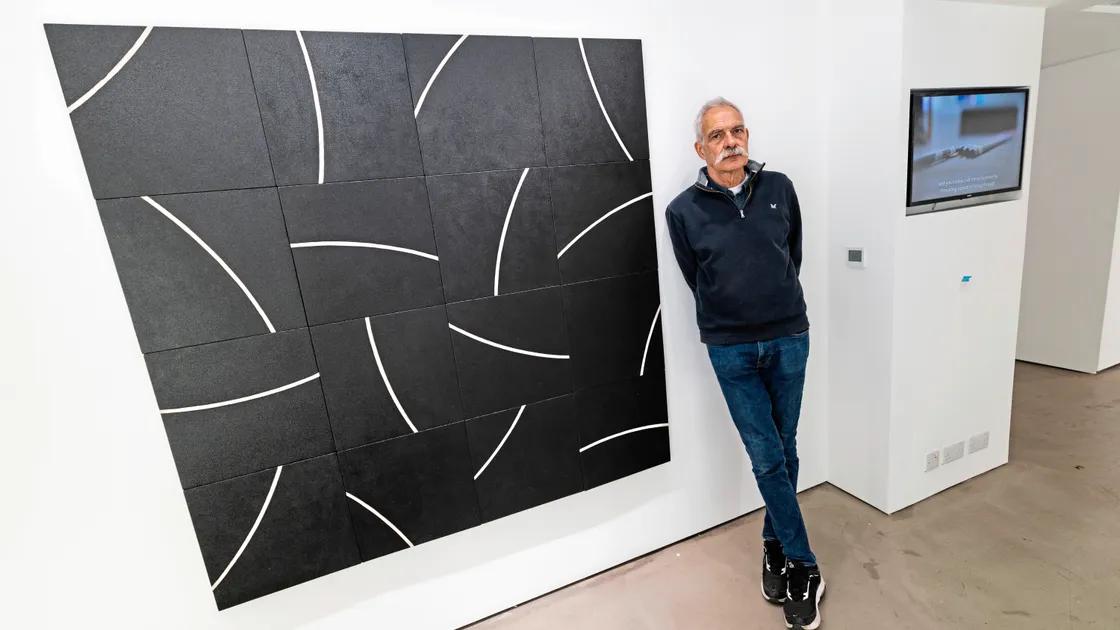
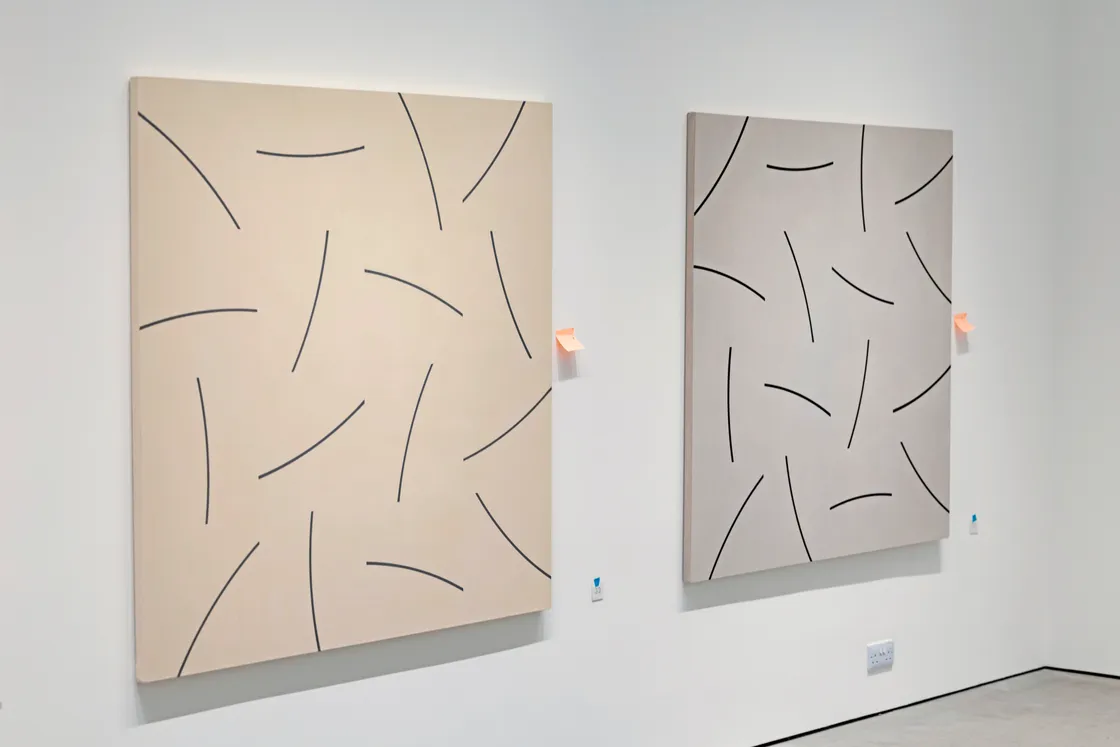
The second body, Circle Squared, is both an evolution and a deconstruction of the car drawings and concerns the problem of ‘circling the square’.
Enlarging the lines on gesso – a white mixture of chalk, gypsum and pigment used to coat painting panels – Eric then drew two lines and filled them in with oil stick.
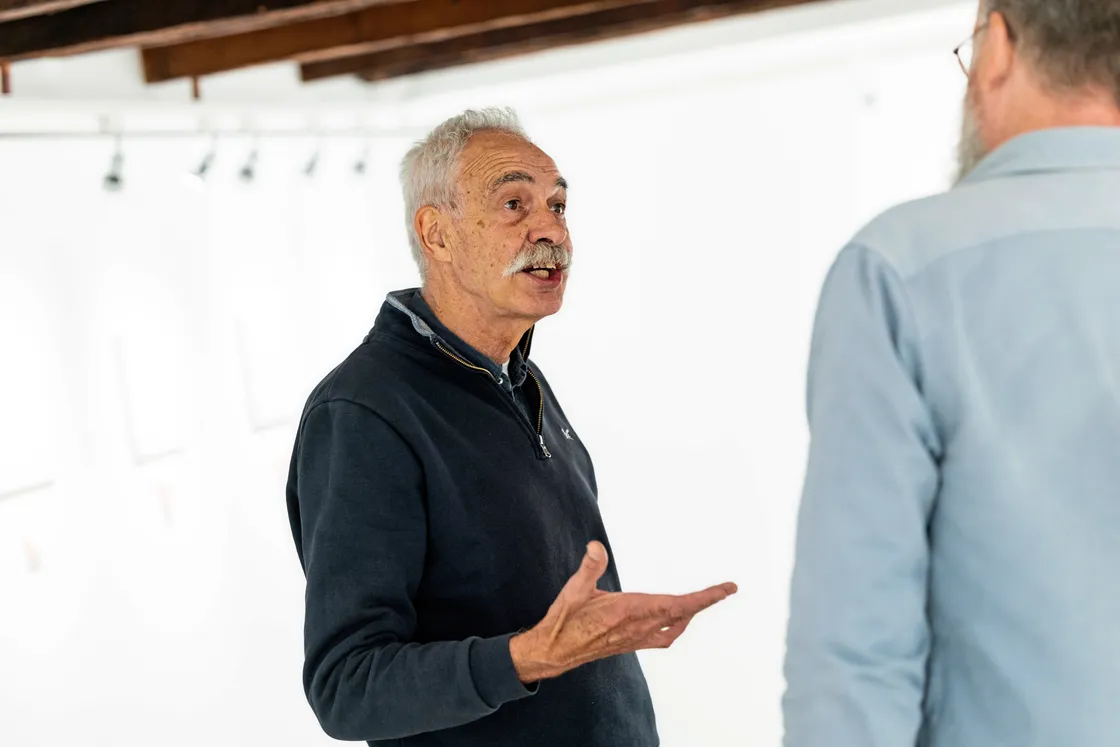
‘There are thousands of permutations, getting into the impossible. Then the problem becomes a visual, intellectual problem. Do you keep the grid, lose the grid? Keep the line, lose the line? Each one tries to create a visual link between the fragmented circle and the square.’
These are further rearranged on nine or 16 panels or 25 panels – perfect squares.
‘They’re just fragments of the circle floating in space.’
The aforementioned Tide Line is a response to the local tidal patterns.
‘I used 330g watercolour paper and the wet on wet technique, where the paint merges and spreads over the paper. I’d place a heavy wash of paint on the paper and put it on the sand and let the tide wash over it. I would then pull it up off the sand. It’s literally where water and earth touch each other.’
The effect is of something ephemeral being captured, an almost photographic record of a unique moment in time.
Each of the different sections in the gallery is linked by a 3D representation of the lines created in the work, a realisation of a model Eric made at the start of the project.
I’ve spoken to Eric many times during my time at the Guernsey Press. Squaring Circles is, like all his works, thought-provoking, beautifully realised and, although it artistically and intellectually responds to a mathematical conundrum, it has a wonderful playful energy.
Mr Snell, welcome home.
Squaring Circles by Eric Snell is at the AFG Gallery, Mansell Street until Saturday 8 November.


You need to be logged in to comment.