
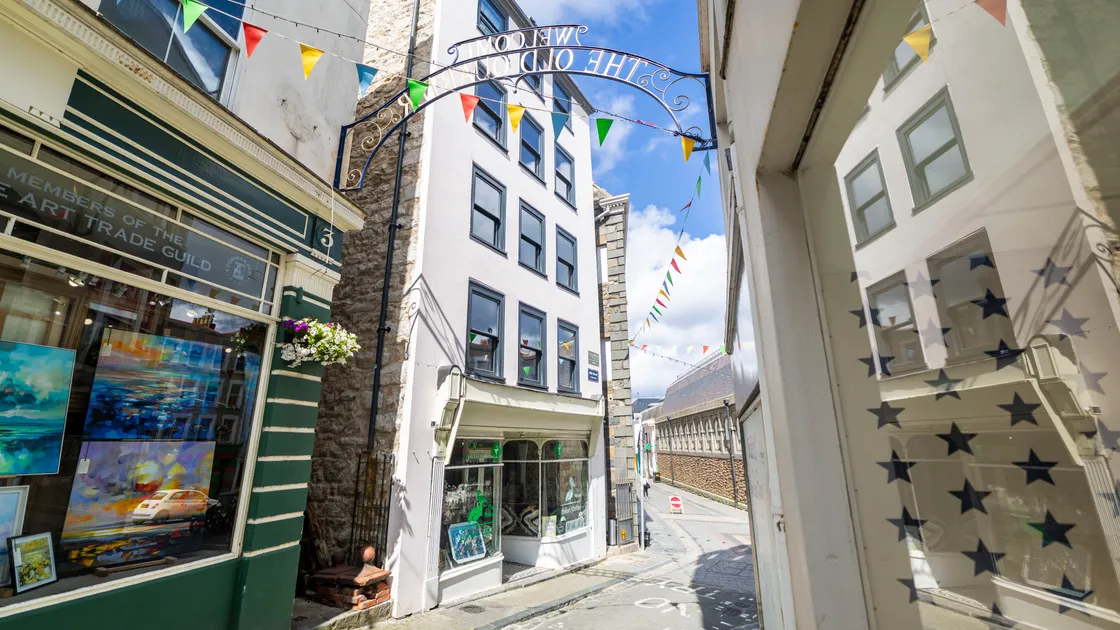
The court was told that the five-storey building at 1, Mill Street, St Peter Port, was in a conservation area and included some features dating from 1720 to 1740.
The shopfront was Victorian/Edwardian and it was one of only about 20 buildings of its type left in St Peter Port.
Director Daniel Klaassen entered guilty pleas to five matters on behalf of Continental Environmental Services Guernsey Ltd.
The court heard how parts of the roof had been replaced, windows removed and exchanged for others, and internal and external elements of the building’s fabric had been altered.
Following an inspection in June 2024, an expert found that no part of the building had been left untouched and there were many defects in the work carried out. That charge resulted in a fine of £8,000.
The other matters related to that fact that the company failed to carry out the measures of a compliance notice served by the planners, namely to stop using the ground floor as coffee shop. Judge Gary Perry rejected the defence argument that it had been a pop-up-shop, saying that the two years for which it ran could hardly be classed as temporary.
A second failure to carry out the terms of a compliance notice was linked to the non-removal of a shed and a third to the failure to demolish an extension that was built to accommodate toilets for the coffee shop.
It also admitted failing to respond to the relevant authority within the requisite 21 days after the works were made, subject to a challenge notice in April 2024.
Each of the latter four offences attracted penalties of £3,000.
The court heard how the company had bought the property in November 2022.
Defending, Advocate Alan Merrien said his client had been concerned about the state of the roof from the start and contacted the planning authority in early 2023.
He was told that some work could be done as an emergency measure but it had to be followed by as retrospective planning application. That was never submitted.
He said that his client had been unable to get help from an architect, and had made a mistake by doing his own research, misunderstanding the planners’ conservation notes, and believing he had exemptions.
Mr Klaassen had engaged with the planners throughout by sending them e-mails and photos of what he was doing, he said.
He was eventually told that all needed to be brought together in a single planning application.
The company was a holding one for the property and had no income, and so Mr Klaassen had been doing a lot of the work himself. One inspector had noted that his efforts to protect the historic aspects of the building had been 'admirable', said Advocate Merrien.
His client had not charged the operator for rent on the cafe and said that he had done it for the community.
Advocate Merrien said Mr Klaassen now wished to apologise for what had been done and said a retrospective planning application would now be made, which would include a request for permission to open a coffee shop.
Judge Gary Perry said St Peter Port was a beautiful town and one of the reasons for that was the strict enforcement of the planning laws. Buying such a building came with a great sense of responsibility, he said.
Too often people carried out work without permission which was totally unacceptable.
The planners had engaged with the defendant and put a huge amount of resources in to trying to help Mr Klaassen to maintain the fabric of the building.
But the defendant had acted ‘foolishly and recklessly’ against the instructions he had been given, said the judge.
Such cases had to be met with tough penalties to deter others who might be considering doing the same.