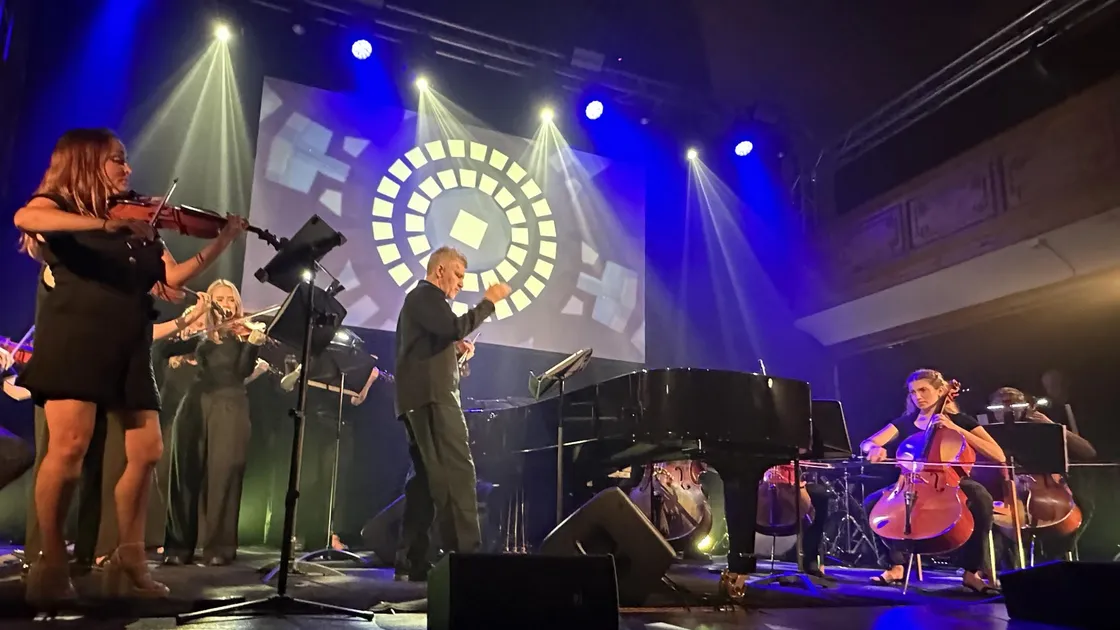
I admit to being both swept away and left utterly at sea by this remarkable, original, frustrating and highly personal concert. The notes I scribbled in the dark, trying to keep my bearings in the rush of impressions, were illegible when I looked at them in the light of day. I couldn’t identify a lot of the music I subsequently read was played in association with particular parishes. But what a tide of feeling it conjured up; what a powerful current of recognition it created in its play between image and sound. I was left almost breathless when I surfaced to hear the applause from an audience who sounded as overwhelmed as I had been.
David Le Page, Guernsey-born violin prodigy, director of the Orchestra of the Swan, composer and leader of many other ensembles, has always filled halls when he returns to perform here, as many at St James could testify. Who could ever forget his deeply moving Pilgrimage to Bach, set in some of the island’s most ancient churches?
His performances with Samphire Ensemble, previously Town Church Strings, have tended to follow a theme and moved beyond the traditionally classical towards the more experimental. Now, in Soundings, the stated idea was to ‘explore the idea of where one thing becomes another – land and sea, past and present, noise and music’ to create ‘an evocative portrait of Guernsey that invites audiences to experience the island not only as a place, but as a living soundscape’.
Guernsey is an unusual place, by the standards of the outside world. Guernsey-born individuals are deep-rooted in their parishes, and maintain a lifelong loyalty, often returning after decades off-island to live close to where they started out. Even as a blow-in of 23 years’ standing, I feel fiercely protective of the parish I live in, and can’t imagine moving elsewhere. Which is a roundabout way of saying David Le Page took on an ambitious task in creating an evocation of the island that bore him.
Everyone carries an iconic idea of ‘their’ corner of Guernsey, and would be seeking it out in what they saw and heard.
Theoretically this could be polarising, but in practice I found that the underlying unifier is the relentless basso continuo, audible on a still night from almost every corner of Guernsey… the wash of the waves. The island’s landscape, history, character – even size! – is defined by what happens around its fringes. And that susurration is the soundtrack to island-dwellers’ lives. So the strong allegiance that parishioners feel is still defined by where they live – in relation to the sea. (Even beautiful bucolic St Andrew’s is most typically defined as ‘the only landlocked parish’).
The coastline is effectively the shared circulatory system that cannot be blocked, and saltwater is the island’s lifeblood. These thoughts seeped into me as the immersive, even slightly hallucinogenic, evening rose and fell within the resonant cave of St James.
In a way it was a relief not to be able to read the programme or decode my notes.
The mesmeric effect of blending input from eyes and ears helped to fray the cord between consciousness and self – was this an out-of-body experience? – and ease the mind into a limbic state, where sound and image could flow without passing through a filter.
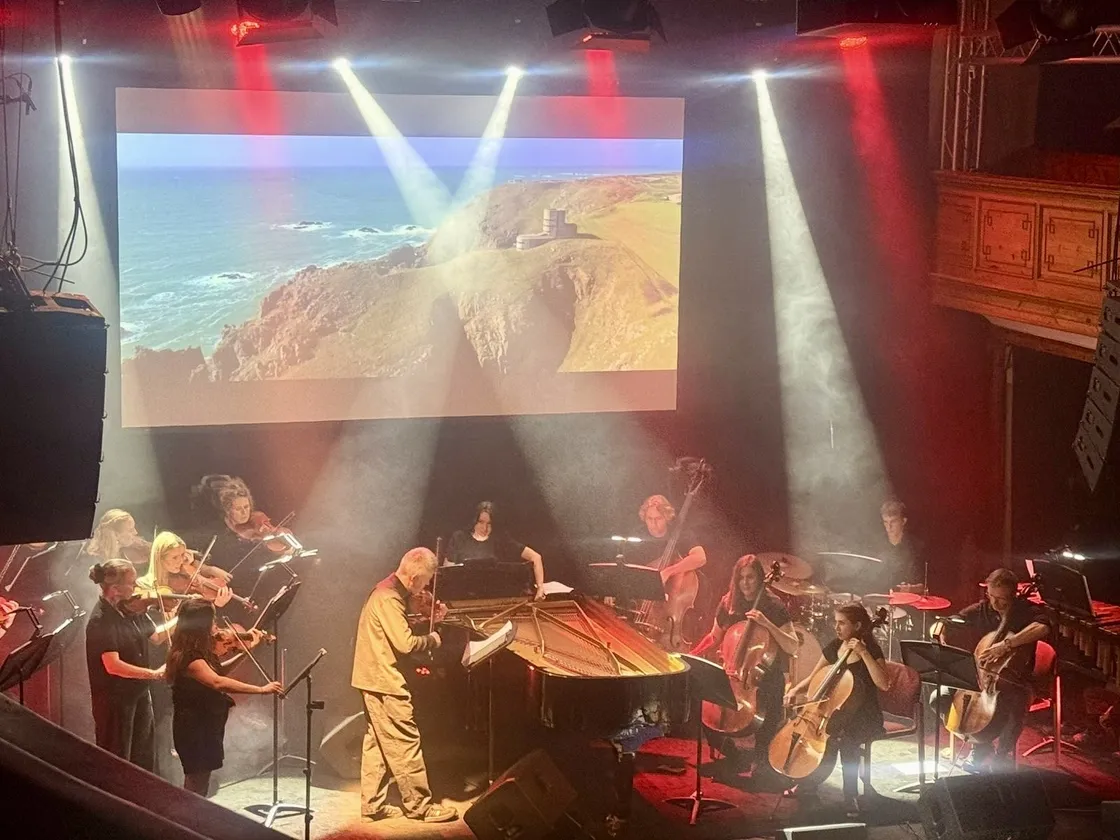
Particular impressions stand out. The airiness of the strings, suggesting the fast-moving clouds blown overhead, above the restlessness of the waves. David’s individual strand of sound, wheeling like a gull along the gusty cliffs or scudding in a storm of strings and percussion. The geometric precision of the piano, minimalist and immovable as the granite bedrock beneath.
A ricochet of drums in St Sampson’s introducing a lively tune full of Celtic energy, creating an outward-turned impetus – to venture beyond home to new horizons?
St Martin’s… was the image of an eye the unsleeping lighthouse and foghorn on the point? The spare, elegant melody between piano and strings gave an air of genteel melancholy drifting through narrow overgrown lanes.
The sea birds’ wistful blown-back calls were a perfect introduction to Vale, where the Air from Grieg’s Holberg Suite seemed to gaze nostalgically back towards a more stately past. Samphire played it with a beautifully restrained balance between precision and expression. My illegible notes include ‘drifting smoke’ – if that implied the veil of memory through which we glimpse the past, it would seem entirely appropriate.
Forest centred around Le Gouffre, the tiny bay Victor Hugo first named ‘A harbour on four floors’ due to its vertical racks of rock and sheer inaccessibility. This for me had an air of Dylan Thomas, drunk on words and images: greenery feverish with lush life, hulking cobs, salt crusting every surface and the grit and effort to prevail over the ceaseless assault of the sea.
Interval came as a pressure-valve for an audience so brimming with impressions that they had to ventilate them or burst. What I found so striking was the change from the usual St James audience: this crowd was younger, more demonstrative and clearly excited by what they had just experienced. If they were first-timers I’d guess with some confidence that they’d be back. If for just this one reason, the concert must be judged a success; and it was only halfway through.
Back to the middle then: St Andrew’s, the ‘cornerstone’, uniquely marooned in farmland, deprived of coastline but compensated with a serene pastoral character. A wooden xylophone set a rustic tone, joined with clean precision by the strings, before David lifted his violin to float notes above this landscape like dandelion floss over fields.
Jessica Nash’s Sunrise took us into Castel. The piano felt like the pulse of the tide, that thrust and drag, waking or sleeping, continuing to beat at the shoreline. A gorgeous segue from minor to major was urged forward by the drum, and the ensemble moved as one in the current.
Torteval expressed a more sombre aspect of the island. The German sentry towers loomed sinister and expressionless over a churning bass thrum from the piano; I seem to recall the wail of a siren. It felt like the sound of desperation, with yet a lone independent voice transcending this despair, as David offered a bird’s eye view over and beyond the grim scenario beneath.
To conjure up St Peter Port, with its cobbles, pavements, harbour and laser-cut crenellated skyline required a very different approach. It was almost startling to be transported from all that fluid spontaneity into an urban grid, in the form of Vivaldi’s Winter. Its strict formality offered a counterpoint to the swirl of impressions we could dip in and out of before – and that evolved into music of such dreamy lyricism, there was a sense of the sweet sunsoaked exhaustion that follows a day’s beachcombing and rockpool-hopping as you head back up the hill to home. And…exhale.
After a few moments of silence as we all drifted back to earth, the audience erupted, as though at a rock concert. It was a euphoric explosion of pleasure; what they had experienced that evening had clearly resonated with them. This felt like one of those performances people continue to refer back to for years.
Two questions remain with me, in the aftermath of this huge, imaginatively engaging project. It feels so intimately connected to Guernsey, would David ever take it into a wider forum? (In my view, with a bit of tweaking, I’m sure he could.)
And secondly, with all this intense focus on the spirit of each singular part of Guernsey, how long can David resist the magnetic tug of his homeland?
‘I was excited to experience something new’
As one of the ‘younger’ members of the audience at St James, Maisie Bisson offers her impressions of the performance...
I have been involved in local modern music for 10 years now, but have very rarely been to any classical performances, so was excited to experience something new.
Soundings, directed by David Le Page, promised to be an exploration of Guernsey’s coastline, parish by parish. The ensemble’s collection of original pieces, as well as classical and contemporary arrangements, built a meditative atmosphere. The pieces resonated with the diverse audience, whose attention stayed glued to the stage. This was partially enabled by the lack of a formal conductor and the freedom of the musicians to move with the music.
Despite the performance taking place in late May, moments of the evening felt like being transported back to the depths of winter, when the ocean makes its presence most known.
At points, I found myself wishing that certain pieces were longer, allowing me to fully appreciate their ambience, and that imagery of the sea had provided a backdrop to the entire evening. Regardless, the performance captured the unique relationship that the islanders of Guernsey have with the sea: a balance of respect and appreciation.
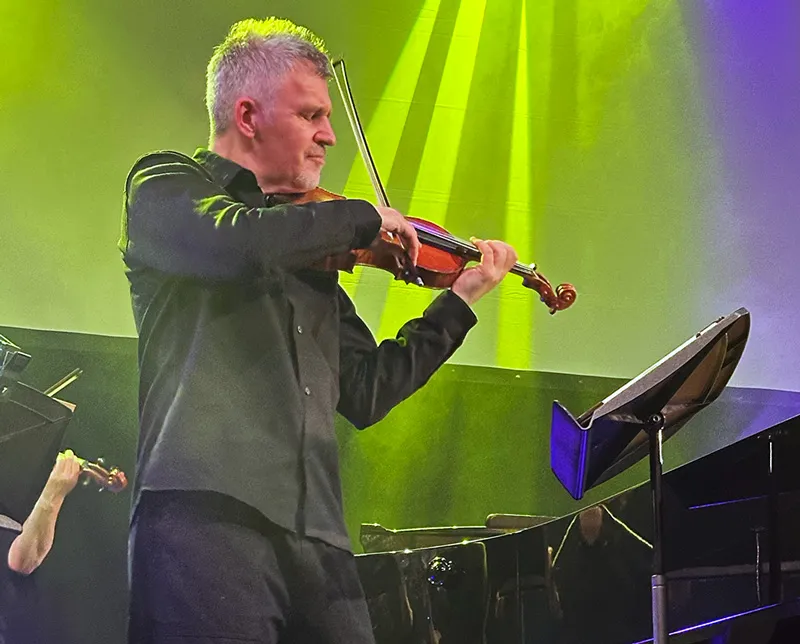
As someone who was born and grew up in Guernsey, Soundings felt deeply personal.
The project explored the character of the island’s coastline and parishes through the idea of liminality – those places where one thing becomes another, where sea becomes land, granite becomes soil, and landscape, memory and history overlap.
What made the performance so remarkable was that it emerged from within the ensemble itself. At its heart, Samphire is a collective of local artists working broadly within the classical tradition, yet this was a programme that reached far beyond the conventions of a purely interpretative art form. Combining music, words, sound design and film, 14 of the 24 works were written by members of the ensemble, only a handful were familiar repertoire, and just two came from the classical canon in the conventional sense.
Thanks to the vision and support of the team at St James, more than 300 people joined us, representing an extraordinary breadth of ages, from young children and families to people in their 80s. For me, that was perhaps the most encouraging aspect of all. It suggests that there is a real appetite for thoughtful, emotionally-engaging work that is rooted in classical music but open to contemporary culture and other art forms. In a world where all art from all times is available at the touch of a button, Samphire is not simply a group of musicians but a collective of composers, writers, filmmakers, sound designers and performers, finding new ways to bring those influences together and create experiences that feel relevant, moving and connected to the places and communities from which they grow.
David Le Page
The Samphire Ensemble’s next concert, titled Electric Eden is at Town Church on Saturday 29 August.