

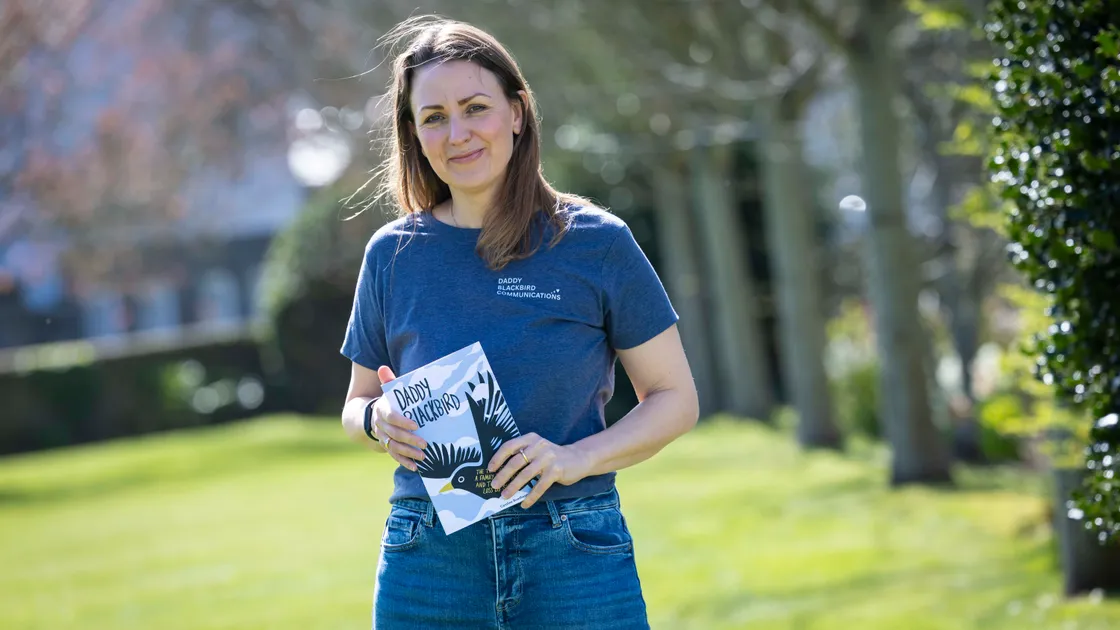
After the man they loved unexpectedly took his own life, the girls of the Roodhouse family are left surviving as a power triangle, reminding others of the harrowing impact of suicide and how to talk about it.
Caroline Roodhouse has quite literally written a book on grief and loss by suicide, hoping to resonate and raise awareness for others struggling. Daddy Blackbird is part memoir, part support guide, a personal account of what happened to her young family, when her husband, Steve – and father of their two girls, Evie, 16, and Ada, 9 – went to work one day seven years ago and never returned.
‘I had no idea,’ she said.
‘It was a Monday – I think there’s something about Mondays – and he was starting a new job that day. He went off to work like any other normal morning, but then that was it. He was missing for two days before we found out it was death by suicide. He was found in his car – didn’t make it to work, he stopped and chose a different way. My girls were only nine and two, and suddenly we were plunged into this world that we knew nothing about. Loss by a suicide is so much bigger and more complex than any other type of death. We went from being a square of four that fit, to a wonky triangle that didn’t make sense overnight. I was trying to come to terms with this new odd number, and with being a widow – not a wife. It took years before I was functioning properly – whatever “properly” means. To feel strong enough and proud enough of who we are as a unit without Steve, because he was such a part of who we were. Eventually we became this power triangle, but that was seven years in the making.’
Since publishing, Caroline has received many messages from thankful readers – some who resonated, and others who say they carry the book with them, as an important reminder of who would miss them if they were gone.
‘It makes me quite emotional,’ said Caroline.
‘Sometimes people just need reminding that there are people who care about them – that they are noticed.’
Caroline went from working in internal communications to becoming an author, keynote speaker and mental health advocate, who has contributed to the development of the recently launched British Standard BS 30480 of Suicide in the Workplace. She now spends her life dedicated to helping others and reducing the stigma and fear around suicide. She is convinced that shying away from the topic is detrimental to healing, and that it is time the world was more open, compassionate and aware.
‘I want to show everyone that it’s simple to talk about this without it needing to be too heavy, or too scary. Without worrying what the correct response needs to be. This is a conversation that we can’t keep hiding from.’
She believes it starts with the right training and tools to feel confident engaging in conversations around mental crisis, suicide and postvention (support and intervention activities conducted after a suicide death). The British Standard document took two years and 70 different organisations to produce, and Caroline wrote the first steps guide for it.
‘I just want people to not be afraid of it, or feel that they’re pressured into implementing it as a tick list for company reputation,’ she said.
‘It’s just a tool to help people open the conversation and normalise talking about mental health. One of the main myths about suicide is the fear that if you mention it to someone, it’s going to put the idea in their head. That’s absolutely not true. Actually, the best thing you can say to someone you’re worried about is: “Are you considering taking you life?” Don’t beat around the bush. Not “doing something silly”, not “hurting yourself” – but point blank. I promise it’s never going to make somebody who wasn’t thinking about it, go off and do it. But it breaks the conversation barrier for somebody who is. And then it’s just about being there to listen. You don’t try and fix them, you just sit in the mud with them. Asking that direct question can be really powerful. And I don’t know what difference it would have made if somebody had said that to Steve.’
After everything Caroline has learnt since, she said she still cannot pinpoint any obvious clues she missed when her husband was considering ending his life. Though looking back, there had been a subtle build-up of contributing factors.
‘He wasn’t happy at work – I knew that,’ she said.
‘Steve had previously spent a big chunk of time working for an organisation where he was bullied – shouted at, spat at – it was a “wolf culture”. And that stayed with him, I know that. It changed him beyond any sort of recognition in his new job and his identity as a valuable member of the team. Being treated like that suggests you have no value. Though he was moved to a different role, I think it was too late. Both his parents had also died close together just a few years before and I don’t think he ever processed that. There’s never one thing. There was never a moment where he said “I don’t want to be here anymore” or “I feel like I’m a burden”. But he was looking old, and tired. Our daughters never slept. They were always ill, in and out of hospital. We were both shattered, but then you look at every other parent and they’re shattered too. So it’s very hard when you’re in it.’
Which is why Caroline believes it is so important for workplaces to be more alert and considerate. People are often able to hide things best from the people they love. But at work – where most spend the majority of their time – there is often less compulsion to put on the same facade.
‘There’s a massive opportunity for intervention at work,’ said Caroline.
‘It can be very hard for family – particularly friend groups who might only meet up once a fortnight – to spot the same subtle shifts in mood that work colleagues might. The standard teaches organisations how to do that, and how to be a supportive environment.’
The document has now been downloaded 10,000 times in over 100 countries.
‘I realised that the lived experience of my loss, and the skills I had in communication might actually be something I could bring to organisations and talk about what this is like, and what we need to do to make teams and workplaces more comfortable, more open and more compassionate.’
Caroline’s mission to turn her grief into good is mirrored by her daughters. Her eldest, Evie, won multiple awards for her work in schools, educating other children on how to use better language around suicide, after hating the way they casually joked about it.
She has held various assemblies, and appeared on news channels, sparking a national discussion.
‘I can’t talk about it every day,’ said Evie.
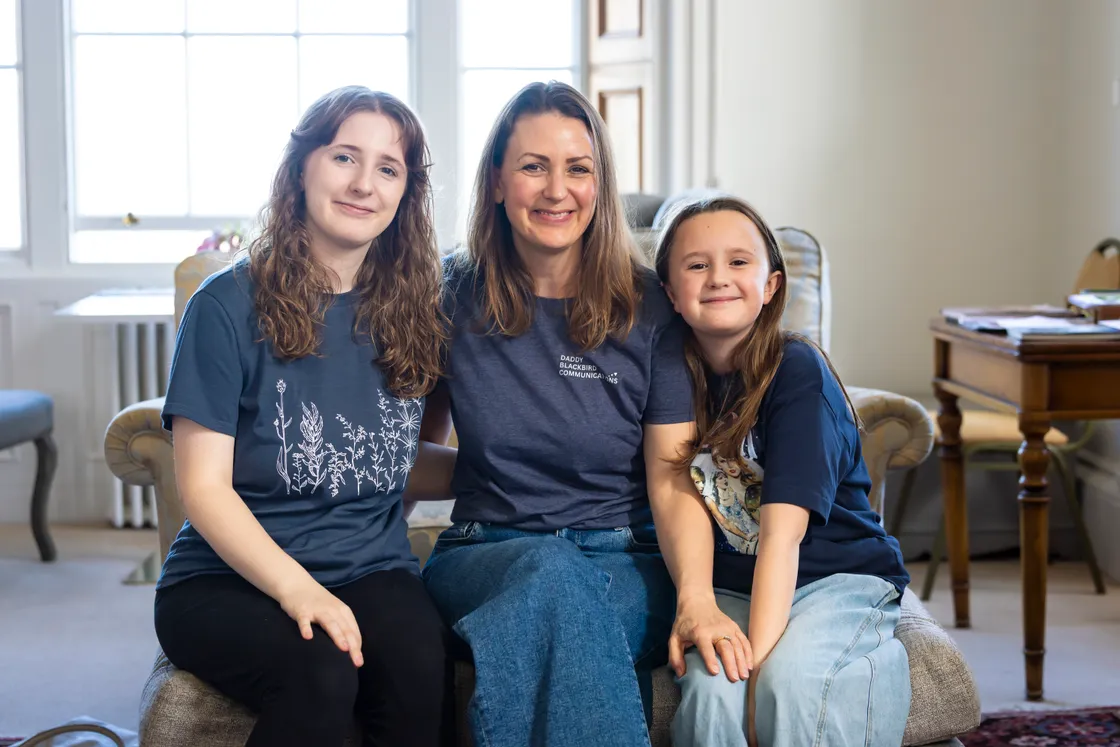
‘I’m very proud of all the work I got done at the time, raising awareness. But afterwards I needed a very long time of completely disconnecting from it all. It can be incredibly draining. But now I can recognise when it’s getting too much, and when I need to take a step back. As much as it is a big part of our lives, sometimes I just don’t want it to be. I had a lot of really bad experiences early on with telling people, which scared me off from sharing it. While some of my friends in secondary school were very respectful, there were others who would come up and play mean “dead dad” jokes, and send horrible videos. I was 11. I could never even think of saying some of the things they said to me. There’s a lot of people I don’t talk to anymore. I’m sticking to me and my music. And now, I’ll only tell people how I lost my father if it is an absolute must.’
Her younger sister, Ada, is a junior youth ambassador for the children’s bereavement charity, Winston’s Wish.
‘Some days I feel ready to talk about it and other days I don’t,’ she said.
‘I get very frustrated when other kids think they can relate when their dad just goes away for the weekend: “My dad’s not going to be here this Father’s Day, so I know how you feel.” Let’s just say – they don’t say it again. But I’ve got a few good friends who are really good at knowing when I’m upset and talk to me.’
The close sisters sometimes join their mum on her seminars, spreading their compassion across the country. They said they are proud of their mum and expect that her powerful advocacy work will forever be a key part of their lives.
‘I don’t see how you could ever stop,’ Ada told her mum.
‘Now you’ve started, it would feel weird to do anything else.’
Local support available
Guernsey Samaritans - www.samaritans.org
Men’s Shed – www.mens-shed-guernsey.com
Guernsey Bereavement Service –
Bailiwick Social Prescribing – bsp.org.gg
Guernsey Mind - www.guernseymind.org.gg

You need to be logged in to comment.