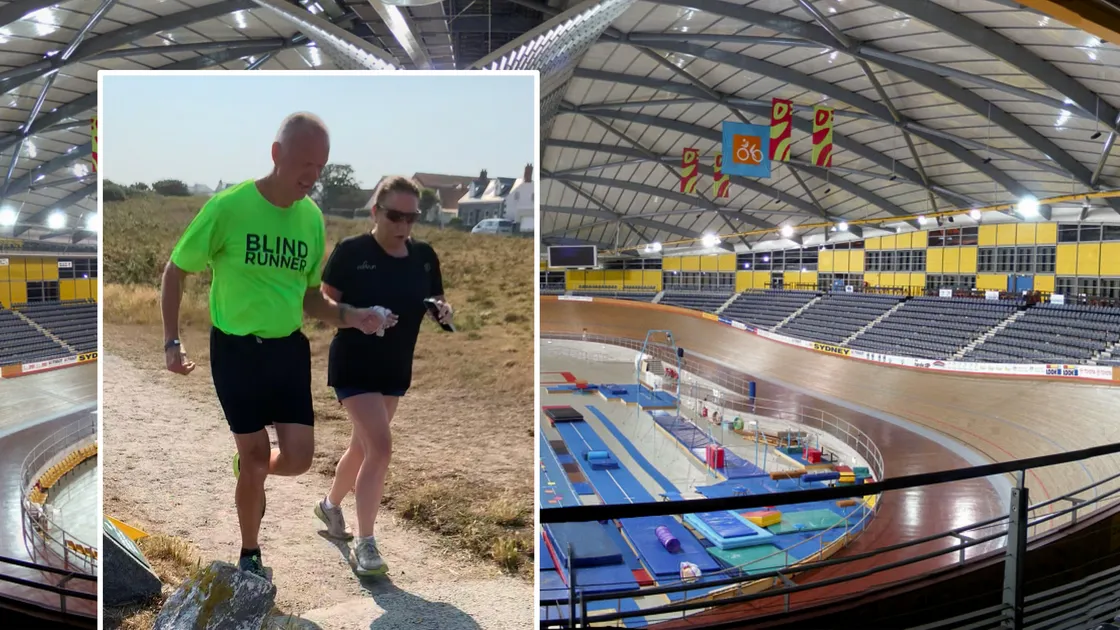
Having donned my high-vis volunteer vest for a recent Guernsey parkrun, I set off along the pebbly footpath across from Pembroke to L’Ancresse towards my marshalling position for the morning. Among the warming-up runners coming past me, each with their cheery ‘hello’s and ‘thanks-for-volunteering’s, was a runner in a bright yellow T-shirt with ‘BLIND RUNNER’ emblazoned across it in bold, black type, accompanied by another runner who was describing the terrain as they went.
I made sure to keep a wide berth, having remembered the pleas to runners from a run director at Gladstone parkrun in the London borough of Brent earlier in the year, where they had four assisted runners among 250 – the rest of us were urged to afford them the space to run freely.
I hadn’t seen an assisted runner at our local event before – though I’ve only been a couple of dozen times – and wondered whether he was visiting.
As it happened, I didn’t need to wait long to find out. As I took up my position where the course crossed the Longree, a woman came up and asked if the runners would be coming past that spot.
Yes indeed, twice, I was able to tell her. Did she have someone taking part?
During a long and interesting chat, Eileen described her partner Rob Allen’s regular participation in his local parkrun at Hogmoor Inclosure near Borden in Hampshire, as a blind runner. She looked a little apprehensive.
‘Rob came out last night with his fellow runner and they walked the course to familiarise themselves with it,’ she said.
I supposed it was the rabbit holes that posed a threat. I often warn visiting runners that although we have some of the best views of any parkrun in the world, you can’t spend much time looking up for fear of going over on an ankle. But it was the big pebbles along the coastal path that she seemed most concerned about.
It was only towards the end of our chat, as I was preparing for the arrival of the lead group of runners haring towards us, that Eileen casually dropped in the fact that Rob had represented Great Britain and Northern Ireland at the Atlanta ‘96 and Sydney 2000 Paralympic Games, each time as a cyclist.
Never off duty, I duly unmasked myself – metaphorically, you understand – as a features reporter for the local paper, and fixed up a post-race interview.
Rob’s parkrun stats show that he has completed a grand total of 75 of the 5km races by the time I speak to him – 74 in Borden over a period of four years and then this one in Guernsey.
‘This isn’t my first visit to Guernsey, as Eileen and I have been a few times to visit my stepdaughter Angela [Calnan] and her partner Lee,’ he tells me.
‘But today was my first parkrun here in Guernsey and because I’m totally blind, the guiding was all down to Ange. It’s a bit fiddlier this course, because there’s some narrow bits and for Ange to try and guide me single-file was obviously very difficult – I had to walk behind her. And also the rabbit holes. My one at home is much easier – it’s only sand or scalpings – but it’s good fun.’
Although they didn’t ask the race director to make any pre-race announcement, such as I heard in London, Rob and Angela find the other runners have been very supportive.
‘As you can see, I’ve got “blind runner” written on my shirt, and it’s amazing how many people cheer you on,’ says Rob.
‘People who are much quicker than you zoom by but they still say “well done” and everybody’s so kind. It’s a really nice event, parkrun, with all the marshals etc. It is a fantastic thing.’
Of course, I’m eager to take Rob back to his ‘cycling exploits of yesteryear’.
‘It wasn’t that long ago!’ he objects.
‘I’m a retired Paralympian. I went to two Olympics, many years ago. I went to Atlanta with a female cyclist [Kathryn Miles] – which we call a pilot – on my tandem, and I went to Sydney with a guy called Andy Slater. I used to race on a tandem on the velodrome. My event was the 1km time trial tandem open. In Sydney, we got a silver. The Japanese just beat us, otherwise I’d have got an OBE or something. I’d have been quite chuffed with that.’
In fact, I later discover, Rob and Andy managed to break their own world record and post the fastest time at the purpose-built Dunc Gray Velodrome in Bass Hill, Sydney during that Paralympic event, reducing their time by half a second to 1:05.332. But the very next pair – Shigeo Yoshinara and Koichi Mizusawa of Japan – promptly went even faster, posting 1:04.950 to take the lead. They then had to wait while another five pairs undertook their time trial, before knowing they would at least have silver medals to take home. Hosts Australia took bronze.
‘I still ride my bike today – not at the same speed of course,’ says Rob.
‘But my biggest claim to fame would be that in 1999, Andy and I broke the world record for the 1km on a tandem – but that was the able-bodied record, which made me the first disabled person to hold an able-bodied world record.’
I asked how the support provided to British Paralympians compared, back then, to that provided to the likes of Sir Chris Hoy.
‘By 2000, the UK lottery had taken hold and we got lots of sponsorship – they looked after us very well,’ Rob says.
‘I trained with Chris Hoy before he was famous. I’d like to say I taught him everything he knew but I can’t quite say that. I tell you what, though, he is one of the kindest, loveliest people you could ever want to meet. He used to help me weight train in the gym and he was so generous with his advice and help.’
Very few Olympians are full-time athletes, let alone Paralympians, so Rob has had extensive careers outside of cycling, for which he credits his education.
‘I was born with very poor sight but I went to a sighted school – a standard education, I didn’t go to a blind school,’ he says.
‘So when I left at 15, I went into a sighted job as an auxiliary nurse. I used to literally walk down a hospital corridor with a bedpan in one hand and a white stick in the other. That was my job at Holy Cross in Haslemere until I was 28 and a week after I left, I got my first guide dog, as I was really blind by then. I haven’t seen day or night for 30 years.’
From that nursing work, Rob became a masseur.
‘I mainly massaged people with bad backs and for a period of time I worked with people with severe physical disabilities, which was good fun,’ he says.
Now 66, he has retired from massage and keeps himself busy cycling, playing saxophone and doing parkrun at the weekends.
His personal best time is 24:11, which he managed in April of this year. But his time in Guernsey came in at 35:35.
‘The pace was all right for me but poor Angela had to guide and run near her limit,’ he says.
Although 20 years his junior, Angela is a veteran of 135 parkruns and in finishing in that time, she was only three minutes outside her quickest time of the year, despite assisting on the course for the first time.
So will they be back to do it again?
‘Will we, Ange?’ asks Rob.
‘Yes!’ came the emphatic response.
Look out for your friendly, local-visiting Paralympian appearing at Guernsey parkrun sometime soon.