

It was a simple enough message which I chose to convey, as I hauled my bike out of the bike rack at North Beach and turned around to speak to the couple who were retrieving theirs.
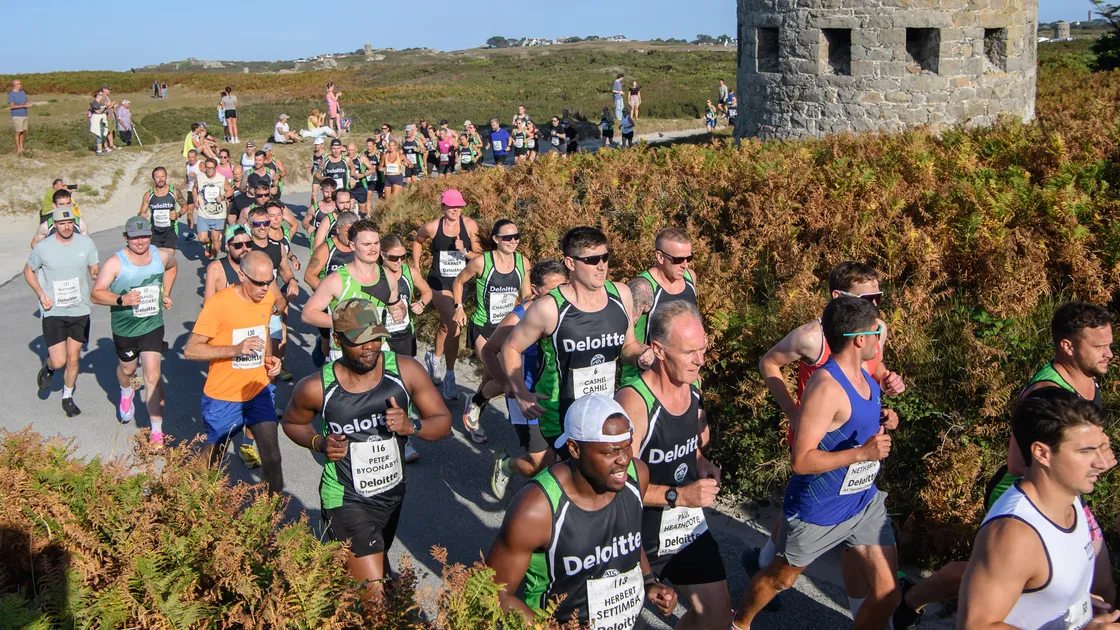
We’d just come back on the 10pm boat from Herm, full of beer and merriment after celebrating the completion of the seventh and final race of the All Terrain Challenge – an event marking its 30th year.
I just wanted to thank them for all their positivity and encouragement, which they had shown to me and all the other runners in their own and other divisions.
But, to my surprise, I couldn’t get the words out. Then I chose to force them out. And then the whole speech was a mess of wobbly vocals and tears.
Now the cynical observer might pick up on that reference to beer and merriment and conclude that I’m just a ‘you’re-my-best-mate-you-are’ merchant. But there was more to it than that. Zoe and Steve are familiar faces, as fellow runners at the Lee Merrien Running club. I see them most Wednesdays and they are always encouraging and positive. Really nothing new there, I told myself, as I cycled away. So what was all that about?
And I realised that their buoyancy has always been something I’ve taken for granted. It’s just how they are. They’re those sort of people – outgoing, confident, sociable and supportive.
What was different – very different – this time, was that I hadn’t taken it for granted. Not in the least. On several occasions during an arduous week that had stretched me out and wrung me dry, their encouragement had given me the strength to take a few more steps, the motivation to finish, the positivity to believe I belonged in such an event. I’ve trained for four marathons, started two and finished one. I’ve done a few halves. I’ve done a few Rotary walks. But this thing eroded me physically in ways I hadn’t encountered before.
And now I was effectively thanking them for being them, with all those years of unacknowledged support finally reconciled in my realisation that they had been exactly what I needed when I was really in need.
But, as all 107 finishers will tell you, they were not, in fact, unusual. The whole event had morphed into one giant mutual support network of runners great and small – tall and short, fast and sluggish, young and old – not one of whom had lorded it over another.
Apparently, it’s always like that. This is what people have been banging on about all these years, when they’ve been bigging up the ATC.
Four hours before the first race briefing was due to start at Icart at 4pm on Sunday 19 July – brought forward in case England made it to the World Cup final (sigh) – I actually sent an email to the organisers asking if there was still anyone on the waiting list. If so, I would drop out because my lower back was aching after moving some scenery for a play, and so I had little hope of finishing the full week. I’d seen a doctor, who told me I could not, ‘of course’, take part, but advised painkillers and anti-inflammatories and referred me to a physio, who would next be available on the Wednesday.
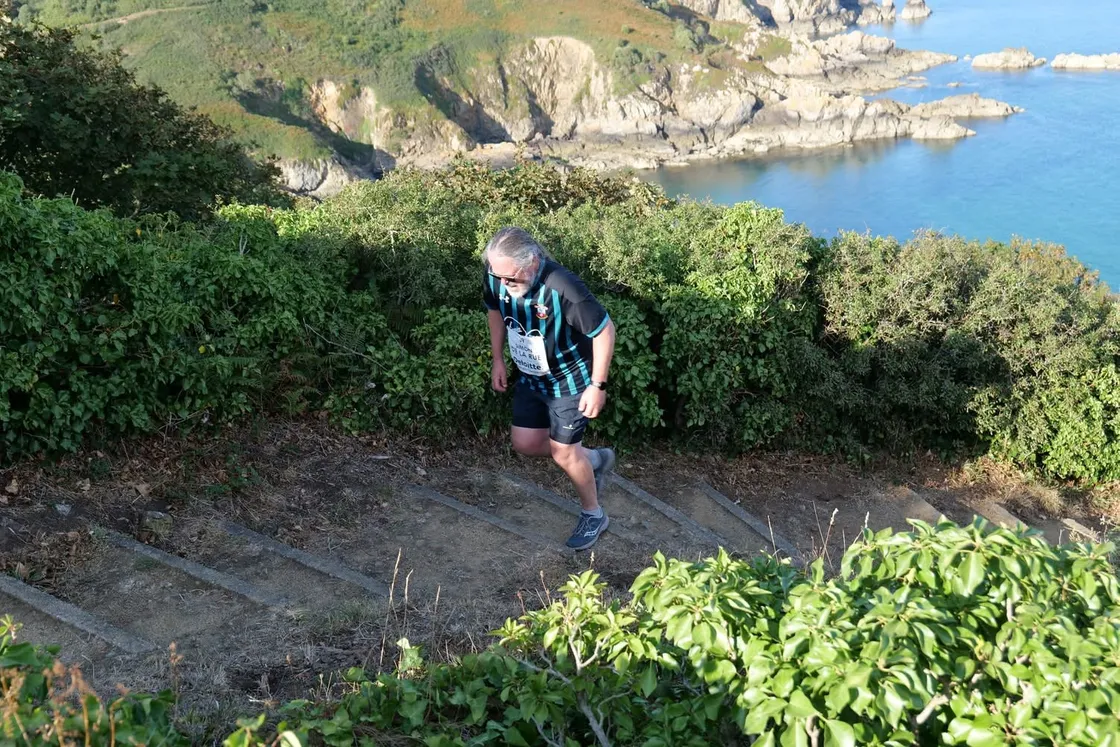
I got no reply to the email, so I just turned up on autopilot and ended up running the 5km route around the cliffs that took in the Moulin Huet and Saints Bay steps.
This was my first ever run on the cliffs, so I was keen to give it a go, even if it was the beginning and end of my participation.
I found it tougher than I’d imagined and I wasn’t surprised to find that my calves were singing the next morning. But I was pleasantly surprised to find that my back was no worse the next day.
On the Monday evening, we gathered at Pembroke to run a 4km road race, which seemed a much more familiar proposition, even if we did have to go over the hill by the green waste tip four times. This time I pushed myself a bit harder, and regretted it the next day, when those calves became even tighter – probably the lingering effects of the cliffs, rather than the latter effort, in hindsight.
On the third night, our results over the first two days determined the divisions in which we would be placed for the remainder of the competition. I was ninth out of 19 in the bottom division of six, which meant my Tuesday night’s work was a mere three laps around the Saumarez Park loop that majored on the gravel paths. Suddenly, being in our own division, with placings up for grabs, increased the sense of competition and we began to rank ourselves against each other as well as against the clock.
And yet every time someone overtook another runner, all you heard was ‘well done’ and ‘keep going’ – albeit panted out almost incoherently amid gasps for breath. I felt like I had a bit more in me for the last lap but I knew I couldn’t stride out for fear of tearing a calf. So I just carried on with my short, choppy strides and went at a cadence of about 190 paces a minute. I must have looked like a character from a Benny Hill sketch.
All the runners from the other divisions cheered us all the way round and especially at the finish by the cafe, which stayed open late for us. All the races were basically every runner against his or her own demons and against the clock, as is often the case, but the sixth division race was also, suddenly, a running event in which I finished second. A runner of my calibre doesn’t get to experience that very often. I’m sure I’ll remember it fondly.
Wednesday was a Footes Lane takeover for an event called ‘devil takes the hindmost’. It was hearing this event described to me about 20 years ago that first piqued my interest in – and fuelled my ambition to take part in – the ATC. I’ve planned to enter for about the last eight years and have always been prevented either by holiday plans or injury. And here I was getting to do this weird and wonderful race almost immediately after a physio session which really loosened me up.
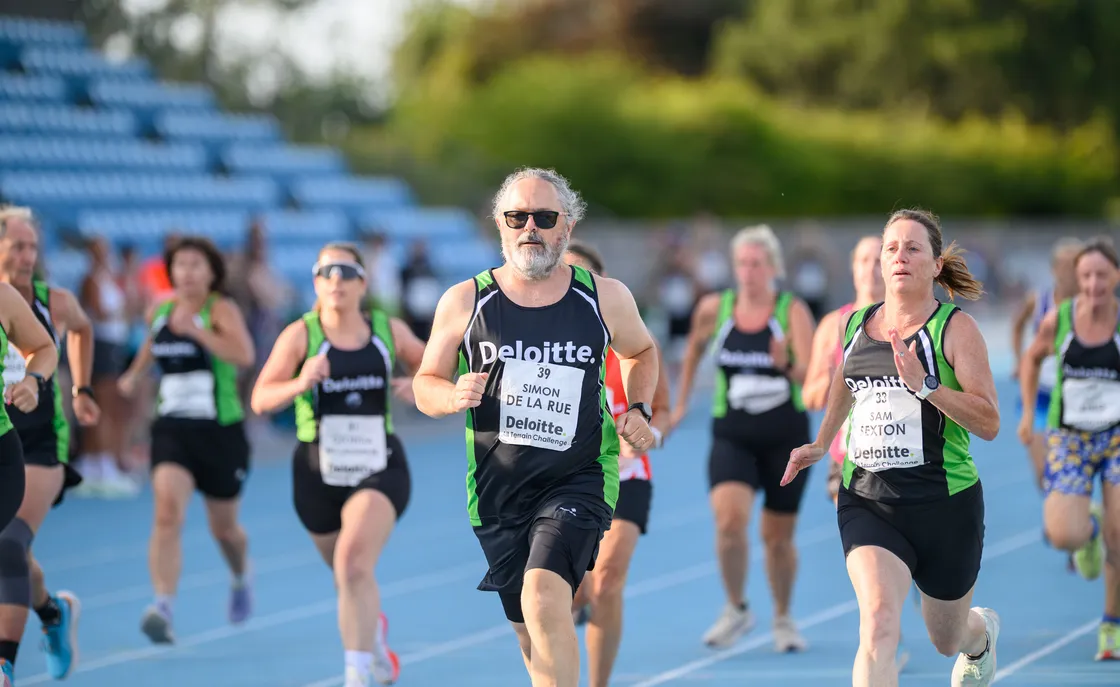
The way it works is this: all the runners in your division start jogging around the track behind a pacemaker who they’re not allowed to overtake. At 350m, this pacemaker slopes off into the infield and a sprint ensues over the remaining 50 metres to the finish line. The last two runners over the line are eliminated – their names shouted by the observing volunteers – and the rest follow the replacement pacemaker for another 150m before the next sprint, when another two bite the dust. Then it’s 150m jogs and 50m sprints until only one is left. The winner was credited with a zero time penalty and every other runner had five seconds added to their time for every place they finished below that.
So again, there I was – a runner who typically finishes parkrun firmly mid-pack in about 27 minutes – having to think tactically, weigh up strategies and pick a modus operandi. I decided to hang around on the shoulder of each pacemaker, wind up my speed gradually each time and aim for something near my top speed from the outset. I took some pride in another second-placed finish and yet it was typical of the week’s camaraderie, that at one point we all complained to one pacemaker that she was going too fast for our group – the ones at the back couldn’t catch up.
It was during this event that the overall Division One leader, in one particular stride, tore a hamstring and ended his chances of winning the event and the attendant prize money from sponsors Deloitte.
It demonstrated that even the elite runners – those who regularly represent the island very well in competitions in Hampshire and beyond – are in some peril when they take on a challenge like the ATC.
It also demonstrated that the camaraderie is every bit as strong at the top end, as at the bottom. James Priest – for it was he – continued to attend the races to lend his vocal support, culminating in his hobbling around Herm to see a fantastically close finish. But I’m getting ahead of myself.
I was delighted to find on the Thursday morning that my calves had finally recovered and I wasn’t feeling any ill effects from the sprinting.
I’d heard from quite a few runners, however, that a really good way to avoid a creeping accumulation of soreness was to get in the sea each day. So at 4pm I went for a swim at Rousse with my son and we stayed in for half an hour.
Big mistake.
It turns out these swims really only work AFTER the race. Little more than an hour after coming out, I was trying to warm up and found that I couldn’t. My legs were wooden pegs.
Oh well, just the 8km of cliff running to come. What could go wrong?
This was where the ATC really broke me. I came very close to giving up. In fact, I effectively did. About 200 yards after Jaonnet Bay, I stopped, suddenly unsure if I’d come the right way. When I heard the runner behind me catching up, I realised I was on track but I didn’t start up again. I wanted to stop. But then, if I did stop, I’d still have to get back to my bike at Icart, so I was going to have to do this whether I ran it or walked. And as that runner rounded the corner, I trudged into a lumbering jog again, reluctantly.
It was then that I realised there were two distinct ways to respond to the dread I was feeling, the unresponsive legs, and the sense of inadequacy and discomfort. The first was to say ‘I’m never doing this again’. The second was to say ‘I really need to practise my cliff running’.
And I immediately knew I would be saying the latter to myself as soon as the pain was over.
I didn’t used to be this masochistic. It’s habit-forming.
I wasn’t the only one going through the ringer. Tears were shed at the end by some – whether through relief, pain or trauma, I couldn’t tell and didn’t ask.
Friday was a doddle by comparison. And a treat. The organisers had arranged for a one-hour closure of the Val des Terres and at 6.30pm on the very dot, a States Works van arrived to put barriers up across the bottom of the hill. Once the existing traffic had cleared, it was time to run up to the top, effectively on the same route as the motorsport hill climb.
Our division was first to go this time, and we all took it easy to start with, which was good, because we soon discovered we had nothing else but easy to offer. About halfway up my exhalations had become a kind of ghoulish death-rattle and when I’d finally got over the line, I felt like someone had gone at my lungs with a cheese grater. But it was all over in five minutes and suddenly we had just one event to go before completion.
While chatting to one fellow competitor on the way back down, I mentioned that I’d not really thought I had much chance of completing the week, and she revealed that not one but two people she knew had suggested to her that they didn’t think she should – or could – do it.
‘Not a participant, surely?’ I asked.
‘No,’ she said. ‘And doesn’t that tell you something.’
And so there we all were on Herm’s coastal paths on the Saturday, inadvertently providing obstacle courses for all the parents of toddlers making their way back to the camp site from Shell Beach as we warmed up quads, hammies, calves and glutes one more time – not in the hope of running any faster, but with the certainty that failure to do so would lead to injury.
Again, we in Division Six got off lightly – up the hill from the harbour to the village, down the spine, almost to Shell Beach then along the common, drop down to the beach, along the sand, come off at the kiosk and then back to the Mermaid. Just over two miles.
My 15st frame and small feet meant I dreaded the sand, and I’d heard nothing but dire warnings about it even from the better runners. And it was grim, to be fair, but by this time, I’d zoned out and was thinking of the satisfaction of finishing and the fact that I owed it to everyone who had in any way encouraged me during the week, to finish, from participants simply clapping, to marshals calling out my name as I passed, to my wife patiently making tea every night for a week.
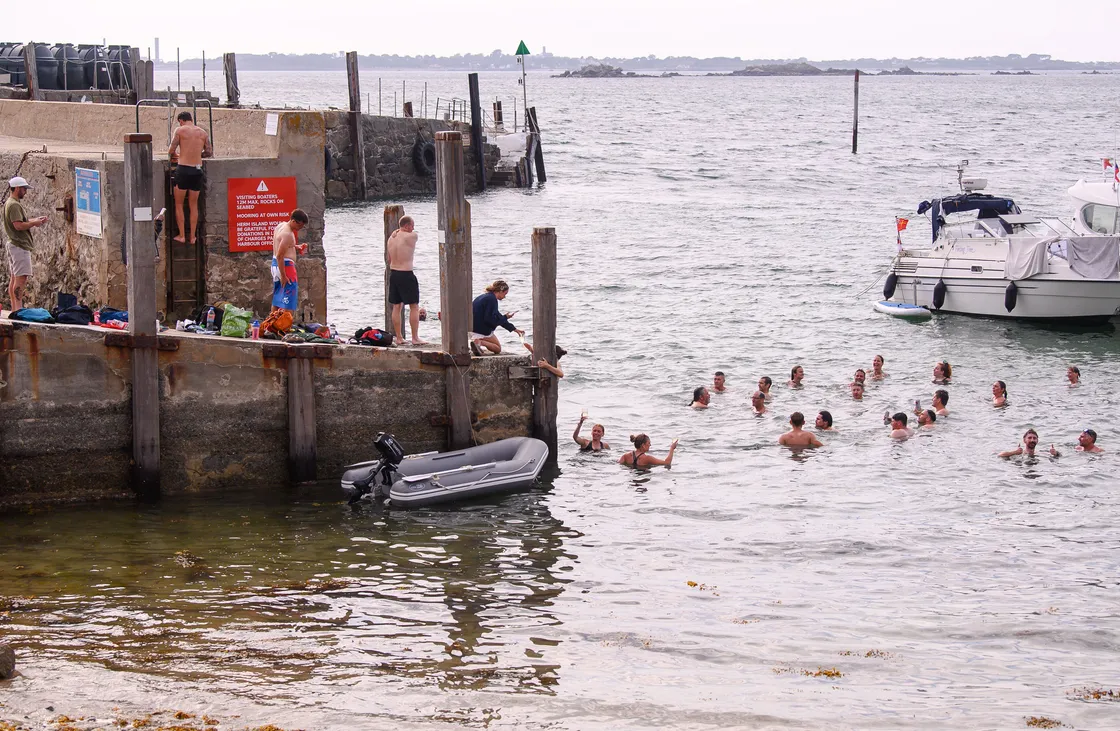
And eventually the sand ended and the path to a well-earned pint – or four – was clear and sun-flecked.
But we all held off that first drink to see the other divisions coming home, with the tightest three-way Division One finish in the event’s history.
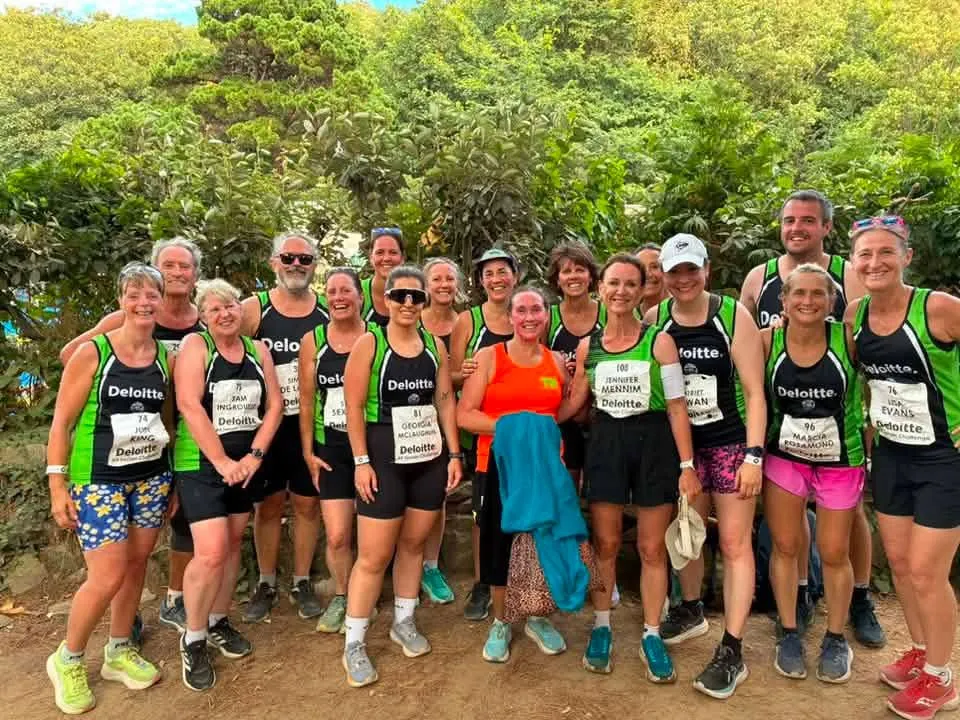
We drank, we ate, we celebrated each others’ successes and we swapped names with people we’d come to know all week just by sight.
But instead of ‘see you tomorrow’, which is how conversations had been ending all week, it was ‘see you next year’ – which was a form of encouragement in its own right.




You need to be logged in to comment.