June
The Press began the month of June revelling in the joy of hindsight, with a comment column that railed against the ‘astonishing’ lack of foresight on the part of the States in having failed to divert La Charroterie stream years earlier.
Deputy Roger Berry’s confirmation at the previous States meeting that 200m. gallons (757m. litres) would be gathered each year, following the imminent installation of the necessary pumping plant and pipework, prompted our editor to claim that spending ‘£100,000 three or four years ago... could have saved losses of up to £1m. this year’, given the loss of revenue the drought had caused to so many industries.
‘Had the stream been harnessed two years ago, 400 million gallons would have been rather useful during two consecutive dry summers,’ was the terse assessment, along with a claim that members of the public had long demanded greater harnessing of stream water, only to be told the expense could not be justified. Because landowners had allowed the pipes to be laid across their properties, the meadow at La Colombelle escaped having to be flooded.
Further capture projects were by now underway at La Mare de Carteret and Moulin Huet.
In a similar vein but on a grander scale, plans for land reclamation at Belle Greve Bay resurfaced because they included provision for a new reservoir – though it was expected the scheme could take 20-30 years to complete.
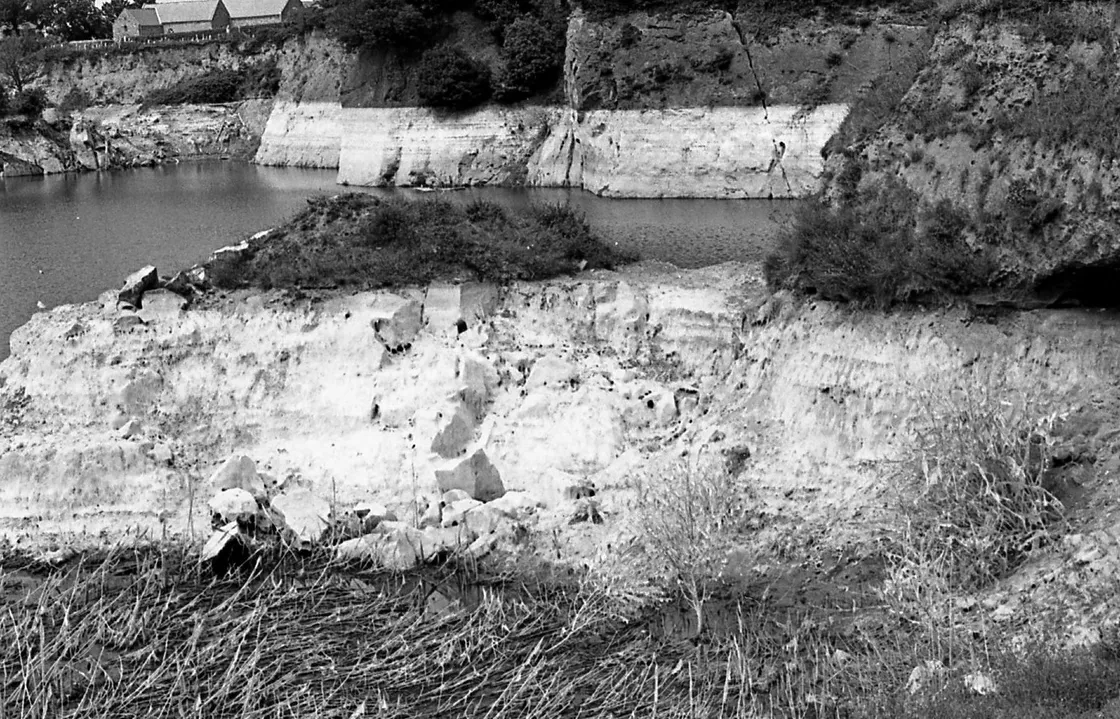
Fears of the consequences of draining Longue Hougue quarry were keeping the site’s neighbours awake at night. A petition led by former quarry worker Kenneth Edwards was said to be supported by 17 residents of Church Road, St Sampson’s. His own house was 40ft from the quarry edge and his garden stopped just 3ft away.
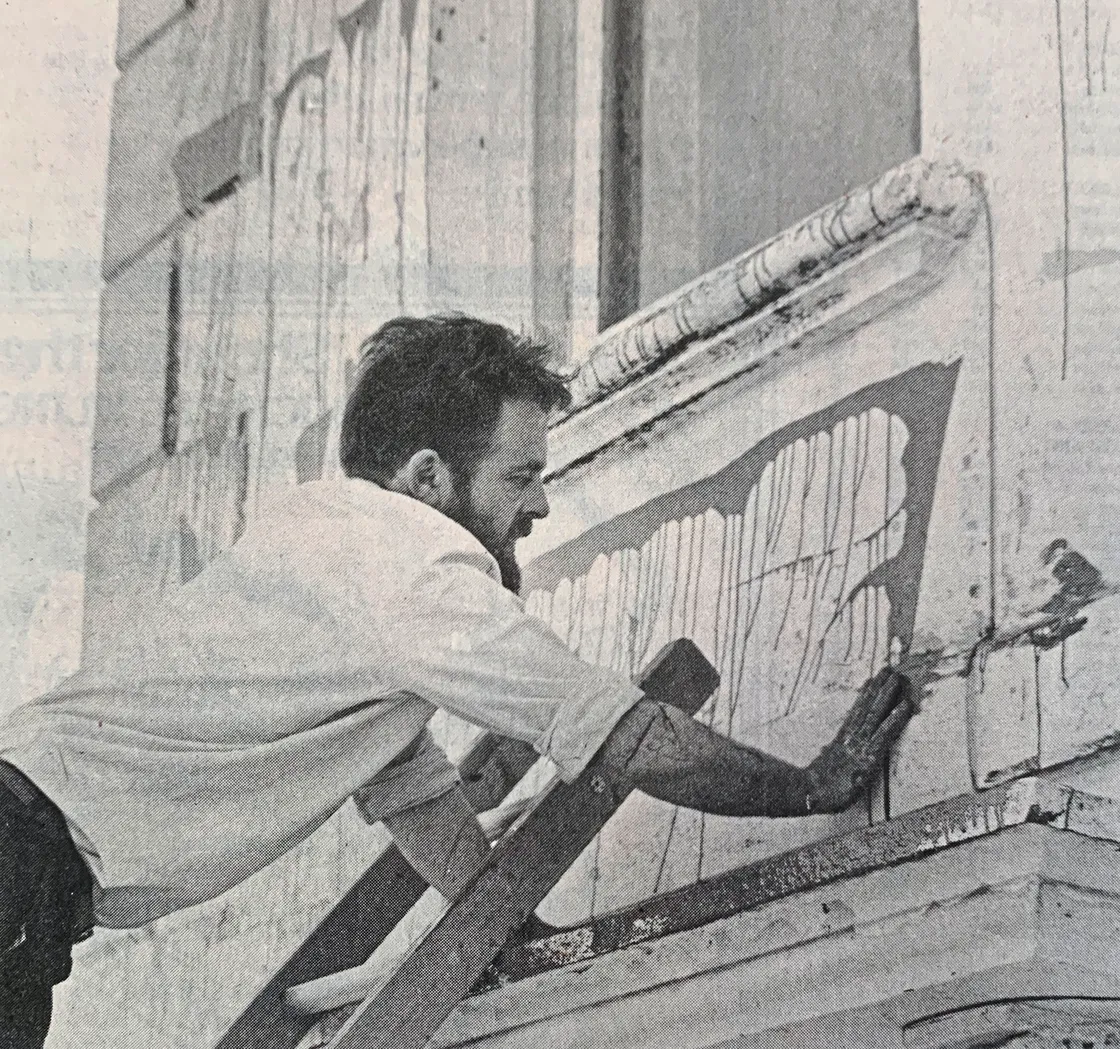
On 3 June we carried a picture of Mr Edwards up a ladder, daubing his own house with red paint to represent blood, saying the States Water Board was ‘playing Russian roulette with our lives’.
Eight million gallons had been pumped out of Longue Hougue quarry in May alone, meaning the overall depletion of the island’s reserves in that one month had been 46m. gallons, rather than 54. Deputy Berry praised islanders for heeding the message to save water and using 18 million gallons less than they had the previous May.
‘If the same degree of conservation could be achieved in June, then the island would be well on the way to avoiding the use of standpipes later in the year,’ he said.
That same community spirit kept the suggestions coming in, with one anonymous reader from the Hougue du Pommier area, near Galaad Methodist Church, claiming to have drawn 100 gallons from his own mini-well, just five feet in depth. He recommended others follow suit.
Elsewhere in our pages, a novel solution to the crisis came in the form of a hair care advertisement. For just 34p – about the same price as a box of clothes-washing detergent – you could buy a box of Aero dry shampoo, containing a somewhat vague ‘several shampoos’, and ‘help Guernsey’s acute water problem’.
Made in Guernsey by Simco, it just needed to be puffed in and brushed out in five minutes, and was available from your friendly neighbourhood chemist.

By 8 June, all water meters had been read in St Peter Port and St Andrew’s and staff were moving into Castel and St Martin’s, all in the service of water rationing.
Meanwhile, going by the orders it had received for plastic piping, Norman Piette estimated there were 120 new boreholes planned around the island.
No such problems at the two big breweries, however, each having their own springs to draw from. Guernsey Brewery and Randalls reassured islanders that there was no danger of a shortage and the former even offered the States 15,000 gallons of surplus water each week, which it said the SWB had refused, calling it ‘peanuts’.
Within a week of our report, the opportunity to take some of this water – which could not be stored at the site and simply ran to waste – was taken up by a car cleaning firm, a steam cleaning company and several individuals.
Hospitality businesses bought into the campaign to save water in various innovative ways.
Rex Priaulx posted daily bulletins at his Grosvenor Hotel and his 44 guests were inspired to help reduce usage there by 65%. And the Rocquettes Hotel gave away a carafe of wine to the customer who most accurately guessed its water meter reading, which it took every few days.
Several of the larger businesses, including the Royal Hotel, began investigating the installation of desalination equipment, estimated to cost £3,500 a pop. Bear in mind you could buy a Ford Cortina 1600 4-door saloon for half of that in June 1976, and a brand-new three-bedroomed bungalow would set you back £10,500.
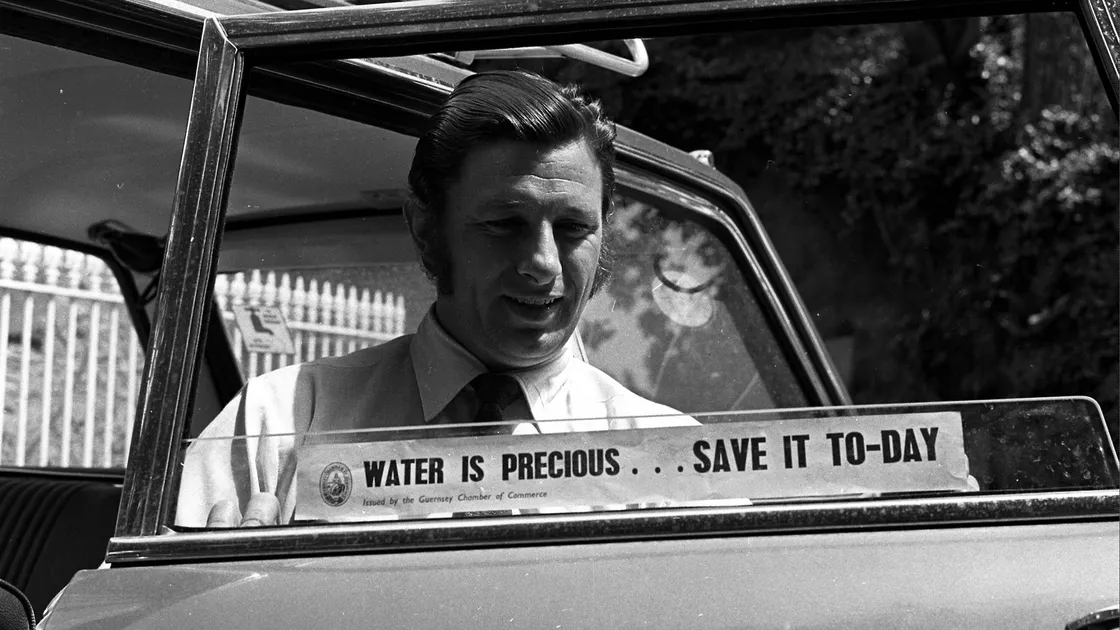
Alongside a photo of Deputy Berry putting a car sticker in his window with a water-saving message, came news that two UK civil engineers – Messrs T and C Hawksley – had been brought over to look at increasing capacity at St Saviour’s Reservoir and turning Longue Hougue into a proper reservoir, while protecting the church and graveyard and reducing the salt level. Within a week, they were bringing in geologists to examine the quarry walls, with particular attention being paid to the area alongside the graveyard.
Mid-month, as the Odeon was gearing up to show the new Warner Brothers movie All The President’s Men, chaos was being predicted by launderette owner John Powell.
He said he was going to have to close early every day as soon as his water ration was used up, which he said would prompt islanders to rush around trying to find one that’s still open.
Within a couple of weeks, launderettes were considering membership schemes because their regular customers were being squeezed out by newcomers who’d been put on meters. John Palmeri of Laundamatic in St Sampson’s was thinking of buying in non-catchment water, and said customers were quite willing to pay the extra cost – up from 30p to 50p per wash. But Edna Cooper of Sarnia Washeterias, Grand Bouet, was convinced that was too high a price for her customers.
Amid a flurry of applications from growers to the SWB for additional water were nine which made claims that boreholes had run dry. Many applications for bigger rations were being turned down and inspectors were sent out to assess the situation on behalf of the States. It was estimated the rationing would have to continue as it was until November and might not be entirely relaxed until the spring, even assuming there was rain.
It was revealed that the total rainfall between December 1975 and May 1976 had been the lowest since records began in 1843.
Milk yields were down and a lack of grass meant cows were being fed hay and silage which would normally be reserved for winter.
The SWB had already spent its annual budget and, in confident anticipation of approval by the States Assembly, was already spending the additional £2.8m. it said it needed to improve water supply infrastructure. Deputy Berry warned that well water should be boiled and reassured islanders that all States supplies were tested daily.
On the one hand, water usage had been cut by 40% year-on-year, due to all sorts of schemes and efforts by businesses and individuals. On the other hand, there was, by 19 June, only 40 million gallons at Longue Hougue that could still be used for domestic supply or horticulture. The other 160 million gallons would have to remain – apart from cooling the power station engines – because there was now insufficient water to mix it with, which was necessary to reduce its salt levels.
Islanders who were threatening not to pay their increased water rates to pay for less water were warned they would have their supply cut off as a consequence.
Sewage cart drivers found they had more time on their hands than usual, but schoolchildren who hoped for the same were to be disappointed. Rumours of early closures were scotched on 25 June.
On the same day, we published an article by geologist Rex Birch scotching the misapprehension that ‘our water comes underground from the Pyrenees or from the Cherbourg Peninsula’.
‘It is not true,’ he wrote. ‘The only water we receive is that which falls on the island as rain, nothing else.’
He went on to explain why the island was so dependent on winter rain for replenishing its supplies, saying that most summer rain was accounted for by evapotranspiration – no sooner has it fallen, than it gets burned off. Well, most of it. Streams are filled, briefly, but little of that water finds its way into the water table. He also explained that the very low permeability of our granites and gneisses was the reason why Guernsey’s streams still flowed in most summers, as it takes months for water seeping into rock to emerge downhill in springs.
‘What we have to fear for summer water shortages is not lack of summer rain, but lack of winter rain,’ he concluded.
PREVENT BIG CLIFFS BLAZE APPEAL ran our headline the following day, as water from the now-captured Moulin Huet stream was used to quell fire at Coin Colin. Posters were put up to encourage people not to light any fires or dispose of cigarette ends on the cliffs or the common.
A rather grizzly story appeared in a little column on our front page on Saturday 26 June – a day on which the mercury rose to 30.8 Celsius (87.4F). This is the full text, as printed under the headline ‘Bones in well mystery at St Peter’s’.
‘A collection of bones was found at the bottom of a well by Mr Geoffrey Brehaut, of Mont Val, Rue Des Bordages, St Peter’s. They were handed over to the police, who took them to the States pathologist. It will have to be established whether or not the bones are human. They were covered with stones. Mr Brehaut is clearing the well because of the water shortage. He recalls that about seven years ago its door was smashed open for no apparent reason.’
Three days later we were able to report that the bones had been established to be those of a dog.
The month ended with disastrous news for growers and those who enjoyed judging their produce.
Weekly exports of tomatoes were down by 90,000 trays, as the fruit was ripening before it could swell. Rejected tomatoes were having to be picked up quickly, as the depots were full of rejected fruit. Carnations were also travelling badly and even those that were sold didn’t last, leading to complaints.
David Falla of Northbrook, Rue Sauvage, had already dumped 130,000 bedding plants and was expecting to dump 50,000 more that week.
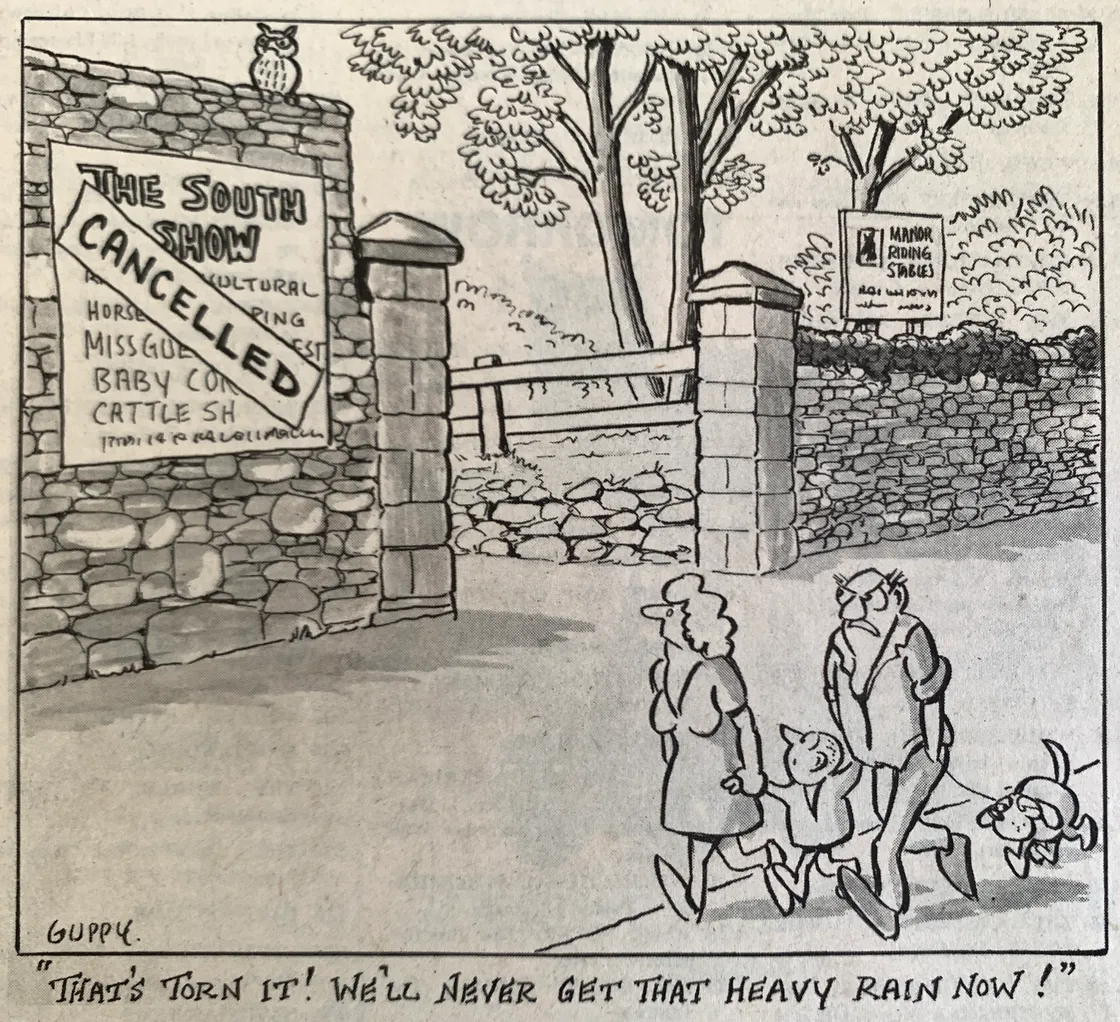
It was also announced that the South Show was to be cancelled amid fire risk considerations and fears over damage to the land. The West and North Shows were therefore cast in doubt, as the three events shared tent hire and carriage costs.
But the Island Flower Show at St Martin’s Parish Hall would still go ahead, as would the Miss Guernsey contest – usually a feature of the South Show – which was destined to be won by ‘18-year-old blonde’ Irene Matthews, a cigarette promoter from Liverpool with ambitions to become an air hostess.
Monthly water statistics
April
100 million gallons used, 50 collected, 343 remaining in storage.
May
96 million gallons used, 50 collected, 297 remaining in storage.
June
79 million gallons used, 60 collected, 278 remaining in storage.