Global attention was never the plan when, 30 years ago this year, two men decided that Guernsey needed to have its own internet country code.
Dr Nigel Roberts, who was behind the idea, along with Alderney’s Laurie Brown, and who now lives in the Newtown area of the island, said it very nearly didn’t happen at all.
At that time the vast majority of internet sites used the .com and, in the case of the UK, the co.uk codes, with .net also popular. But there were lesser ones, too, which could be set up by countries to create a unique online identity.
‘We were told that the three Crown Dependencies were supposed to be lumped together along with the United Kingdom in the .uk domain,’ said Nigel.
‘The absurd part was that some uninhabited British Overseas Territories – rocks whose only residents were penguins and the occasional visiting scientist – had their own internet codes. But none of the Crown Dependencies did.’
The pair took to the newfangled communication method known as email to fight their campaign and eventually there was a breakthrough when their idea received backing from three unexpected areas – the CIA’s records, or The World Factbook; a contact at Germany’s national standards body (DIN) and the fact that the international postal system itself had always used JE, GG and IM for the two Channel Islands and the Isle of Man for sorting mail.
This information was sent to Professor Jonathan B Postel, who Nigel said was a ‘bearded, Gandalf-like Californian academic’ who at that time personally controlled the internet’s address book of names and numbers.
As a result, Professor Postel added the .je .gg and .im to the official list of internet codes.
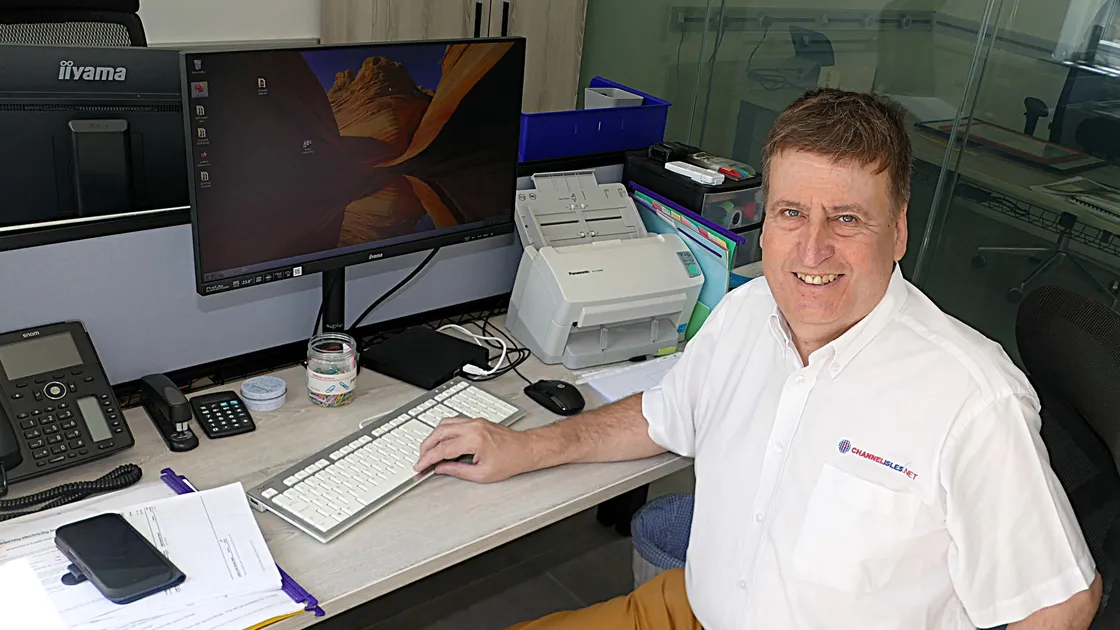
This in turn led to the establishment of Channelisles.net, the organisation which continues to administer the domains.
That meant that local firms could start to use .gg as an identifier to show that they were Guernsey-based – although one suspects that many also purchased .com and/or .co.uk domains to cover all bases.
Two years later the Internet Corporation for Assigned Names and Numbers – Icann – was established to govern the domain name system and Nigel sat on its founding Name Council, the Country Code Council and later held a seat on the Icann board itself, which is now a non-profit organisation.
But as the years passed, the local domain started to gain in popularity among non-Guernsey companies and it emerged that a happy coincidence was responsible.
For years the term ‘good game’, or GG for short, had been a sign-off used in competitive gaming. In the UK it was also familiar to people who remembered one of the late Bruce Forsyth’s catchphrases on The Generation Game TV show.
So the use of the abbreviation started to pop up on gaming websites, and then gaming tournament organisers, streamers, esports teams and gaming studios followed suit, giving the .gg domain a much higher profile than any of its creators had ever intended.
‘30 years ago, few could have envisioned the role that a small island’s two-letter domain would come to play in global digital culture,’ said Nigel.
‘The .gg extension is today a source of considerable pride for the islands. At a time when there are now several thousand additional generic extensions (such as .xyz, .biz and .top), it is a testament to the enduring relevance of place-based identity in an interconnected world, and to the local community.’