
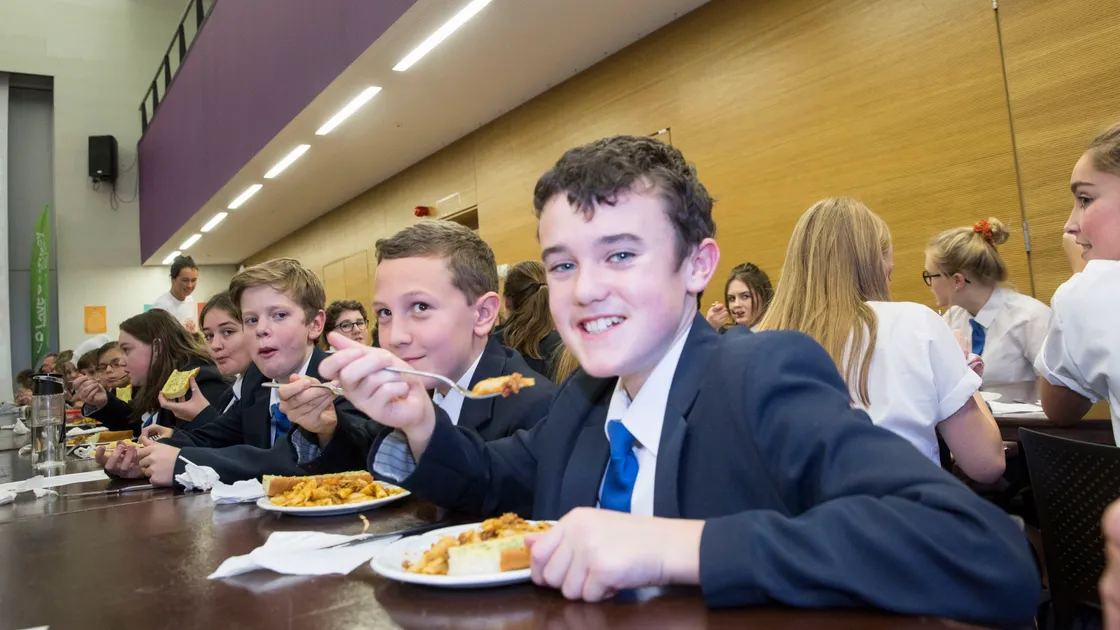
As part of Guernsey Waste’s Food Not Rubbish campaign, more than 500 pupils and staff tucked into a hot meal, aiming to show how much food islanders throw away.
The total is estimated at a cost of £10m. per annum to local families.
Deputy head teacher Tracy Hubert, said: ‘The event is about creating a situation of lifelong learning for the pupils.
‘We are encouraged to recycle and reduce our waste at home and now we wanted there to be a link with schools too.
‘So, say in 10 years’ time this has become a learned behaviour and saving as much food as possible is done without even a thought. It has taken months of work and organisation to feed this many has to be to a T.
‘We’ve sourced cutlery and crockery, we have sourced an external chef as well – Calum [Le Noury] from Sarnia Hotels. And for me, having had some conversations with the pupils, it is more for them than just a free meal, they realise the importance behind why we are doing this.’
On the menu was pasta or jacket potato, with an assortment of toppings, plus pudding.
Guernsey Waste recycling officer Tina Norman-Ross said the menu for the Big Feed was chosen because all the ingredients can easily be served up for other meals.
‘We want people to think of their leftovers as good food waiting to be eaten. It doesn’t need to become complicated and it doesn’t need to be gourmet, it just needs to become habit.
‘If food waste was a country it would be the third biggest contributor to the world’s greenhouse gas emissions, behind the USA and China.
‘That is the scale of the problem, but it only takes small changes to reduce our own waste, and those translate into big savings,’ said Mrs Norman-Ross.
Jake Morris, 13, was surprised by the amount one family throws away each year.
‘It is really good to see where and how much food we waste.
‘People often throw away food that is maybe only a day out of date or after it was purchased.
‘If food waste is reduced then that is really important,’ he said.
It is usually bread, fruit and vegetables, salad and dairy that ends up in the bin most commonly.
Mrs Norman-Ross added: ‘It may be the odd apple here and a potato there, or the stale crusts off a loaf of bread, but if you think about how much each of these items cost to buy, it all adds up. The good news is this is easy to prevent, and the campaigns will show islanders how.’


You need to be logged in to comment. If you had an account on our previous site, you can migrate your old account and comment profile to this site by visiting this page and entering the email address for your old account. We'll then send you an email with a link to follow to complete the process.