
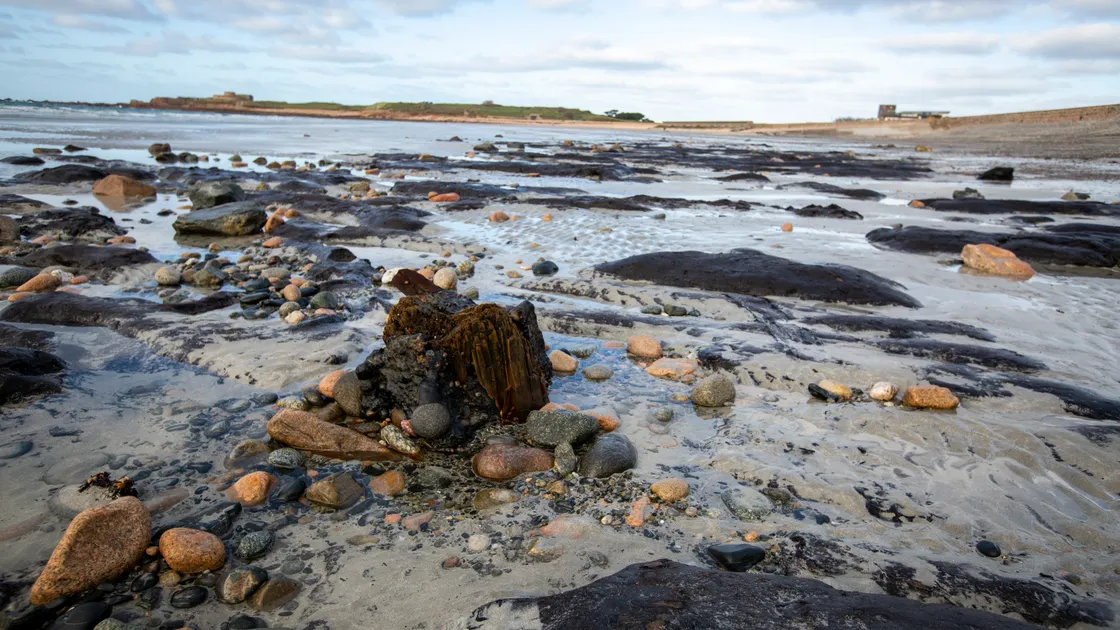
The forest dates back to the Neolithic era when early humans made the most of the natural resources it provided.
‘It’s been chopped down through the ages and harvested for the peat which was used for heating,’ said Andy Lane, archaeology section secretary at La Societe Guernesiaise.
Following the thousands of years of use from humans across the bronze and iron ages, it is believed that in 709 AD the same tidal wave that separated Mont Saint Michel from France took out the forest, leaving it to be buried in the sand.
It was first documented in the mid-19th century when the wood was mistaken for the timbers of a wrecked ship, but over time peat bogs, moss and hazelnuts were discovered and the site was soon realised to be that of a forest.
Evidence of where medieval islanders had harvested materials can be seen in the changes in colours of the peat and ancient wood cuts have been noted in some of the stumps.
The oak and hazel trees are thought to have stretched far along the west coast between Perelle and Cobo, however currently the remains are only seen at Vazon.
The site is 700m long and 100m wide, with sightings most commonly happening just below La Grande Mare.
It usually makes an appearance every six to seven years, however it has become more frequent in recent times with the site last surfacing in 2020.
Tidal change is normally the main factor in its uncovering alongside high force winds that blows away sand which reveals more layers.
The area holds great significance in Guernsey folklore and there are even stories of a ghostly sow and her piglets who haunt the area looking for acorns.




You need to be logged in to comment.