

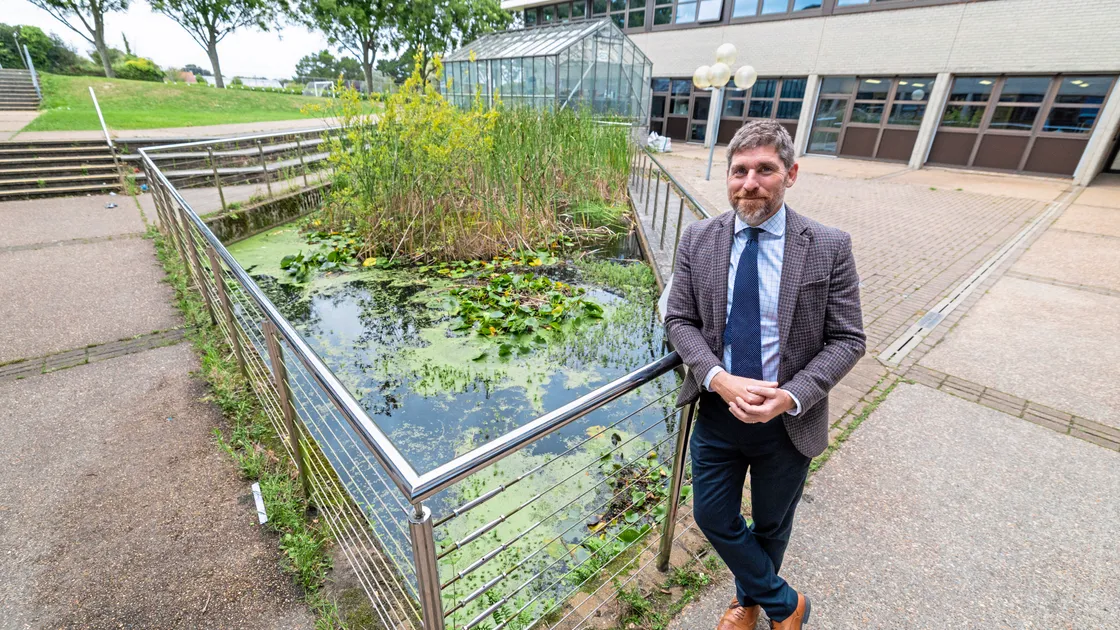
Chris Taylor, Les Varendes High School’s head of Year 7, a biology teacher and a keen marine biologist, went knee-deep into the school’s untouched pond, which has been part of its grounds since it opened in the 1980s.
With a goal to restore and manage its natural ecosystem, he waded into the unknown last weekend and started clearing out the rubbish, plants and weeds that are trying to claim it as their own.
‘We’ve got a biological example of succession going on here,’ he said.
‘The land’s trying to reclaim it, so all these plants are growing. We’ve even got a land-based tree in the middle. If we left it much longer, it would become scrubland.
‘It’s got loads of bulrushes, pond weed, and it has formed a really thick mat which is taking all the oxygen out, and everything below is becoming anoxic and potentially dying, so I want to try and get it back to functioning.’
With support from the Guernsey Nature Commission, he hopes to create a multi-faceted educational resource – inspiring students in various subjects and fostering environmental awareness.
‘We’ve got a wonderful facility here and something to be proud of,’ he said.
‘It’s been a great resource – it has got fish in it. But if we’re not careful, it can soon feel like we’re just living in sterile classrooms. Guernsey offers a beautiful opportunity to link with nature and I think we should be encouraging our students to feel that so maybe they’ll carry on these actions around the island and further afield. We need it for our mental health, and for learning to be caring, thoughtful and kind to people and the environment. I think it all stems from things like this.’
Mr Taylor said he was doing the first stage himself – removing the overgrowth, bulrushes and litter and letting the pond breathe.
‘We’ve got to take a lot of matter out, but it’s important to do it sensitively and also know what you’re leaving.
‘We want a very natural resource that will repopulate and I’m quite happy to do it myself, because I don’t want everything just ripped out and left bare.’
He plans to leave the lilies and a section of bulrushes.
Once it is cleared, the students will be involved in researching and sourcing plants and fish, and coming up with designs and ideas for how to plant and replenish the pond with new life. Mr Taylor will take their plans to Grow.
‘Hopefully we’ll have more freshwater Guernsey natives, more irises and flowering,’ he said.
‘Something that’s in line with what the States wants and what the island deserves.
‘I’m hoping it will provide a nice area with a high level of biodiversity for students to sit around and take pride in. Maybe they can use it for inspiration for English, literature, art, geography but – I’m a scientist – so most importantly, I’m hoping to get lots of organisms in there that we can study.’
Undeterred by the pond's appearance, Mr Taylor said it was a project he had wanted to submerge himself in for some time.
He applied to secure funding last year.
‘I wasn’t nervous to go in. This is right up my street,’ he said.
‘It varies in depth from knee height to waist height – I was careful to shuffle around so I didn’t drop off an edge.’
He said future plans included building a duck house and re-wilding part of the playing field into a wildflower and native species garden for students to enjoy and study.

You need to be logged in to comment.