

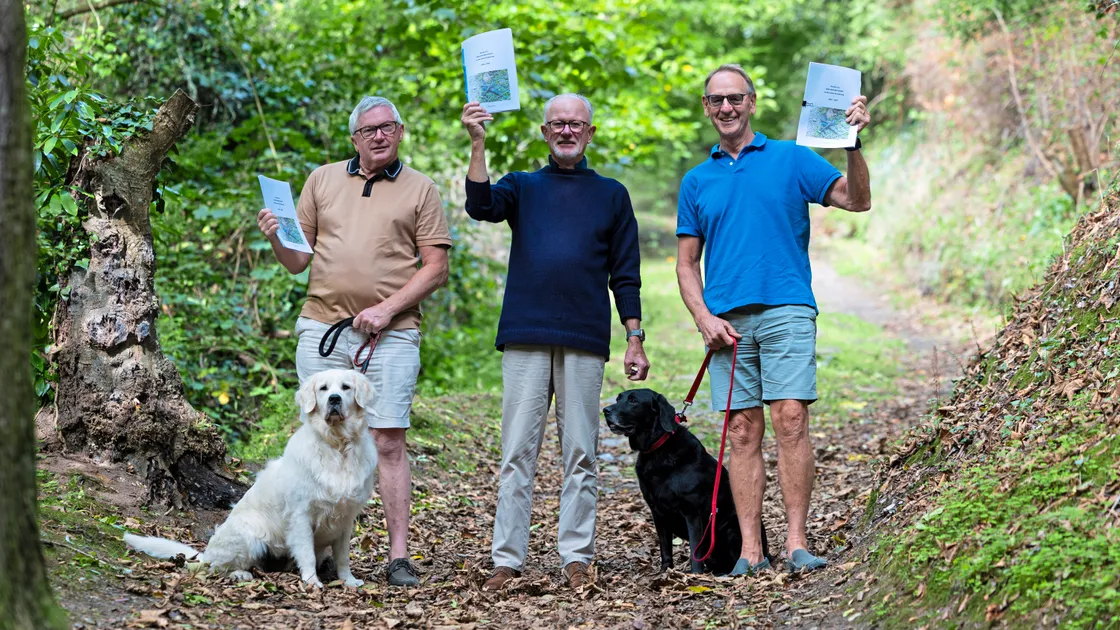
The study, which was conducted by 47 volunteers over a five-year time frame, digitally logged 3,249 instances of dog-fouling across all 10 parishes, plus L’Ancresse Common, with each area studied over a 30-day period.
The common, the cliff paths in St Martin’s, Le Guet at Cobo and Saumarez Park were among the locations with the highest concentrations of dog poo.
Angus Bodman, who helped to organise the survey, said he was astonished by the findings, and hoped the work – which has been backed by the States Veterinary team and parish douzaines – would lead to comprehensive changes to the island’s dog licensing and identification process.
‘We have demonstrated there is a problem, how else are we going to resolve it?’ he said.
For the purposes of the survey, each parish was split up into varying numbers of routes, which were then covered by survey volunteers. There were 647 deposits recorded in St Sampson’s – the most of any parish.
The next highest parish was St Martin’s, with 483, while Vale was third with 478.
In St Saviour’s there were 54 deposits – the lowest recorded figure from a parish – with St Andrew’s and Torteval the next lowest, on 84 and 97 respectively.
Urban areas of St Peter Port, St Sampson’s and Vale were found to be hot spots, while locations offering public parking, such as Bordeaux Harbour, Lihou headland, Petit Bot valley, Le Prevote, Pleinmont and Les Tielles also suffered disproportionate fouling.
Rural parts of Castel, St Andrew’s, St Peter’s, Forest, and Torteval suffered much less.
The report said the data suggested the island suffered at least 38,500 instances of fouling every year.
But it warned that figure was a ‘considerable under-estimate’ of the totality of the issue, as the survey had not been able to cover every square metre of public land, nor beaches or private grazing land.
Mr Bodman said, while the survey confirmed most local dog owners to be ‘absolutely religious’ about picking up after their pet, a small proportion – which he estimated to be about 5% – were ‘thoughtless and wilful’.
‘When you think there are about 12,000 dogs on the island – only half of which are registered – and they each do a poo twice a day, that’s 24,000 instances a day, about 720,000 deposits a month and 8.6m. a year.’
‘We’ve found a tiny proportion of the total possible deposits, which confirms that dog-fouling is the result of just a tiny percentage of dog owners.’
One of the more shocking discoveries of the survey occurred along Gypsy Lane in St Martin’s, where Mr Bodman said 60 bags of waste were found at one site.
‘We actually found the individual who was responsible for doing that, he said to us that throwing them where he did was what he had always done. We managed to make him stop.’
He said many dog owners, who had encountered volunteers while they were out walking, had been supportive of the project.
‘They were saying “thank heavens someone is doing something about it”.’
Mr Bodman said the survey demonstrated the need for ‘innovative’ change in the management of the island’s dog licensing and identification process.
He has been assisted in developing legislative proposals by Paul Bugden, a retired lawyer who is now policy officer for the Clean Earth Trust. He has redrafted relevant legislation for future consideration by law officers.
Among the reforms Mr Bodman wanted to see was an increase in the dog licence fee from the current £10 to at least £25.
This would help fund a centralised digital licensing system that would incorporate DNA tagging.
Mr Bodman said he had worked closely with the States’ veterinary team to identify a forensic science operator in the States, which could process bulk samples of dog DNA and then store the data.
The software would also make provision for the issuing of warning letters and fines for owners.
‘Some may say this is a sledgehammer to crack a nut and there isn’t a problem, and clearly for many people who drive around it’s not a problem, but for those who walk around and keep their eyes open it is an issue, and a perennial issue at that,’ he said.
‘It is not going away, and it is damaging to our image.’




You need to be logged in to comment.