

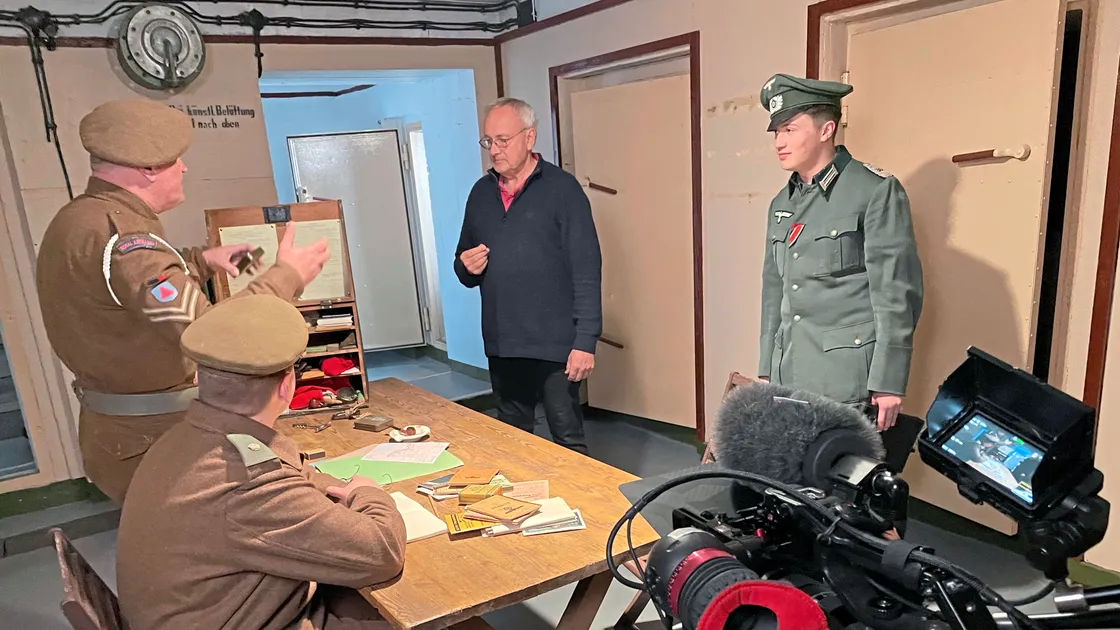
A new documentary about the Occupation of Alderney goes over material that will probably be familiar to many people with an interest in the topic, but for me and others I suspect a lot of what it recounts will come as a shock.
‘Horrific’ was how one of the seven people who joined me at the Mallard for the film’s first screening described the story that the film told.
Ghosts of Alderney – Hitler’s Island Slaves, is hosted by Piers Secunda and provides a view of the events of those years that focuses on the personal stories of a few of the prisoners.
Secunda is not a historian but an artist who became interested in Alderney’s occupation some five years ago, he tells us.
And that leads to a documentary that I found gripping and moving because of the human touch that he brings to his investigation in which he aims to bring the ‘ghosts of Alderney back to life’.
But one thing it is not is a ‘call to arms’ for something to be done, such as digging up reported graves, with the presenter instead giving what came across to me as an impartial, measured yet thoughtful perspective on the human impact of the events.
Yes, there are the obligatory talking heads of historians and academics, including Madeleine Bunting and Colin Partridge, who provide context for those who might not be familiar with the background to Alderney’s unique story.
But once we are told about how the island was taken over and the vast majority of the population evacuated, the tale moves on to what happened next.

As most Bailiwick residents will already know, the Germans built four prison camps on the island and imported labourers from other camps.
One in particular was Drancy, in northern France.
I had not been aware that, for some at least, the option of going to Alderney was the alternative to being sent east, to Germany or Poland.
During the film we meet the families of some of the men who were sent to the island, many of them teenagers taken from places such as Russia, Ukraine and Eastern Europe.
A lucky turn provided Secunda with a list of names of Jewish men who had been sent to the island and he was able to make contact with several of their families as a result.
All too often we hear about the atrocities and the more than 1,200 people who died during the Occupation, as well as hundreds who are missing. There were very few named individuals, but Secunda managed to track down several relatives of men who were taken there, some of whom survived to tell their families of the appalling things that they witnessed.
I had also not heard the name of Dr Raymond Haas before, but he was a Jewish man who ended up in Alderney. His being married to the daughter of a German soldier meant that he was sent west, not east.
Secunda described him as the ‘unsung hero of Norderney’ – one of the Alderney camps – since he kept prisoners who were ailing in the infirmary and kept them alive.
The film recounts some of the horrific stories that the survivors reported to their families but also, and this was another tale I had not heard, why those in charge of the camps were never prosecuted.
There is reference to the report prepared by Lord Pickles, following his team’s investigation into what happened in Alderney, with one of them talking about the deal with the Russians as part of a cover-up, which included how the report of what had happened in Alderney by ‘Bunny’ Pantcheff had never been acted upon.

What happened involved the fact that the vast majority of the prisoners who were killed and badly treated were not British, and the then British government was more interested in prosecuting the Germans who had killed British soldiers who had been involved in what became known as The Great Escape.
A deal was done and the Pantcheff report was swapped with the names held by the Russians. But the Russians did nothing with those details, allowing the guilty to disappear back into normal life.
The film concludes with Secunda making screen prints of those whose families he had contacted as a way to commemorate them.
He pays a visit to a cemetery at Mont de Huisnes in Normandy, where victims buried in Alderney were repatriated in 1963 and whose names appear on the memorial, and points out that this is one thing the island does not have – a place where there are names of individuals. Perhaps Alderney will have its own similar memorial one day?
I hope the film is picked up by a TV channel and shown to a wider audience, since although it attracted a few to the Mallard Cinema during its week-long run, I am sure more would be likely to watch on TV.

You need to be logged in to comment.