

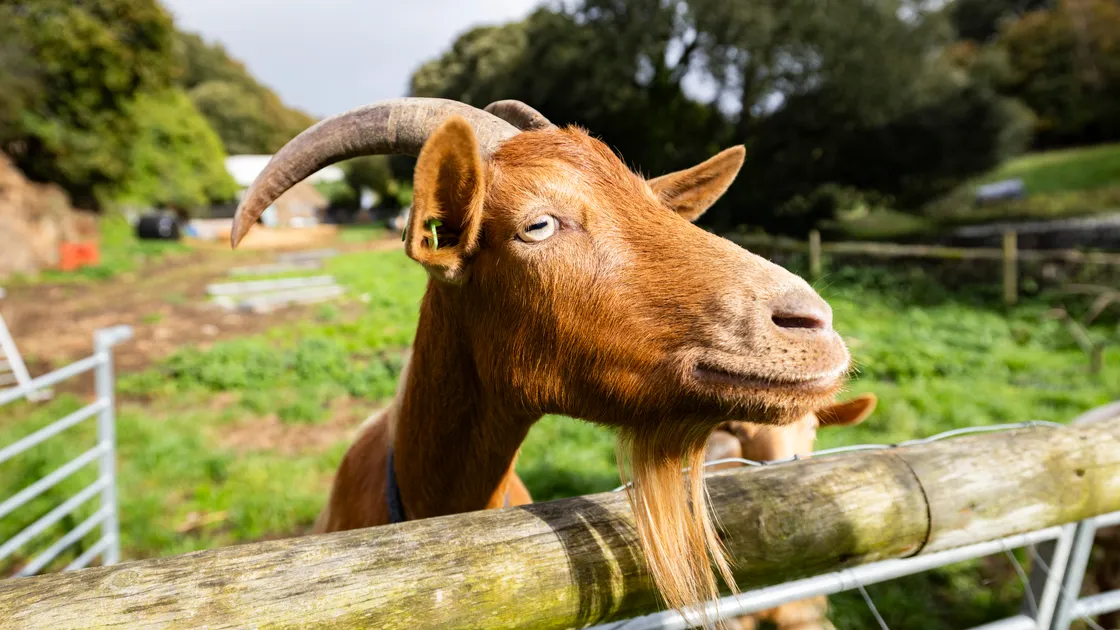
An emergency symposium on the breed last October said the goat’s prospects in its home island were at real risk unless serious steps were taken.
However a week before its AGM, Keith Opie, president of the Royal Golden Guernsey Goat Breed Society, said he was now feeling much more optimistic about the breed’s future on Guernsey, although he admitted there was still work to do.
‘The breed is thriving in the UK and even in America,’ he said. ‘But over here, we’ve got quite a dearth of the numbers of goat-keepers and the number of goats, but since the excellent symposium organised by Government House we have had more people come forward and I hope even more will attend our AGM.’
There are currently fewer than 100 female goats on the island, and 40 of them are too old to breed.
However, Mr Opie said he had judged the breed at the last goat show and was encouraged with the response.
‘There were quite a few youngsters keen to keep goats and to breed their animals as well, which is really nice to see,’ he said. ‘I also went to the AGM of the island’s goat society, and again, there were some new people there who were quite keen to get involved.’
As well as breeders and owners, Mr Opie said he had discussions with other local environmental groups which had got in touch since the symposium.
‘We’ve had a couple of meetings with the presidents of La Societe and the National Trust about how they could get involved and had some positive conversations which we hope will go further,’ he said.
The Royal Golden Guernsey goat received its title from His Majesty the King in July 2024, recognising the breed’s unique contribution to the Bailiwick’s agricultural and cultural heritage.
Golden-coloured goats have been known in Guernsey for some 200 years, with the first documented reference published in 1826. They were in danger of being wiped out around the Occupation before a breeding programme was launched in the 1950s.
As well as a low breeding stock, one of the other threats to the breed’s future locally was identified as a lack of genetic diversity.
Attempts to widen the genetic stock have been hampered by restrictions on the importation of livestock and semen due to diseases, such as blue-tongue, a virus transmitted by midge not found in Guernsey.
However, this was another area in which Mr Opie was hopeful they would soon have good news.
‘The ones that we’ve got are pretty closely related, so we really need to get some more males over with a different lineage, so the genetic pool is not too closely related,’ he said.
‘There’s steps being taken to do that and although there are quite a lot of restrictions in place, I think there are ways, and the States vet has been helping in that respect, of making life a little bit easier to import male goats and semen as well. We’ve even got one of the members who’s now able to do artificial insemination.’
Despite the upbeat message, Mr Opie said he was still keen to hear from more islanders who wanted to get involved.
‘All are very welcome to the AGM, whether you’re a long-time goat-keeper or simply interested in the breed. Please do come along as we still need your support to help safeguard both the breed and the society here on our island.’
The AGM is being held on Friday 27 February at 7.30pm at the offices of Border Developments Ltd, The Poplars, Les Canus, St Sampson, GY2 4UL. For more information contact secretary jessvalpied@gmail.com





You need to be logged in to comment.